
Leonard Bernstein–On The Town and On the Waterfront
In our last post, we said that, if we were forced to choose Leonard Bernstein’s single greatest legacy, we would have to say it was his gift of explanation. Starting in 1954, a decade after his successful Broadway debut with On the Town (1944), he set a standard of excellence in explaining musical composition, orchestration and performance that may never be equaled.
His lectures had intensity, depth of content and incredible insight, even though he was incredibly productive in the 1950’s; he wrote the score for the movie, On the Waterfront, in 1954, the opera, Candide, in 1956, the musicals Wonderful Town in 1953 and West Side Story in 1957 and became the music director at the New York Philharmonic Orchestra in 1958.
We ended our initial discussion of Bernstein with a song from his 1944 Broadway show and his 1949 movie, On the Town, and we included some music from the movie, because of the excellent cast in the movie (Gene Kelly, Frank Sinatra and Jules Munshin).
Now we would like to provide you with a 2015 recording of the same song.
One thing you may note is the change in the lyric from the movie to the stage production in 2015. Because of the Hays Code, the movie was not allowed to use the lyric “helluva town.” In terms of vocal quality, we would have to say the movie stars did a better job, but that is just a matter of taste. Both are good.
On the Town is a derivative work. The show was based upon a Jerome Robbins ballet (music by Leonard Bernstein) named Fancy Free, also first performed in 1944. Robbins and Bernstein were convinced that the ballet could be turned into a musical by their friend and business partner, Paul Feigay. They engaged two more friends, Betty Comden and Adolph Green, to write the book and lyrics. However, because the Jerome Robbins choreography and ballet music played such a huge role in the Broadway production, we are including an audio selection of ballet music that Bernstein recorded in 1945, one year after the show opened on Broadway.
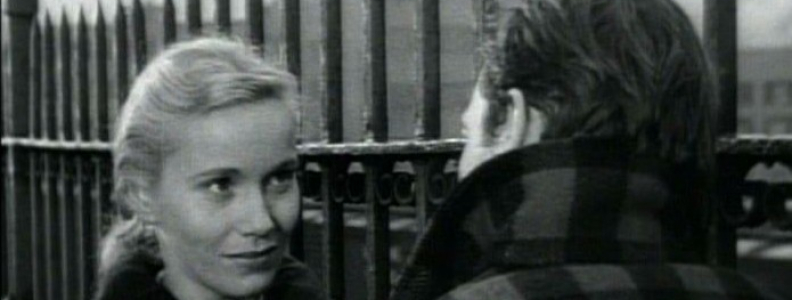
This brings us to the second piece of music written by Bernstein, this time for the movie, On the Waterfront. Released in 1954, the movie is based on a series of articles written about crime on the waterfront. It involves a mob boss named Johnny Friendly and his gang of thugs. One of the gang members is Charley Malloy, who betrayed his younger brother, Terry, a promising fighter, by making Terry take a dive in a match he could have won. Charley uses Terry to entice a dockworker (Joey) onto the roof of a building, without telling Terry that Joey is going to be killed. During the mourning period, Terry gets to know Joey’s sister, Edie, and begins to fall in love with her. Eventually, Terry must choose between protecting his brother or regaining his own honor. Terry’s choice to regain his humanity causes his brother’s death. This leads Terry to fight Friendly and his mob for control of the waterfront.
The movie starred Marlon Brando as Terry and Eva Marie Saint as Edie; it was shot in black and white to convey the poverty and emptiness of the tenements around the docks. Bernstein wrote a score that emphasizes the violent nature of the work and the corruption surrounding the union. We are going to provide two clips from the score. The first is a symphonic suite from the soundtrack; it lasts about 5 and a half minutes; around 2:45, we move from the rough and tumble sound of the docks to the love theme.
You sense from the pulsing rhythms of the music that the docks are a dangerous place, especially for anyone with a conscience. Even the love theme lacks any sense of rich warmth; it is thin and wistful, like Edie. Yet, it reminds us that a living things can grow through holes in the concrete. Here is Bernstein conducting the love theme in a recording entitled, “A Total Embrace.”
In the next post, we are going to discuss Bernstein’s opera, Candide.