“Something’s Coming” and the Gym Dance–Bernstein Conducts
In the first post, we outlined the story of the musical, West Side Story, and we provided the Overture and the recreation by David Fletcher. In this segment, we want to start the process of taking most of the songs in order, so that the musical comes alive for you. Please click on the link so that you can watch the embedded clips.
The book usually carries most of the weight in telling the story; however, in many ways, the book for West Side Story plays the role of filling in details, the way recitative is used in opera. Here, as in opera, the real story is expressed in the songs/arias. We see and hear all about the characters–their loves, their agonies, their triumphs, their defeats—in the lyrics of the songs.
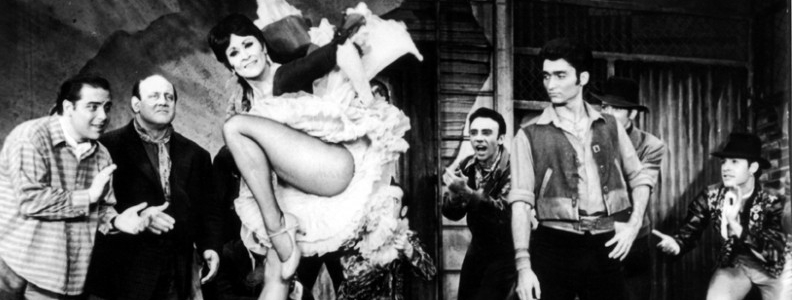
As the show begins, we see via music and dance the basic conflict between the two gangs, the Jets and the Sharks. A former Jet, Tony, is asked to come back that night to support the Jets at the local gym, where a dance is to take place. Tony reluctantly agrees; at the same time, he feels something big is coming his way, something good is coming his way. His great expectations are all enunciated in song, not dialogue. We can almost hear the beating of his heart as he sings “Something’s Coming.” We present the (audio only) clip of Jose Carreras singing this song from the PBS special of Leonard Bernstein conducting the score from West Side Story.
The libretto briefly introduces us to Maria in the next scene; she is being fitted for a dress in order to go to her first dance that night at the gym.
In the blink of an eye, we flow right into the gym, and here we find the various antagonists and their girlfriends. Before Tony and Maria can meet, the music must set the stage. It is done through loud, raucous Latin music (mambo). Then, by some miracle, we see the two lovers and hear the strains of the song “Maria” set to the softly accentuated music in the cha-cha.
In our first clip of the dance music, we provide an audio only version that Bernstein recorded with the New York Philharmonic in 1961. Just let your ear get accustomed to the sound of the music. We will slice the music into pieces in just a minute.
Next, we have a clip of the blues portion of the dance music, as conducted by Bernstein in the PBS special.
Finally, we a “before” and “after” sequence of clips for the music that is labeled, “the cha-cha.” In reality, this is the love song “Maria” set to an almost mystical latin rhythm. But we have a second purpose in showing you this clip. It provides a glimpse into how music becomes art. The first clip is the orchestra’s initial performance of the “Maria” dance theme.
In the second clip, we see Bernstein address certain members of the orchestra and request that they make a series of adjustments to the first take; and suddenly, as they make the changes, we see the “performance” unfold. It is as though we had been asleep, oblivious to the process of making music. Then Bernstein awakens us, and we see the artistry and discipline needed to produce just the right sound. It is thrilling to see the transformation appear like magic before our eyes.
In the next post, we will start with two of the great love songs of all time, “Maria” and “Tonight.” After we have heard various renditions, we will close with an immigrant’s anthem–“America.”