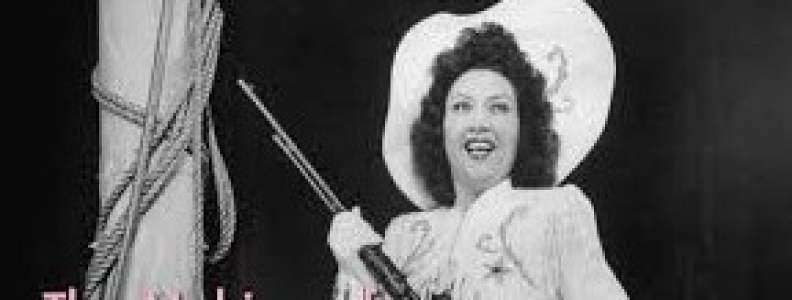
Irving Berlin’s Smash Hit–Annie Get Your Gun
According to Wikipedia, the woman that we know as Annie Oakley was born August 13, 1860 as Phoebe Ann Mosey in western Ohio. Her father died in early 1866, and she began trapping at age 7 and shooting and hunting by age 8 in order to support her family.
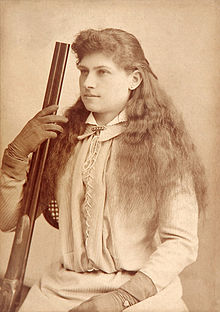
Annie Oakley
She could outshoot anyone she ever met, including Frank Butler, a well-known marksman. It is fact that she entered into a shooting match with Butler; and, over the course of 25 shots apiece, bested him, fair and square. What we don’t know with certainty is the date; some say 1875 when she was 15; others say 1881 when she was 21. Most of the evidence points to 1881.
Whatever the date of the shooting match, she and Frank fell in love and married one year later. They lived in Cincinnati for a while; then she and Frank began to perform together. One solid fact is that Frank was proud of Annie and her abilities and supported her throughout their married life.
In 1885, they joined Buffalo Bill’s Wild West; and at five feet tall, Annie could shoot anything from anywhere. Sitting Bull, another member of the troup, called her “Watanya Cicilla” or “Little Sure Shot.” She was America’s first female star; and, other than Buffalo Bill himself, she made more than any other performer in the show.
It is believed that she taught more than 15,000 women how to use a gun so that they could defend themselves. “I would like to see every woman know how to handle guns as naturally as they know how to handle babies.” She was a champion of women’s rights and lived long enough to see women gain the right to vote in 1920. She died in 1926; as a result, Frank stopped eating and followed her 18 days later. They died penniless; their money had been given to family and charities.
Those are the facts; but neither Broadway nor Hollywood ever let facts stand in the way of a good yarn. Enter Richard Rodgers and Oscar Hammerstein II. After the success of Oklahoma!, they decided to produce plays and musicals created by others. Their first production was I Remember Mama in 1944; their second opportunity came from Dorothy Fields in 1945. You may remember her work; when we were studying Jerome Kern, we found out that she wrote the lyrics for the songs “I Won’t Dance” and “Lovely to Look At,” both of which were interpolated into the movie version of the Broadway show, Roberta. She first contacted Mike Todd, who wasn’t interested. Then, she approached Oscar and Dick. Were they interested in a musical about a sharpshooter named Annie Oakley, if Dorothy wrote the lyrics and wrote the book with her brother Herb? Richard Rodgers had worked with Herb on his first big Broadway success with Larry Hart, Dearest Enemy. Oscar and Dick were interested, so interested that they arranged to bring Jerome Kern back to Broadway to write the score and have Ethel Merman sing the lead role. Unfortunately for all concerned (and for that matter, the entire country) Kern’s return to New York had tragic consequences. Crossing the street on November 5, 1945, he suffered a cerebral hemorrhage and died shortly thereafter.
Oscar and Dick were heartbroken over the loss and uncertain what to do about the show. Oscar suggested calling Irving Berlin, but neither man know how Dorothy might react, because Irving wrote both music and lyrics. When they broached the subject with Dorothy, they found that she was very excited about the prospect of working with Berlin. It was Berlin who was uncertain. Irving had not written for Broadway in many years and liked the freedom he enjoyed in Hollywood. Oscar and Dick didn’t argue; instead, they just asked him to read the book (Act One had been written). Irving agreed. But after he read it, he was still unconvinced that he could write period songs for a book musical.
According to Berlin, Rodgers called him and suggested that they might be able to get Josh Logan to direct it. This aroused Berlin’s interest because he had just worked successfully with Logan on the Broadway revue, This Is the Army. The Rodgers call came on a Friday, and again Rodgers asked Berlin to re-read the libretto and to think about it over the weekend. “I read the first act again and over the weekend wrote two songs, ‘They Say It’s Wonderful’ and ‘Doin’ What Comes Natur’lly.’ I then met with Dick and Oscar on Monday but was still playing it very cautiously and asked to think it over another week. Dick Rodgers, very rightly, said ‘Why another week?’ Having in mind the two songs I had already written, I said okay.”
There was only one major problem during out-of-town tryouts: Berlin didn’t like the orchestrations. As a matter of fact, neither did Rodgers, so Dick called Max Dreyfus and asked for Robert Russell Bennett, even though Bennett was on the road with another show. However, according to Rodgers, Bennett arrived the following morning at the Shubert Theatre in New Haven and re-orchestrated the show. As the man says, “the rest is history.”
Annie Get Your Gun opened on Broadway in 1946 and was Irving Berlin’s one and only great Broadway success. His fear was turned into such deep satisfaction that he came back with Call Me Madame in 1950, the same year that the movie adaptation of Annie Get Your Gun was released.
Coming back to the 1946 musical, the story starts with Annie as the star of Buffalo Bill’s Wild West Show. Annie is staying at a summer hotel on the outskirts of Cincinnati. She acknowledges that she is not an educated woman but does okay using common sense, revealing this philosophy in the song, “Doin’ What Comes Natur’lly.” According to David Ewen, “Miss Merman brought provocative sex insinuations” to the lyrics of this song. Annie meets and likes Frank Butler, played by Ray Middleton. The trouble is that Frank works for the Pawnee Bill Show, a rival to Buffalo Bill’s outfit. Annie suffers another disappointment when she discovers that Frank is attracted to proper young ladies (“The Girl That I Marry”). Annie admits that her skill with a gun is not enough to win a man like Frank, as she sings “You Can’t Get a Man with a Gun.”
However, they find that they have one thing in common, they both love playing to an audience in a live show (“There’s No Business Like Show Business”). And after getting to know her, Frank finds that he is drawn to her; and they sing about how being in love might feel (“They Say It’s Wonderful”). He finally admits to himself and others that he loves her in “My Defenses Are Down.” However, he cannot propose because she is going into her act, taking on Indian clothes and singing, “I’m An Indian, Too.”
Reality now intervenes. They both realize that they have a big problem–they work for competing shows. This means that they will have to part. Annie admits that she wasn’t thinking with her brain in “I Got Lost in his Arms,” but tries to cheer herself up with an optimistic view of what is good in her life as she sings “I Got the Sun in the Morning.”
When the two shows merge into one, Annie and Frank can be together; however, they still must compete with one another in the show. The competition in the arena leads them to quarrel as to who is the best shot. While this natural competitiveness is expressed in the song “Anything You Can Do,” they both are able to overcome their competitive instincts to stay together.
In the movie, released in 1950, Conrad Salinger worked on the orchestrations, as he had done for Leonard Bernstein’s score for “On the Town,” a few years earlier. The plot for the movie differed from the story in the musical. Now, at the outset Frank was with Buffalo Bill’s Show, and Annie was still hunting small game for the hotel. She survives with her siblings, “Doin’ What Comes Natur’lly.” But she is also engaged to shoot against a “big swollen-headed stiff” from the Wild West Show. Not knowing it is Frank Butler she is going to shoot against, she meets him, falls in love, finds out he doesn’t like back-woods women (“The Girl That I Marry”) and discovers that his love is one thing she can’t win with a gun (“You Can’t Get a Man with a Gun”). She wins the match and is enticed to join the Wild West Show, even though she knows nothing about “show business.” They all try to explain it to her in “There’s No Business Like Show Business.”
While working together, Frank slowly falls in love with Annie and again they explore their feelings in “They Say It’s Wonderful.” Frank plans to marry Annie and admits “My Defenses Are Down,” but changes his mind when Annie performs a special stunt and Chief Sitting Bull adopts her into the Sioux tribe (“I’m An Indian, Too”). Frank’s pride is hurt, and he leaves to join Pawnee Bill’s Show.
After returning from a tour in Europe, Annie finds out that the show is broke and that the only way to save it is to merge with Pawnee Bill’s Show, which they think is profitable. After the merger discussions start, it turns out that Pawnee Bill’s Show is broke, too. Annie offers to sell her medals to get both shows back off the ground, admitting that, even without her medals, she has the best part of life as she sings “I Got the Sun in the Morning.” However, when Annie and Frank meet, the spark of love turns into other kinds of sparks, forcing the two shows to stay separate (“Anything You Can Do”).
In a contrived ending, Annie lets Frank win a shooting match in order to bring him back. There had to be a better way to get the two back together than to pander to false, male pride, but no one asked us for our opinion back in 1950.
Now that we have given you the history of the musical and the movie, we think that the best way to present this material is through the lens of the original 1946 musical. In this post, we will provide an audio clip of Stanley Black’s rendition of the Overture from Annie Get Your Gun, recorded in London in 1973. In each future post, we will outline part of the 1946 story again, with music from various sources. Because of a dispute with Decca, no original cast album was ever released. However, we do have 1946 Decca recordings, featuring Ethel Merman and Ray Middleton, and we have some of the songs from the movie, sung by Betty Hutton and Howard Keel. So, let’s sit back and enjoy a recreation of the hit musical from 1946, Annie Get Your Gun.