Annie Get Your Gun–Part Two
In the last post, we noted that Dorothy Fields wanted to do this project; she was the driving force behind the musical about Annie Oakley. We guessed that Dorothy had been impressed with Annie Oakley’s rise from poverty; impressed that Annie could provide for her family at an age of 7 or 8. Dorothy also must have been impressed with Annie’s softer side; Annie met Frank and the two fell in love. Frank was dedicated to Annie and not just because she was talented. There must have been something about her character that led him to support her career over his.
Thus, we speculated that Dorothy felt two powerful emotions when she contemplated the life of Annie Oakley: she admired a great professional sharpshooter; and she had a deep affection for the woman. As we said: “We think that Dorothy’s original vision affected every one of the members of the creative team responsible for making the musical a success.”
In a brief recap of Part One, the first scene starts with Annie staying at a summer hotel, called The Wilson House, on the outskirts of Cincinnati. She is already the star of Buffalo Bill’s Wild West Show and is proud of that fact. We know about the show from the first song, “Colonel Buffalo Bill.” We also are introduced to Frank Butler, a sharpshooting star with the Pawnee Bill Show, a rival to Buffalo Bill’s outfit. He is also staying at the same hotel and warns the ladies that he is known for loving and leaving ladies all across the country in “I’m a Bad, Bad Man.”
At the same time, Annie admits to the hotel owner, Foster Wilson, that she is not an educated woman. Nevertheless, she does okay and is able to care for herself and her four siblings. She reveals her philosophy in the song, “Doin’ What Comes Natur’lly,” with the help of Wilson and her four siblings.
Annie meets and is immediately attracted to Frank Butler, played by Ray Middleton, but there are impediments to the affair. Frank works for the Pawnee Bill Show, and he has very definite ideas of the woman he will marry. She “will wear satins and laces and smell of cologne.” Irving Berlin inserted the song, “The Girl That I Marry,” in order to set up Annie’s lament. Frank’s ode to womanhood results in Annie’s lament; she admits that her skill with a gun is not the kind of skill needed to win a man like Frank, as she sings “You Can’t Get a Man with a Gun.”
Before the day is over, however, Buffalo Bill, his manager, Frank and Annie all agree on one thing that they have in common–they love playing to an audience in a live show (“There’s No Business Like Show Business”).
We now start the second half of Act One. In scene two, taking place about six weeks later, Frank finds that he is becoming enamored with Annie. Neither is confessing their blossoming love for the other; instead, just as Oscar Hammerstein did in Oklahoma! (“People Will Say We’re in Love”) and Carousel (“If I Loved You”), Berlin’s lyrics use the “conditional tense” as the characters discuss their feelings of love. Frank asks Annie if she has ever been in love, and she responds “Somebody who loved me back?” He says “Yeah.” She replies: “Then, no I ain’t. But I heard tell about it.” So, she talks about “rumors” and “they say.” Frank admits that he has been in love a couple of times himself and that the rumors are true. He couches his response in the phrase, “You’ll find…” (“They Say It’s Wonderful”).
Our first musical illustration comes from the 1946 Decca recording, with Ethel Merman and Ray Middleton.
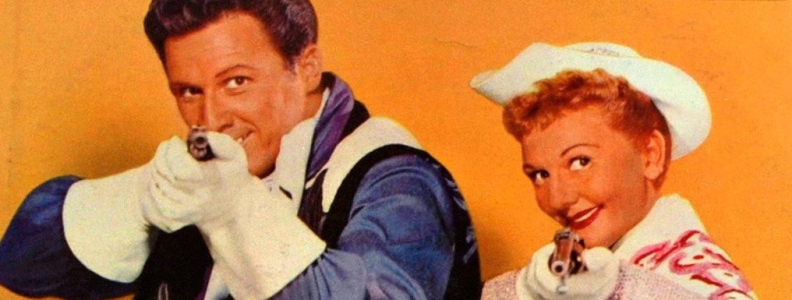
Next, we have the movie version, staring Betty Hutton and Howard Keel.
While it is not a major hit outside the show, there is a wonderful number that Annie, Buffalo Bill, Charlie Davenport and Frank Butler sing in order to put Annie’s young siblings to sleep (“Moonshine Lullaby”). Here is an audio clip from the 1946 Decca recording.
A few days later, Annie and the show make it to Minneapolis, where Frank uses the arena to admit that he loves her in “My Defenses Are Down.”
Here is an audio clip from the 1946 Decca recording, featuring Ray Middleton and a male chorus.
Act One ends as Annie joins in the Drum Dance and a Ceremonial Chant. She appears as an Indian squaw, singing, “I’m An Indian, Too.” We are providing an audio clip of Ethel Merman and a chorus from the 1946 Decca recording.
We will start with Act Two in Part Three, coming up in a couple of days.