Funny Face–ReMade in 1957
We are going to take a step back in time; well, to be honest, we are going to take two steps back in time. The first step back is from 2017 to 1957, a span of 60 years. To some of us, this is just a matter of a step back into the early years of our lives; however, most of our followers had not yet been born. And we recognize, somewhat painfully at times, that anything that happened before one’s birth is, by definition, ancient. Ancient or not, we are stepping back into what has been “jokingly regarded as the first (and only) ‘MGM’ musical made at Paramount Studios since Roger Edens was the producer, Stanley Donen was the director, and quite a few of the staff members under the Arthur Freed Unit at Metro (including Adolph Deutsch, Conrad Salinger, and Skip Martin), along with [Fred] Astaire and Key Thompson, were brought over to Paramount to make this film.” (quote from Wikipedia)
Fred Astaire is usually the focus of any discussion of the 1957 movie, because he and his sister, Adele, starred in the 1927 Broadway musical of the same name. However, the movie does not focus on Astaire but on the man the Astaire part was modeled after—Richard Avedon. For more about the movie, the show and much more, please click on this link to our website.
Richard Avedon and Dick Avery were close in one important way: both were focused on the character of the subject being photographed. As stated in Wikipedia, Avedon’s photos often expressed “his desire to capture tragic beauty in photos.” He also became one of the leading fashion photographers who, in the 1950’s, changed the face of fashion photography by showing models “full of emotion, smiling, laughing, and, many times, in action in outdoor settings which was revolutionary at the time.” (Wikipedia)
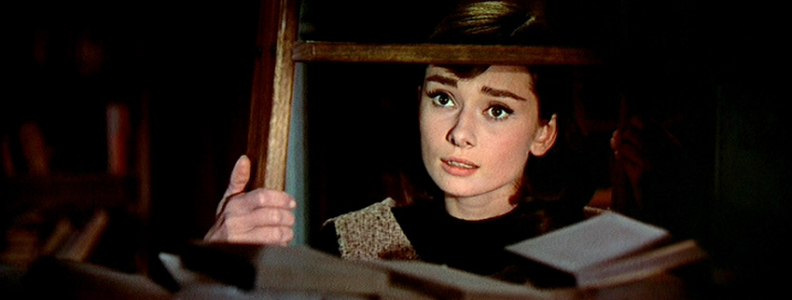
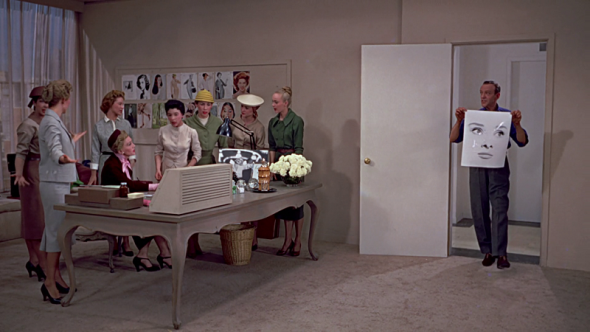
Here is an actual photograph that Avedon took of Audrey Hepburn for the movie (in Fred’s hands).
We see this form of “action” photography in the movie, as Audrey Hepburn is captured in a series of pictures taken by Fred Astaire in Paris at various locales.
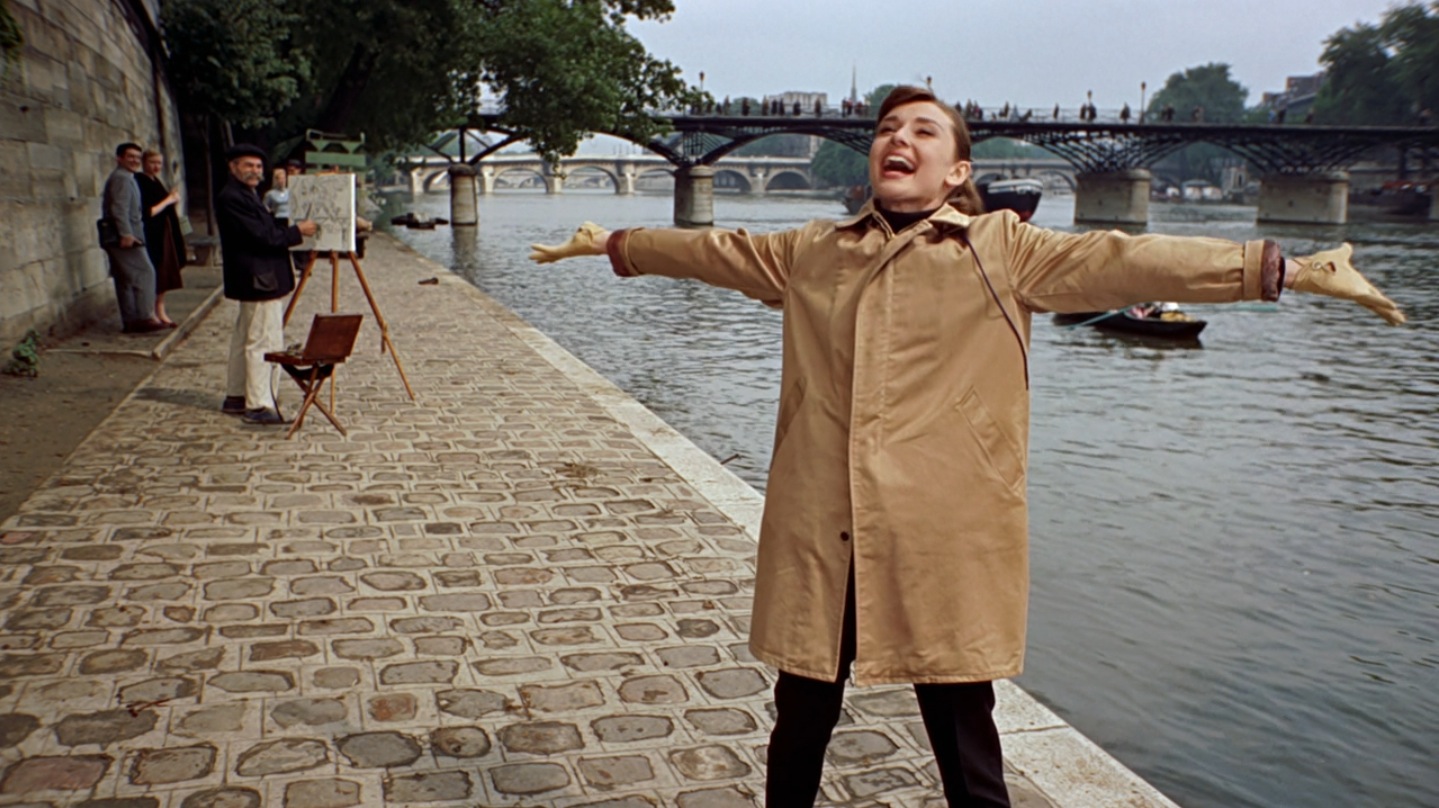
The movie stops at these moments, as the motion picture is replaced by shots of the still photographs.
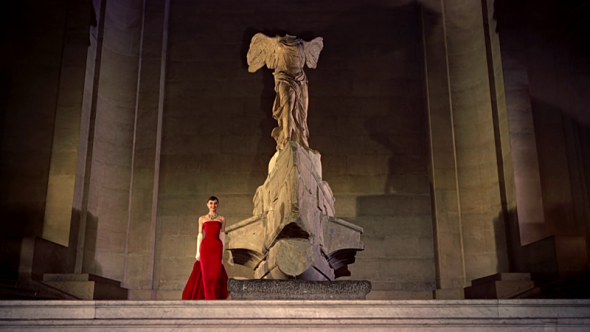
The photos, including Audrey’s tears, which served to accentuate her vulnerable beauty, also captured her growing love for her photographer, Dick Avery/Fred Astaire.
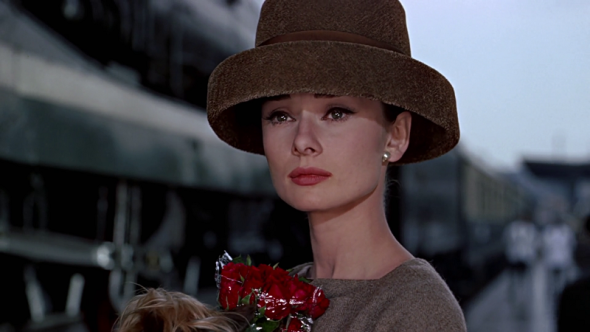
Hepburn insisted on Astaire for the role, which explains the reason for the movement of so many MGM musical personnel over to Paramount to film this one movie.
There is a further connection to the fashion world, as Kay Thompson’s role as Maggie Prescott is loosely based on Diana Vreeland’s career at Harper’s Bazaar.
Leonard Gershe, who wrote the screenplay, was nominated for the “Best Written American Musical” by the Writers Guild of America, but the most important recognition came in the areas of photographic innovations (Special Citation from National Board of Review), cinematography (Ray June), costume design (Edith Head and Hubert de Givenchy) and art direction-set direction (Hal Pereira, George W. Davis, Sam Comer and Ray Moyer).
Let’s listen to the John Wilson Orchestra play the Overture to Funny Face at the 2012 PROM.