
Dancing in the Dark or Cheek to Cheek–The Art of Progressions
From time to time, we take sharp right or left hand turns from our discussion of major musicals on stage and in film. Please hold on, as we are about to execute an illegal U-turn.
Progressions come in many flavors. First, there is the progression of each composer. They start at a low level, and if they are good, they wind up much higher. For example, in 1919, Cole Porter wrote a very nice but forgettable melody, called “An Old-Fashioned Garden.” It was also the first time that the famous Robert Russell Bennett created an orchestration for a Broadway song (Hitchy-Koo of 1919).
We have heard the music from Porter’s great hit, Kiss Me, Kate; but let’s just take an ordinary song from High Society as our comparable song at the end of Porter’s career. Most people point to “True Love” when they think of the score from High Society. We find the duet between Bing Crosby and Louis Armstrong (“Jazz”) to be irresistible.
But there is a second kind of progression. It is the progression from one composer to another. We have seen how Victor Herbert led to Jerome Kern, who in turn led to Richard Rodgers, George Gershwin and Cole Porter. Irving Berlin was in a class by himself, and others, like Herbert, tried to emulate Berlin’s uncanny ability to change his melodies to fit with the times. With Berlin, compare “Alexander’s Ragtime Band” from 1911 to the infectious “Let Yourself Go” from 1936’s Follow the Fleet. First, let’s look and listen to Alice Faye.
Now, let’s enjoy “Let Yourself Go” from Follow the Fleet; remember that Ginger’s voice is dubbed about 2 minutes into the song.
Don’t go anywhere. Stay where you are; as Al Jolson used to say, “You ain’t heard nothing yet.” The third kind of progression is the support that performers and composers received from those behind the set or the camera. We are talking about orchestrators, arrangers and choreographers. Fred Astaire, for example, was a good dancer on Broadway; he didn’t suddenly learn how to dance when he went to Hollywood. But his collaboration with Hermes Pan at RKO led to some memorable dance routines in the “Fred and Ginger” movies.
Even though we could do a hundred posts on progressions of theatrical art in one form or another, we are going to focus on dancing as the best way to explain, in word, in sound and in picture, how the art form went from “Oh, it’s time for another dance” to “Oh, did you see that!”
A dance routine can be nothing but rhythmic excitement, and we will clap like crazy. An example is Jerome Kern’s “Shorty George.” We may say that this is a Kern song, but the performance is a combined effort by Fred and Rita, orchestrations by Lyle “Spud” Murphy, choreography by Asstaire and a big band sound from Xavier Cugat and his Orchestra.
A dance routine can be a dramatic part of the show or movie, such as the haunting “Dancing in the Dark,” from Schwartz and Dietz, but don’t forget the orchestration by Conrad Salinger, the choreography by Michael Kidd and Fred Astaire and the performances by Fred and Cyd Charisse.
A dance can be staged as a show within a show, such as the “Top Hat” production number in the movie, Top Hat. It is staged in front of an imaginary audience so that the movie audience can enjoy the routine.
If Fred and Hermes were tops in the 1930’s; think about the choreographers and dancers who followed in the 1940’s and 50’s, people like Stanley Donen, Gene Kelly, Jerome Robbins, Agnes DeMille and Bob Fosse.
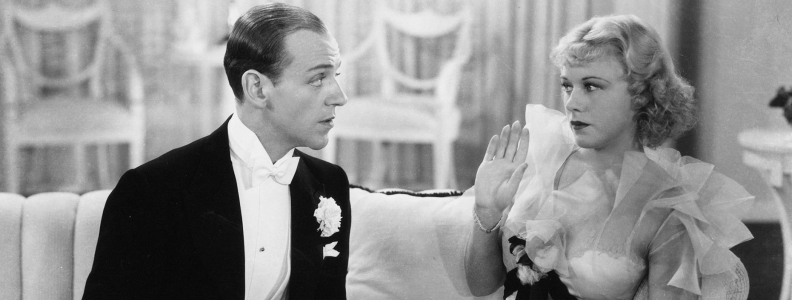
In the 1930’s, the most memorable movies were the series of RKO movies made by Fred and Ginger. Absent the dancing, there wasn’t too much sexual excitement in these movies. In eight movies, there was one kiss; and quite frankly, that kiss was nothing to write home about. To be blunt, the two dance partners were not close friends. In fact, they didn’t have a lot of respect for each other. Ginger thought that Fred was too big for his britches, a highbrow. She could have been Annie Oakley, singing “Anything You Can Do,” I can do better in high heels and backwards.
Fred thought that Ginger was more interested in her clothes than her dancing, was a prima donna and was a glorified chorus girl.
Yet, their movies were all about Fred wooing Ginger until she said yes to marriage (Hayes code didn’t permit her to say yes to anything but marriage). Thus, if the acting was cool, the dancing had to be red-hot. And it was; it was a rhythmic seduction. It is interesting that she was the personification of temptation in her low-cut gowns with nothing worn underneath. Yet, she started every dance at a distance, and Fred had to manipulate her body, by twists and turns, until we could imagine what they were in fact doing right there on the screen in front of 20-30 stage hands. Their routines consisted of the most sophisticated bodily contact that two people can enjoy outside of the bedroom. The best example of this is seen in the dance routine for “Night and Day,” the Cole Porter standard from the 1934 movie, The Gay Divorcee.