
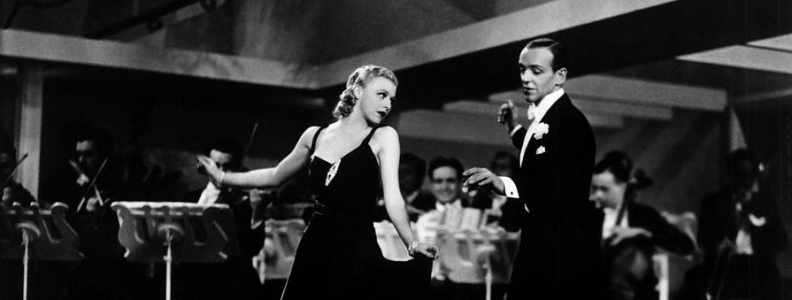
Dancing Onstage and in the Movies–Part Three: Roberta/Swing Time
The movie Roberta (1935) was an adaptation of a Jerome Kern Broadway show of the same name. As with so many adaptations, much of the original score was dropped and new songs were added. In particular, “The Touch of Your Hand” and “You’re Devastating” were dropped; and “I Won’t Dance” and “Lovely to Look At” were added, but with lyrics by Dorothy Fields, instead of Otto Harbach. Most of the story remained the same in the movie as in the musical on Broadway: an American exile in Paris (Madame Roberta, played by Helen Westley) runs a successful couturier shop in Paris, has taken in a young dressmaker who is a White Russian of noble birth, named Stephanie (Irene Dunne), receives a surprise visit from her nephew, John Kent (Randolph Scott) but dies during his visit. At the same time, Kent’s friend and band leader, Huck Haines (Fred Astaire), discovers an old friend of his masquerading as one of Madame Roberta’s more flirtatious customers, Madame Scharwenka (Ginger Rogers).
While the movie has its twists and turns, Fred and Ginger fall in love, as do Stephanie and John.
Going back to one of the new songs added to the movie (“I Won’t Dance”), this song gives Fred and Ginger a chance to shift the attention to them and to create some “heat” on the screen. The lyric gives Fred the opportunity to talk about Ginger’s sex appeal and then create a dance routine with just enough sexual energy to be convincing without running afoul of the Hays Code.
The dance music created from the song “Smoke Gets in Your Eyes” is more formal, more in keeping with Russian royalty. Subtle though it may be, it is still part of the wooing process, just higher up on 5th Avenue.
Staying with Jerome Kern but moving on to the 1936 RKO Pictures movie, Swing Time, we see another Fred and Ginger vehicle. However, the score also contains an excellent example of one of Kern’s instrumental pieces of music that was never written to be sung; it is the “Waltz in Swing Time.”
We have a little anecdote to share with you about how this waltz came into being. We can only speculate as to how much of the composition came from the writing of Jerome Kern and how much was the result of Robert Russell Bennett’s orchestration. While working at RKO Pictures in 1936 on Swing Time with Jerome Kern, Robert Russell Bennett got a last minute call from Kern to say that they needed a new dance. “Go over and see Fred [Astaire] and find out what he wants.”
Bennett recalls feeling a little put out: “Composers are supposed to give their arrangers a little more time than that, but they don’t always do it. After a short visit with Astaire I came up with the ‘Waltz in Swing Time.’ ”
This waltz was intended by Fred, in the movie, to break up any fledgling romance between Ginger and Romero, Fred’s rival for Ginger’s affections. The dance serves to establish the intimacy between Fred and Ginger and to warn Romero to stay away.
Earlier in the movie, Fred had attempted to get to know Ginger by pretending to be a novice, with two left feet. He succeeded only in getting her fired, but then danced an incredible routine with her to the music of “Pick Yourself Up” in order to win back her job and to try to win her heart. Because the dance was intended to showcase the steps that Ginger had taught him, it has very little sexual connotation in it.
The final dance that we are going to look at from Swing Time is the song and dance routine, “Never Gonna Dance.” It is a bitter parting, for Fred is sure that he has lost Ginger forever. It took a long time to get the routine just right, and Ginger’s feet were bleeding by the end of the day. However, the two dancers were never more eloquent; their bodies spoke of a past romance and a current longing. It almost reminds us of the parting of Clara and her Prince at the end of The Nutcracker Suite.