Dancing Onstage and in the Movies–Part Ten: Passing the Torch
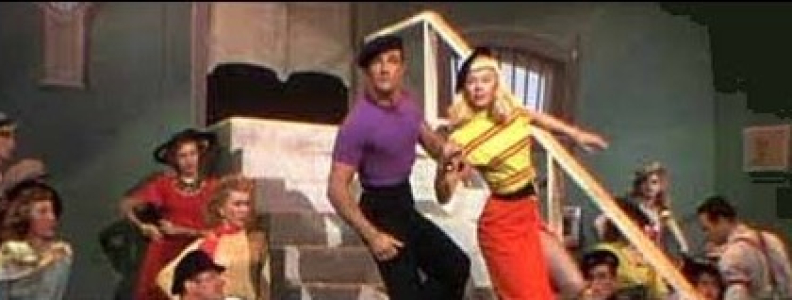
In order to go forward with our exploration of dance in musicals and movies, quite often we need to go back in order to set the stage, so to speak, so that we can assimilate something new. In this case, we are going to go back to 1936 and the Rodgers and Hart show, On Your Toes. In that case, the ballet was still a ballet within a show; the two were still separate. Eventually, the ballet form became more integrated into the movie or musical. We just saw some of this integration in Gene Kelly’s ballet in An American in Paris.
As we go through this series of posts, we would like to show how dance started (two different concepts) and then how various styles of dance started to become “synthesized” into just “dancing.”
We start with ballet. Ballet had found a home on Broadway as early as the days of the Victor Herbert operettas; however, the dances used ballet soloists and were choreographed in the same way as a classic ballet.
If we look at the traditional Broadway and Hollywood dancing styles from the 1920’s, we can see that ballroom (fox trot, waltz, polka) routines adapted to jazz rhythms and transitioned into swing routines by the 1930’s and 1940’s. Based on the same jazz rhythms, syncopated tap dancing became an appreciated art form. There is a big difference between a tap dance and a syncopated tap dance. We will get into this more in the next post.
The first attempt at the integration of ballet and the type of music written for a Broadway show can best be seen in the Rodgers and Hart show, On Your Toes. What made the ballet Slaughter on Tenth Avenue so special was that it was created by George Balanchine to accompany a jazz score written by Richard Rodgers for a Broadway show. Further, it was performed by Ray Bolger, not a ballet soloist or principal. Let’s take a look at how this ballet was shortened and re-imagined in the biopic of the lives of Rodgers and Hart–Words and Music. Here is a clip from the movie, starring Vera-Ellen and Gene Kelly.
While this is an interesting example of the synthesis of dance and music, the ballet was still a ballet. Beside Balanchine, there was another Russian-trained dancer who played a major role in molding dance in America, Mikhail Mordkin.
Starting in the 1920’s, ballet dancers were finding a home on Broadway and in the movies. One of those dancers was Robert Alton, who studied dance with Mikhail Mordkin, among others. Mordkin was formerly with the Bolshoi Ballet and Sergey Diaghliev’s Ballets Russes. Recall that George Balanchine also worked at the Ballet Russes until he came to America and formed the American Ballet Theatre.
Dalton danced on Broadway from 1919 to 1925 but branched off into teaching. He is credited with discovering and helping dancers such as Ray Bolger, Betty Grable, Gene Kelly, Sheree North, Vera-Ellen and Charles Waters. According to Wikipedia and Rachel Straus, Alton “synthesized dance material already popular at the time, and wanted performers to ‘distill their personalities through their dancing.’ ”
Notice that all three dancers associated with the stage version or the movie version of Slaughter on Tenth Avenue (Bolger, Vera-Ellen and Kelly) had been influenced by Robert Alton. It is fascinating how Alton met Kelly. Alton choreographed the dancing in a series of Cole Porter shows, including Anything Goes in 1934, Leave It to Me in 1938, DuBarry Was a Lady in 1939 and Panama Hattie in 1940. He had choreographed revues in Harold Arlen’s Life Begins at 8:40 in 1934 and staged the dance sequences in the 1940 Rodgers and Hart hit, Pal Joey. After watching Gene Kelly teach dancing in Pittsburgh, Alton hired him as one of the dancers in Leave It to Me.
The two teamed up again in Pal Joey, in which Kelly had won the lead role. Notice how Alton’s views on dance influenced Kelly’s views on choreography; during the run of Pal Joey, Kelly gave an interview to reporters: “I don’t believe in conformity to any school of dancing. I create what the drama and the music demand. While I am a hundred percent for ballet technique, I use only what I can adapt to my own use.”
Kelly proved adept at creating new styles for movies from 1942’s vaudeville extravaganza, For Me and My Gal, to Jerome Kern’s Cover Girl in 1944, Cole Porter’s The Pirate in 1948, Leonard Bernstein’s On the Town in 1950, George Gershwin’s An American In Paris in 1951 and Singin’ in the Rain in 1952. His last hit movie was the adaptation of Lerner and Loewe’s Brigadoon in 1954, although he returned to Broadway in 1958 to direct Rodgers and Hammerstein’s Flower Drum Song.
Kelly knew and respected Stanley Donen on Broadway; later, he brought Donen to Hollywood to co-direct On the Town and Singin’ in the Rain. While Kelly’s reign in Hollywood ended in 1954, Donen’s would continue in his place.
In 1954, he directed Seven Brides for Seven Brothers, and went on to direct two more musicals in 1957: the remake of Funny Face with Fred Astaire and Audrey Hepburn and Pajama Game with John Raitt and Doris Day. He directed Damn Yankees in 1958, along with a non-musical Indiscreet with Cary Grant and Ingrid Bergman, Grant and Berman’s first movie since their participation in the Hitchcock thriller, Notorious, in 1946. Donen went on to make another hit with Cary Grant, this time with co-star Audrey Hepburn—1963’s Charade. He directed Gregory Peck and Sophia Loren in 1966 in the thriller, Arabesque, Audrey Hepburn and Albert Finney in 1967’s Two for the Road and Peter Cook and Dudley Moore in 1967’s Bedazzled.