
Dancing Onstage and in the Movies–Part Eleven: Newcomers
After Kelly left Broadway, two other ballet dancers came to the fore—Agnes de Mille and Michael Kidd. Agnes de Mille quickly moved to choreography, and she enjoyed her first major success with the ballet Rodeo in 1942. This led to her Broadway work on Oklahoma! in 1943, Bloomer Girl in 1944, Carousel in 1945, Brigadoon in 1947 (co-recipient of the first Tony award for Best Choreography), Gentlemen Prefer Blondes in 1949, Paint Your Wagon in 1951, The Girl in Pink Tights in 1954, Goldilocks in 1957 and 110 in the Shade in 1963. She was asked to recreate her success on Broadway with the film adaptation of Oklahoma! but was overlooked for the film versions of Carousel and Brigadoon.
The second individual, Michael Kidd, had studied dance at the School of American Ballet and went on to become a soloist at the American Ballet Theatre in the early 1940’s. He performed the lead in Aaron Copeland’s Billy the Kid in 1939 and Fancy Free in 1944, with music by Leonard Bernstein and choreography by Jerome Robbins. Kidd choreographed the dances for Broadway’s Finian’s Rainbow in 1947 and Guys and Dolls in 1950.
However, Kidd’s larger impact would be captured in two movies, The Band Wagon in 1953 and Seven Brides for Seven Brothers in 1954.
His first big film success involved staging the dances in The Band Wagon in 1953. In our earlier post on The Band Wagon, we used Fred to tie together the Broadway shows of Schwartz and Dietz, in order to identify the songs used in the movie and where the songs used in the movie came from (which Broadway show). Many of the songs were uncredited; many used just a wisp of melody. Identifying everything turned us into detectives, and we had as much fun unraveling the mystery as you did reading about it.
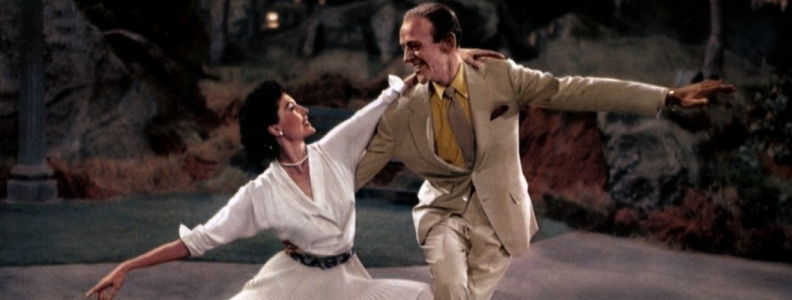
In this post, we want to emphasize how Kidd worked with Fred Astaire (at Astaire’s request), as Hermes Pan had done previously, moving cautiously to consult and suggest, trying to make his suggestions appear to be spontaneous thoughts. They worked together on the dances for “Shine on Your Shoes,” “I Guess I’ll Have to Change My Plans” and “Dancing in the Dark;” but Kidd’s main contribution came in the choreography of the “Girl Hunt Ballet,” a modern dance routine that was quite new for Astaire.
Let’s start by looking at a simple tap dance in “I Guess I’ll Have to Change My Plans.” What we see is just tap; nothing more.
Compare this tap dance to the one performed by Astaire early in the movie, Easter Parade. The song is called “Drum Crazy.”
Note the use in “Drum Crazy” of the taps as an added or counter-syncopation to the music; the taps become a part of the music in the same way that a drummer becomes part of a jazz ensemble. We have referred to this type of dancing as “syncopated tap” in previous posts.
Next, let’s consider “Dancing in the Dark.” We have seen Fred and Ginger perform ballroom dances in “Cheek to Cheek,” “Let’s Face the Music and Dance” and “Waltz in Swing Time.” “Dancing in the Dark” offers longer lines, slower, balletic movement and a greater emphasis on form, instead of rhythm. This now takes Astaire another step further away from his roots.
Finally, Astaire’s break with his past is completed in an unequivocal manner, as Kidd takes Astaire into modern dance in the “Girl Hunt Ballet.” We have a shortened clip; but it gives you the essence of the changes. The movements are carefully planned, come in short bursts and incorporate more than traditional ballet dance form. Second, Astaire is more masculine and tough when confronting the men. However, Cyd Charisse is the sexual aggressor in the dance, a reverse from the male seduction of the female in “Night and Day.”