E.Y. Harburg–One of Our Best Lyricists
In the course of our explorations and discussions, we have discussed many lyricists before, such as Dorothy Fields who worked with Irving Berlin on Annie Get Your Gun and with Jerome Kern on the movie version of Roberta, introducing the songs, “Lovely to Look At” and “I Won’t Dance.” We covered Larry Hart in his collaboration with Richard Rodgers, and Oscar Hammerstein II, who worked with both Kern and Rodgers, as well as Rudolf Friml and Sigmund Romberg. We have mentioned that George M. Cohan, Irving Berlin and Cole Porter wrote both lyrics and music for their compositions.
In some cases, such as with the talented team of Adler and Ross, both men wrote music and lyrics; however, in most cases, words and music were separated into two spheres of expertise, as we saw with Alan J. Lerner, Ira Gershwin, Bert Kalmar and E.Y. (“Yip”) Harburg.
I had intended to include the following discussion of Yip Harburg in our previous posts on Finian’s Rainbow. Somehow, I forgot. Luckily I was reminded of my oversight by our friend, Bill Bradford. Thanks to Bill here is the missing material. Maybe it is a blessing in disguise, because we now have the space to include the full lyrics of some of Yip’s key songs.
Harburg did not start out, like so many others, with a burning desire to write lyrics or work on Broadway. On the other hand, he met Ira Gershwin when they both attended Townsend Harris High School. They both worked on the school paper and became lifelong friends, according to Wikipedia. After WWI, Yip returned to New York and graduated from City College. Eventually, in order to pay off debts from a failed business venture, Ira suggested that Yip follow in Ira’s footsteps and write lyrics. They agreed, and Ira introduced Yip to Jay Gorney. Jay and Yip collaborated on songs for Earl Carroll’s Sketchbook. In 1930, the two wrote a song that would later (1932) be introduced into another revue, Americana. Harburg wrote the lyrics for a Russian lullaby that Gorney had learned from his mother as a child in Russia. The song was “Brother, Can You Spare a Dime?”
As you may recall, Lenny Hayton had worked with Charles Previn and Bing Crosby as an arranger for radio in New York. According to Wikipedia, Brunswick recorded the song on October 25, 1932 with Bing Crosby and Lenny Hayton and his Orchestra. Again, according to Wikipedia, the record became the best-selling record of its period, and came to be viewed as an anthem to the shattered dreams of the era–The Great Depression. Gorney said in an interview in 1974 “I didn’t want a song to depress people. I wanted to write a song to make people think.”
The song certainly does make us think about the men who built major projects and who went to war when they were asked to do so, only to be discarded, thrown away when they were no longer needed. There is a bitter protest embedded in these lyrics:
They used to tell me I was building a dream
And so I followed the mob
When there was earth to plow or guns to bear
I was always there right on the job
They used to tell me I was building a dream
With peace and glory ahead
Why should I be standing in line
Just waiting for bread?
Once I built a railroad, I made it run
Made it race against time
Once I built a railroad, now it’s done
Brother, can you spare a dime?
Once I built a tower up to the sun
Brick and rivet and lime
Once I built a tower, now it’s done
Brother, can you spare a dime?
Once in khaki suits, gee we looked swell
Full of that yankee doodly dum
Half a million boots went sloggin’ through hell
And I was the kid with the drum
Say, don’t you remember, they called me Al
It was Al all the time
Why don’t you remember, I’m your pal
Say buddy, can you spare a dime?
Once in khaki suits, ah gee we looked swell
Full of that yankee doodly dum
Half a million boots went sloggin’ through hell
And I was the kid with the drum
Oh, say, don’t you remember, they called me Al
It was Al all the time
Say, don’t you remember, I’m your pal
Buddy, can you spare a dime?
Let’s listen as Bing Crosby sings these lyrics in 1932.
Gorney and Harburg were offered a contract by Paramount and went to Hollywood. Harburg wrote lyrics for composers such as Harold Arlen, Vernon Duke, Jerome Kern, Jule Styne and Burton Lane. Working with Arlen, the two men wrote a song for an MGM movie. The studio executives wanted to cut the song from the film, as it was slowing down the plot. Thankfully, the music department won the argument, and the song stayed in the 1939 movie, The Wizard of Oz. The song is “Over the Rainbow.”
Isn’t it interesting that the same man wrote both songs. The one thing that ties these songs together is the pathos they create in our hearts. The indispensable man and the little girl who has no real place on the farm are both on the outside, looking in. One song uses strong images and rough language to make its point; the second song uses the language of dreams to break our hearts. Yet, they both work their magic. Here are the lyrics to “Over the Rainbow:”
Somewhere over the rainbow
Way up high
There’s a land that I heard of
Once in a lullabySomewhere over the rainbow
Skies are blue
And the dreams that you dare to dream
Really do come trueSomeday I’ll wish upon a star
And wake up where the clouds are far
Behind me
Where troubles melt like lemon drops
Away above the chimney tops
That’s where you’ll find meSomewhere over the rainbow
Bluebirds fly
Birds fly over the rainbow
Why then, oh why can’t I?If happy little bluebirds fly
Beyond the rainbow
Why, oh why can’t I?
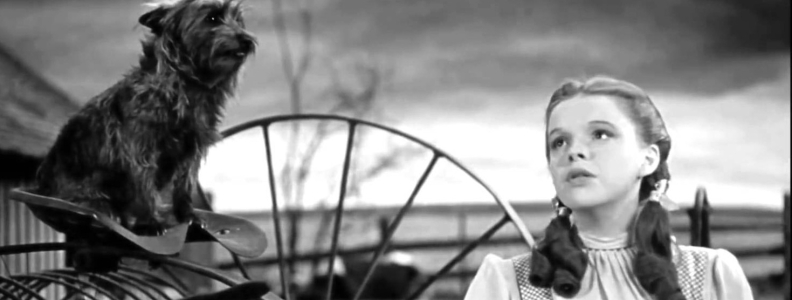
And here is that innocent little girl, wishing to become a beautiful starlet like so many of the other women on the MGM production lot and already having such infinitely greater talent than most of the others. Read the lyrics and listen to the voice and watch the face. It is enough to make a grown man cry. That is what a great lyricist contributes to the world of art.
Harburg was able to take some of the same concepts in “Over the Rainbow” and turn them into a sweeter dream in “Look to the Rainbow” in Finian’s Rainbow. You have heard the song; now concentrate on the words, even as your mind reminds you of the melody.
On the day I was born,
said my father, said he,
I’ve an elegant legacy
waiting for ye.
Tis a rhyme for your lips
and a song for your heart,
To sing whenever the world falls apart.
Look, look, look to the rainbow.
Follow it over the hill and stream.
Look, look, look to the rainbow.
Follow the fellow who follows a dream.
Follow the fellow, follow the fellow,
Follow the fellow who follows a dream.
‘Twas a sumptuous gift bequeathed to a child.
Oh, the lure of that song
Kept her feet running wild.
For you never grow old and you never stand still
With a whippoorwill singing beyond the next hill.
So, I bundled me heart and I roamed the world free.
To the east with the lark
Tow the west with the sea.
And I searched all the world and I scanned all the skies.
But I found it at last in my own true love’s eyes.
Harburg carried the same concept into “How Are Things in Glocca Morra,” where the lonely, homesick memories cloud the brilliant sun in America.
I hear a bird, Londonderry bird,
It well may be he’s bringing me a cheering word.
I hear a breeze, a River Shanon breeze,
It well may be it’s followed me across the seas.
Then tell me please
How are things in Glocca Morra?
Is that little brook still leaping there?
Does it still run down to Donny cove?
Through Killybegs, Kilkerry and Kildare?
How are things in Glocca Mora?
Is that willow tree still weeping there?
Does that lassie with the twinklin’ eye
Come smilin’ by and does she walk away,
Sad and dreamy there not to see me there?
So I ask each weepin’ willow and each brook along the way,
And each lass that comes a-sighin’ too ra lay
How are things in Glocca Morra this fine day?
Compare these tender images with the rather impish, roguish lyrics given to Og in “Something Sort of Grandish” by the same lyricist. Do we mind that Romeo has been separated from his lovely Juliet and paired with Arthur’s Guinevere? Or that resist has been turned into resish? Is condish the same as condition? The use of classical terms alongside popular idioms, such as dish instead of lovely woman, makes this lyric quite special.
Something sweet
Something sort of grandish
Sweeps my soul when thou art near
My heart feels so sugar candish
My head feels so ginger beer
And something so dareish
So I don’t careish
Stirs me from limb to limb
It’s so terrifish, magnifish, delish
To have such an amorish, glamorish dish
Or we could be, oh so, bride and groomish
Skies could be so bluish blue
Life could be so love in bloomish
If my ishes could come true
Thou art sweet
Thou art sort of grandish
Thou outlandish cavalier
From now on, we’re hand in handish
Romeo and Guinevere
Thou art so adorish
Toujours l’amourish
I’m so cherchez la femme
Why should I vanquish
Relinquish, resish
When I simply relish
This swellish condish
I might be manish or mouseish
I might be a fowl or fish
But with thee I’m Eisenhowzish
Please accept my propasish
You’re under my skinish
So please be giveinish
Or it’s the beginish of the finish of me
On Thursday, we will introduce you to Frank Loesser.