
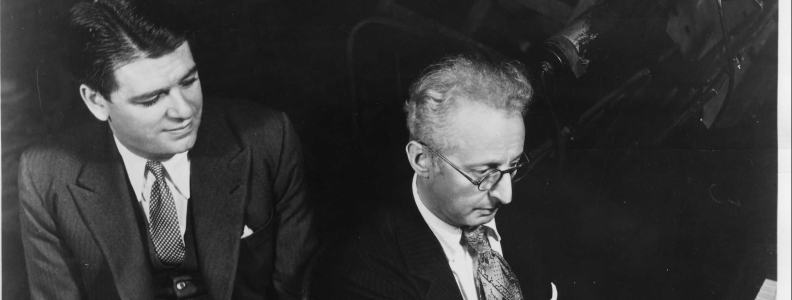
Kern and Hammerstein–“Some Girl” and “All the Things You Are”
We have been focusing on “Ol’ Man River” from the musical, Show Boat, and for good reason. It may not be their best song, but it certainly is the most powerful song either man would ever write. Yet, they wrote many splendid songs as a team, including “The Song Is You” from Music in the Air in 1932 and “Why Was I Born” from Sweet Adeline in 1929. It is a fool’s errand for us to pick out a song and proclaim, “This is their best work.”
It is easier to pick out two songs and say, “These are examples of their best work.”
When we talk about their best work together, we must discuss multipart (choral) songs where the power of the harmony is equal to the power of the melody; but when we do, we need to refer to the team’s silent partner, the great orchestrator Robert Russell Bennett. Kern knew from his earliest days on Broadway that he needed a great orchestrator; initially, Kern relied on Frank Sadler. When Sadler passed away, Kern met and started to work with Bennett. The two men became almost inseparable, especially during the period when they worked together in 1926 and 1927 on Show Boat. In fact, Kern went so far as to insist that Bennett return from his sabbatical in Paris to assist on Show Boat.
Bennett related an anecdote to Edward N. Waters, the biographer of Victor Herbert, about Kern and Kern’s admiration for Herbert’s ability:
“My opinion of Victor’s place in the American musical theatre would have less than no importance, but I can quote you something that you might like to include in your book. Jerome Kern once made an arrangement for orchestra of about 16 bars of one of the melodies while we were on the road together. That night, after we had played the arrangement, he said to the music director, ‘Did you notice the 16 bars that I arranged? They were no good–and that is why that old fellow over there was the greatest of them all,’ pointing to a picture of Victor Herbert on his piano.” [Letter from Bennett, dated June 24, 1950]
It is more important to know what our limitations are than our abilities. In this way, our abilities can speak for themselves; and, at the same time, we can avoid the potholes that gobble up egotists.
So, let’s get to it and enjoy two examples of great choral art.
The first is John McGlinn’s restored Bennett orchestration for the song, “Some Girl Is on Your Mind,” from Sweet Adeline. The song starts off as though it is going to be a simple song, meant to sound as though it had been written in the 1890’s. Three men, Tom Martin, James Day and Sid Barnett, are all smitten with Adeline, and they are together thinking of Addie, as she was called in the show, whose voice drifts in and out. As stated in the liner notes of Broadway Showstoppers, issued by EMI, “This quartet with male chorus is surely one of the most original and hauntingly beautiful variations on the drinking song in the entire literature of musical theatre.” Listen as the music develops in complexity and intensity, as voices are added, as the music swells to its climax. As we listen, we realize that, like Dorothy, we are not in Kansas anymore. The singers are Cris Groenendaal, Brent Barrett, George Dvorsky, Davis Gaines and Judy Kaye.
Next, we need to turn our attention to a song from the ill-fated show, Very Warm for May. It ran for a mere 59 performances in 1939, and it marked the end of Kern’s Broadway career. Coming back from Hollywood in 1945 to write the score for Annie Get Your Gun, he suffered a massive heart attack on the streets of New York and died shortly thereafter. Hammerstein’s career was temporarily derailed, until 1943, when he and Richard Rodgers teamed up to create Oklahoma!
According to the liner notes for Broadway Showstoppers, “Composers Arthur Schwartz, John Green, Harry Warren, Alec Wilder, and others regard ‘All the Things You Are,’ the jewel of the score, as one of the finest songs ever written. Performed in the musical as a double duet with chorus during a rehearsal of the show-within-the-show, the song is here recorded in its original form for the very first time, complete with its gracious Robert Russell Bennett orchestrations.” Here it is performed by Jeanne Lehman, Cris Groenendaal, Rebecca Luker and George Dvorsky.