
How Is Victor Herbert Connected to Northern India?
It has been about one year since we focused on the musical roots of Broadway. And we know that this statement is tantamount to a parent’s request to eat vegetables. Ugh! So, we are aware of the deep pit that we are digging for ourselves. So be it. The show must go on.
As you read this, you must understand from our past posts that our mental focus is curved at best to put it politely, and downright cockeyed if one is less generous. We don’t see in straight lines; we see connections, dots on paper, and we try to explain why the dots are logically connected to one another. While we try to connect the musical dots, another man has spent most of his working life connecting a fascinating array of scientific and artistic information. His name is James Burke, and he is called a science historian. He is an Irishman of wit and humor; he has a facile mind; and he can see patterns where the rest of us see only individual facts. He lives in London and has produced a series of tv programs for the BBC and PBS, entitled Connections. I was introduced to his writing by some friends who gave me a copy of his book, Circles. It is a delight, and I go back to it whenever I want to startle my mind with connections that only Burke can see.
Let me relate one of his stories because the story involves musical history; actually, I am going to relate the tale end of his story. It involves a Frenchman, named Henri Estienne, who in 1554 discovered, translated and printed “the work of a sixth-century B.C. Greek poet named Anacreon, who wrote mainly erotic poetry and drinking songs.” According to Burke, Estienne’s little book caught on in Europe and “was so well known and enjoyed by well-heeled fun-lovers of London that in 1776 they formed a club named, after the poet, the ‘Anacreon Society.’ Aim: meet once every two weeks, get drunk, and sing songs.”
The Society felt they needed a “signature tune” and asked one of its members (John Smith) to compose it. He did and soon the tune “was on the lips of everybody from tipsy clubmen who had survived a night out in London, to a nervous young American lawyer who had survived a night out in Baltimore.” It turned out that that night in Baltimore heralded a special display by His Majesty’s Navy, as the British fired 1800 shells at Fort McHenry. The young lawyer watched the attack and was amazed to see the American flag still flying at the end of the bombardment. “He dashed off a commemorative song on the back of an envelope and set it to John Smith’s tune: ‘Anacreon in Heaven.’ Today, it’s better known … as ‘The Star Spangled Banner.’ ”
Connections.
Many centuries ago, a nomadic people from Northern India (known as Romani) traveled as far west in Europe as Ireland and acted as entertainers and tradesmen. Their dress and traditions may have differed from area to area, and they may have been known by different names, e.g., tinkers or travelers in Ireland, Romany in Scotland, Gypsies in England. (As a side note, you may want to watch the Katharine Hepburn movie, The Little Minister (1934), an adaptation of the 1897 J.M. Barrie play of the same name, in order to understand how the Scots felt about the Romani. However, you will also hear a beguiling score, written by Max Steiner for the movie, interlacing traditional Scottish airs, such as “The Bonnie Banks O’ Loch Lomond,” “Comin’ Thro’ the Rye” and “House of Argyle,” in with his own music.)
In Spain, the Romani are known as Gitanos and have contributed significantly to the Andalusian musical tradition known as flamenco.
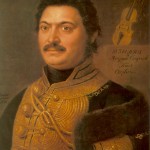
Donat Bihari Portrait
In Hungary, Janos Bihari (1764-1827) was a virtuoso violinist of whom Franz Liszt said: “The tones sung by his magic violin flow on our enchanted ears like the tears….” It has been said that Bihari’s melodies were used by Liszt, Ludwig van Beethoven and others. He was born in the city of Nagybony, a Hungarian settlement that is now part of Slovakia. Bihari was an accepted classical musician, but he was also Romani and an interpreter of verbunkos, a Hungarian dance and music genre. It was said that under Bihari and Jozsef Kossovits verbunkos were interpreted with characteristic Gypsy style.
By 1837, the verbunkos style is said to have changed again under the influence of Ferenc Erkel, a composer of opera (Hunyadi Laszlo, 1844). Bela Bartok’s Contrasts (1938) has a first movement, named “Verbunkos.” Bartok’s Violin Concerto No. 2 is also considered to be an example of the verbunkos style.
Another traditional Hungarian folk dance is Czardas, derived from csarda (an old Hungarian term for “tavern”). The dance was popularized by Romani music bands in Hungary and neighboring lands of Serbia, Slovakia, Slovenia, Croatia, Ukraine, Russia, Poland, Moravia and Bulgaria. A good example of the Czardas (we use the historical spelling, although modern spelling goes back to the Hungarian word, csardas) is Vittorio Monti’s “Csardas” (1904), here performed by the United States Air Force Band.
Note the irony of an Italian composer writing a Czardas in 1904 that has been played by every Romani musician since then. This is yet another example of cross-cultural development of music.
Classic composers who have used Czardas themes in their works include Emmerich Kalman (many of whose shows were imported to Broadway), Franz Liszt, Johannes Brahams, Leo Delibes, Johann Strauss and Pyotr Tchaikovsky.
One of the great orchestral works using traditional Czardas was Liszt’s Hungarian Rhapsody No. 2, C sharp minor.
It is said that one of the most famous examples of this dance in vocal music is found in an Austrian operetta, namely Rosalinde’s songs in Johann Strauss’ Die Fledermaus (1874). Here is a video clip of highlights from The Met’s 2014 English-language production, directed by Jeremy Sams.
Note the nationality of the composers listed above that were influenced by Czardas: Franz Liszt was Hungarian by birth but spent much of his time in Weimar, Germany (where, just before his death in 1886, he met with Claude Debussy, Paul Vidal and Victor Herbert); Johannes Brahms was German; Leo Delibes was French; Johann Strauss II was Austrian; and Pyotr Ilyich Tchaikovsky was Russian.
Victor Herbert, an Irishman, was born in Dublin in 1859, studied music in Germany and was deeply impressed by Liszt. Herbert came to America in 1886 and wrote an American operetta in 1898 (The Fortune Teller) that incorporated Romani style and the Czardas form into the body of his operetta (“Romany Life,” “Czardas” and “Gypsy Love Song”). Sony has made available the Jeanette MacDonald version of “Romany Life” which we include here.
In addition, we have a very interesting audio clip by The Robert Shaw Chorale of “Gypsy Love Song.” with the memorable lyric, “Slumber on, my little gypsy sweetheart.”