

Victor Herbert and His Importance to Broadway
Vocal music has always occupied two, separate categories: one consisting of sacred music and the other consisting of popular music. Great composers, such as George Frideric Handel wrote oratorios, his best-remembered is also his greatest achievement: Messiah, composed in 1741. Wolfgang Amadeus Mozart wrote both comic operas, such as The Marriage of Figaro, and grand operas, such as The Magic Flute. The Marriage of Figaro was presented in 1786, and The Magic Flute was first performed in 1791, just a few months before Mozart’s early demise. The Magic Flute, according to Wikipedia, used the form of Singspiel, a popular form that included both singing and spoken dialogue. The programme at the premiere performance called it a grand opera; Mozart in his personal catalog called it a German opera; and the first printed libretto called it a Singspiel. While opera continued to thrive in German, France and Italy during the 19th and 20th centuries, another form of vocal music arose that, like Singspiel, used both song and dialogue to tell its stories. It has been called light opera or operetta.
The most beloved European operetta is still being performed; it is Die Fledermaus, composed by Johann Strauss II, and first performed in April 1874 in Vienna and in November 1874 in New York. Here is the famous “Overture” to Die Fledermaus, performed by the Vienna Philharmonic Orchestra under the direction of Zubin Mehta from a May 1999 concert at the Heldenplatz in Vienna.
Until Victor Herbert became a leading composer on Broadway, almost all of the operettas and operas performed in New York were imported from Europe and were performed in opera houses or Broadway theaters. Herbert reigned as the most prolific composer on Broadway from 1898 to 1917, but he predicted that the day would soon come when his mantle would fall on the capable shoulders of the next great American composer, Jerome Kern.
Kern admitted that he was heavily in debt to Herbert, just as one day George Gershwin and Richard Rodgers would confess that Kern had been their inspiration to compose musicals for Broadway.
We mentioned Kern’s admiration for Herbert’s ability in our post on Kern and Hammerstein, just a few days ago, in an anecdote that Robert Russell Bennett related to Edward N. Waters, the biographer of Victor Herbert:
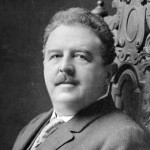 “My opinion of Victor’s place in the American musical theatre would have less than no importance, but I can quote you something that you might like to include in your book. Jerome Kern once made an arrangement for orchestra of about 16 bars of one of the melodies while we were on the road together. That night, after we had played the arrangement, he said to the music director, ‘Did you notice the 16 bars that I arranged? They were no good–and that is why that old fellow over there was the greatest of them all,’ pointing to a picture of Victor Herbert on his piano.” [Letter from Bennett, dated June 24, 1950]
Who was this man, and what did his music sound like? We will return to our roots in the next few posts and will present many of Herbert’s best known musicals for your enjoyment. For now, we have the pleasure of providing the definitive recording of Herbert’s “Overture” to Eileen, the operetta that was to be his beautiful homage to his home country, Ireland. Here is David Brophy conducting the Orchestra of Ireland.
In order to get to know Herbert better, here is a copy of Herbert’s biography from our website.
Victor Herbert was born in Dublin on February 1, 1859, leaving there under difficult circumstances when his father died unexpectedly in 1862, and his mother, Fanny, moved to England to live with her father, Samuel Lover. By 1866, his mother re-married (Doctor Schmidt,) and they returned to her husband’s native Stuttgart to live. For this reason, Herbert carried with him to America two distinct cultures: the Ireland of his birth and life-long affection; and the German music education that would make him a top cellist and composer.
The Irish Sensibility of Victor Herbert
In his relatively short lifespan, his native Ireland went from a colony of England, devastated by the Great Potato Famine, to an independent nation, the new Republic of Ireland. Even with this bold transformation, Ireland’s greatest export continues to be its people. Counting the population of both North and South Ireland, it has today approximately six million citizens; and across the world, its diaspora counts over seventy million.
Herbert must be counted as an Irish “export,” although he never studied in Ireland and his only sources of Irish inspiration came from his maternal grandfather, his mother and the sounds he picked up from published music of traditional airs.
The European Musical Education of Victor Herbert
It is in the new Germany (that Bismark created in 1870) that Herbert studied cello, composition, harmony and counterpoint. By the time he left for America, he was aware of much of Europe’s greatest contributions to music.
From the age of fifteen to seventeen, Herbert studied the cello with Bernhard Cossmann, after which he began his career as a cellist in Europe. His last orchestral work was with Eduard Strauss’ orchestra in its 1880-1881 Vienna season, an experience that undoubtedly provided him with an appreciation of the human voice and good music that was composed for it. Herbert returned to Stuttgart, where he studied theory, harmony and composition under Max Seifritz at the Stuttgart Conservatory. Both of his teachers, Cossmann and Seifritz, were recognized masters in their fields of musical expertise.
Herbert joined the cello faculty of a new music school in Stuttgart in the fall of 1885. In the summer of that year, a young dramatic soprano, Therese Foerster, joined the Royal Opera of Stuttgart. After a feverish courtship, they were married in Vienna in August 1886.
The American Experience of Victor Herbert
Around the time of Herbert’s marriage to Therese, Frank Damrosch signed her to the roster of the Metropolitan Opera Company of New York. The only obstacle to her signing was a concern for her cellist husband. To Damrosch, the solution was obvious; he signed Herbert to a contract as first cellist at the Met.
During October 1886, Herbert and his wife sailed to the United States. (He later became a US citizen.) Herbert came to America only twenty-one years after the Civil War had ended and stayed long enough to see it emerge after WWI as the greatest industrial nation on earth. However, America’s contributions to the world of art forms lay mostly in the future.
During her brief Metropolitan Opera career, Therese sang the title role of Verdi’s Aida, the American premiere of which was sung in German, not Italian.
It was in this new world that Herbert blossomed as a cellist, conductor and composer. His musical curiosity led to an appreciation of the new sounds found in the great melting pot of New York, from its music halls to its vaudeville shows to its ragtime concerts. The emerging African-American and Latin rhythms were already in evidence in his music by the time of the 1901 publication of his composition Pan Americana.
A few years after arriving in New York, Herbert would be considered the best cellist in America. However, his greatest success came as a composer of music for the voice. It’s only natural that Herbert, who had married a singer, would turn to writing for the voice. Moreover, as the Metropolitan Opera’s repertoire was performed in German, it’s natural he would initially set the words of German poets to music in his first compositions for the voice–German art songs. The first evidence that he had begun to work with English-speaking lyricists is found in 1893, when Herbert’s attention had turned to the music hall and musical theater.
Operetta Heaven
Once begun, there was no stopping him. He completed seven operettas in the next five years: Prince Ananias (1894.45); The Wizard of the Nile (1895.33); The Gold Bug (1896.30); The Serenade (1897.13); The Idol’s Eye (1897.42); and The Fortune Teller (1898.60).
His major operettas include Fortune Teller (1898.60), Babes in Toyland (1903.31), Mlle. Modiste (1905.57), The Red Mill (1906.33), Algeria/Rose of Algeria (1908.24/1909.23), Naughty Marietta (1910.35), Sweethearts (1913.24), The Only Girl (1914.27), Princess Pat(1915.23) and Eileen (1917.07).
Herbert’s compositional works for the voice include forty-six operettas, two operas, and many songs.
Honored Place
Herbert has been called the Father of the American Musical Theatre. Florenz Ziegfeld, Jr. called him “the greatest musician American ever developed.” Jerome Kern referred to him as “the greatest of them all.” Musical theatre historian Gerald Bordman considers him “the first towering master of our musical stage….”
Occasioned by the 1934 revival of The Only Girl, Robert A. Simon summed up the Herbert oeuvre in the following manner: “Whatever you may think of the libretto…there is so much vitality in the Herbert tunes that they will remain in circulation after the libretti have had their final revivals.”
The American Songwriters Hall of Fame states in Herbert’s biography that he “was composing music that undoubtedly was a mixture of European romanticism and American tradition. He is arguably the greatest influence on American theater, transitioning it from vaudeville and variety acts to operatic and story-based entertainment.”
Herbert was a leading advocate for the protection of composers’ copyright interests and was one of the nine founders of ASCAP, where he served as a director and vice president from 1914 to 1924. According to ASCAP: “It is difficult to comprehend the American popular song without the music and vision of Victor Herbert. Today, Herbert is revered as one of the giants of the American Musical Theater and troubadour for songwriter.”