
Broadway Enters the Twentieth Century–Major and Minor Trends
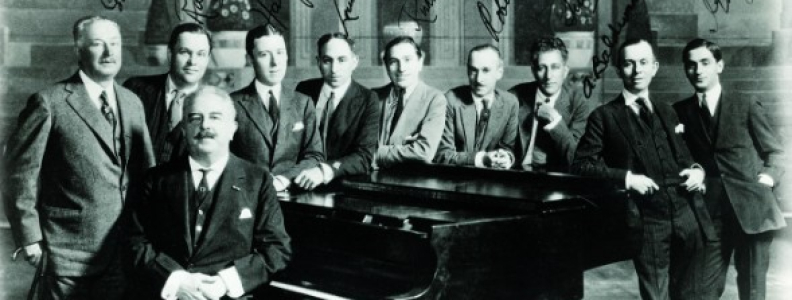
In 1910, the great Italian opera composer, Giacomo Puccini, visited New York to attend the world premiere of his latest opera, The Girl of the Golden West, and was astounded to hear his music being played in the city’s restaurants without his permission or license. Europe had long recognized and enforced the copyright owner’s right to collect fees for any public performance of the owner’s music. In the United States, a Broadway composer, named Raymond Hubbell, became the leading advocate for the formation of a society that would represent composers, authors and publishers; but it was not until 1913 that he was able to convince Victor Herbert to join the effort to form such a society. There were nine co-founders: Hubbell, Nathan Burkan, Herbert, Silvio Hein, Louis Hirsch, Gustave Kerker, Glen MacDonough, George Maxwell and Jay Witmark. Burkan was a lawyer who helped Hubbell get started; Hubbell, Hein, Herbert, Hirsch and Kerker were composers; MacDonough was a lyricist and librettist; and Maxwell and Witmark represented music publishers. In the picture featured above, Irving Berlin was added at a later date as one of the first members.
While Hubbell may have started the effort, he admitted that “Looking back now … I realize how big a part Victor really played in the building up of ASCAP [The American Society of Composers, Authors and Publishers]. It never could have been done without him–he just didn’t recognize setbacks.” The Copyright Act of 1909 may have created the rights to fees, but ASCAP created the enforcement mechanism starting in 1914.
Herbert was nearing the end of his illustrious career–of all of his major works, only Princess Pat in 1915 and Eileen in 1917 were yet to be produced. Herbert was born in 1859 and passed away from a massive heart attack in 1924; Ray Hubbell was born in 1879 and would live until 1954; but while Hubbell was a prolific composer on Broadway, his main body of work ended in the 1920’s and only “Poor Butterfly” from the 1916 edition of The Big Show would become part of the American Songbook. Hirsch was another prolific composer on Broadway, but his last show was produced in 1924. Kerker was approximately the same age as Herbert (born two years earlier and died one year earlier) and was a prolific composer for Broadway but most of his work was done prior to the founding of ASCAP. Hein was a minor composer on Broadway.
According to Wikipedia, in addition to its nine founders, ASCAP’s earliest members included Irving Berlin, George M. Cohan, Rudolf Friml, Otto Harbach, Jerome Kern, John Philip Sousa, Alfred Baldwin Sloane, James Weldon Johnson, Robert Hood Bowers and Harry Tierney. In 1914, Berlin would have been 26 years old, had had his first major international hit in 1911 (“Alexander’s Ragtime Band”) and was in the midst of the performance of his first major Broadway score, Watch Your Step. Cohan was ten years older than Berlin but had produced his greatest Broadway shows by 1914. Friml was only a year younger than Cohan but had just composed his first major score for Broadway in 1912, with The Firefly. His two greatest scores would come in 1924 (Rose-Marie) and 1925 (The Vagabond King).
Of these early members, Kern stands out, with Berlin, as one of the leaders of the new Broadway sound. In 1914, Kern was 29 years old, having been supplying songs for Broadway shows since 1905. Kern’s first full score came in 1912 with The Red Petticoat and was followed in 1914 with The Girl from Utah with its evergreen song, “They Didn’t Believe Me.” His Princess Theatre shows were only a few years away. His career was still in front of him, with Roberta in 1933 being his last great Broadway score.
When we look at major trends, we need to make the connection between Victor Herbert and Jerome Kern; and then between Kern and Richard Rodgers and George Gershwin. These connections are based on the statements made by the composers themselves, as they explained how the music of their predecessors influenced them.
At the same time, it is important to realize that this is not a straight line but more a series of concentric dots in musical notation on old scores and sheet music. While this is an oversimplification, we believe that we are essentially correct when we say that there were two great influences on Broadway: classical European training in composition and African-American musical forms.
On the one hand, Herbert, Kern, Rodgers and Gershwin were all aware of and able to use European theory in their work. You can hear it in their vocal music and in their instrumental music. More than any other composer, Gershwin was able to marry European theory with African-American jazz rhythms, especially in his symphonic works (covered last summer). While Gershwin may have been the most obvious melting pot of old school form and new school sound, Herbert, Kern, Berlin and Rodgers all were affected by both schools. The best example for Herbert is his Pan-Americana Morceau characteristique in 1901, Kern’s score for the 1936 movie Swing Time, Berlin’s popular songs and Rodger’s ballet, Slaughter on Tenth Avenue from his 1936 Broadway show, On Your Toes.
We should also honor the side trips contained in music written for Broadway that is neither classical nor jazz, such as the songs written by Cohan during the years (1904 to 1906) and Karl Hoschna (1908 to 1910).
We are going to leave you with our recording of the Victor Herbert’s piano composition, Pan-Americana that we recorded with New World Records in 2010/2011: Music for Piano and Cello (New World 80721-2). The composition has three movements; the first is intended to portray native American themes. Please listen at 1:06 for the switch to ragtime syncopations, and then listen at 2:01 for the final movement, capturing Hispanic rhythms.
On Thursday, we will take a look at Herbert’s 1903 show, Babes in Toyland, God willing and the creek don’t rise.