Babes In Toyland–The Start of Victor Herbert’s American Sound
When they authored “Ol’ Man River,” Jerome Kern and Oscar Hammerstein II created a song for Show Boat that may never be equaled again. It is unique and cannot be used as a measuring stick, not even for other songs by Kern and Hammerstein. We need to appreciate the song; but no matter how great it is, we need to push it aside when we study musical trends.
We started this series on musical trends with Jerome Kern’s great choral tunes “Some Girl Is on Your Mind” from 1929’s Sweet Adeline and “All the Things You Are” from 1939’s Very Warm for May. It was done this way so that we could work our way back to his more rudimentary compositions, to show how he was finding his footing in jazz-oriented American popular songs. That is why we highlighted “The Ragtime Restaurant,” featured in Kern’s score for The Red Petticoat in 1912. While the song is fun, it is not instructive.
It would be better to focus on one of Kern’s great early compositions, “They Didn’t Believe Me,” one of five songs Kern penned for the English import, The Girl from Utah, in 1914. In the Wikipedia posting for this song, the Wikipedia author referenced Gerald Bordman’s 1985 article, “Jerome David Kern: Innovator/Traditionalist,” published in The Musical Quarterly. The explanation attributed to Bordman is: “The song, with four beats to a bar, departed from the customary waltz-rhythms of European influence and fitted the new American passion for modern dances such as the fox-trot. Kern was also able to use elements of American styles, such as ragtime, as well as syncopation, in his lively dance tunes.”
In an earlier post, we featured Mario Lanza and Kathryn Grayson performing the duet in the 1949 MGM musical, That Midnight Kiss. This time around we are going to feature the original Broadway orchestrations which the late John McGlinn provided to the Boston Pops Orchestra for a night of Broadway standards. Chris Groenendaal and Judy Kaye, singing this evergreen duet, and it sounds as fresh today as it did in 1914. We cannot find a clip of this one song; so we are embedding the entire 1993 concert. Please go to 14:30 on the clip; the duet lasts about four minutes.
With this in mind, we want to contrast this decidedly American sound with the 1903 music composed by Victor Herbert for his Broadway hit, Babes in Toyland. We will present a series of songs from this show, because the songs show not only compositional brilliance but a clear attempt by Victor to find a range of musical forms early in his career. It is this experimentation and exploration that created an early American sound that men, like Kern, could build upon. The range of musical forms also emphasizes our most basic position–that there is no one form of American music.
With this explanation as Prologue, let’s dive into the reason the show was written. On January 20, 1903 a musical extravaganza opened on Broadway and created quite a stir. The show, The Wizard of Oz, featured music by Paul Tietjens and A. Baldwin Sloane and a libretto by L. Frank Baum, based on his earlier novel. Producers wanted to create another extravaganza to compete with The Wizard of Oz. By June 1903, Victor Herbert and Glen MacDonough had created a response, using various characters from Mother Goose rhymes to create a magical kingdom that contains both good and evil. Two “babes,” siblings, Jane and Alan, are the niece and nephew of their evil Uncle Barnaby and find themselves shipwrecked in a fairy-tale land. While the music from The Wizard of Oz has long been forgotten, Victor’s music and Glen MacDonough acrobatic lyrics live on.
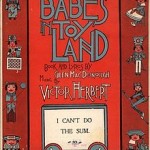 While not strictly a Christmas show, the score for Babes in Toyland certainly associates Christmas festivals with year around toy-making. The catch in the plot is the sad fact that the toymaker is an evil man. In many ways, the show is not for children because it contains too many adult themes and too many witty lyrics that cannot be understood nor fully appreciated by children. Depending on how we count, we find thirty-one to thirty-two songs written by Herbert for this show. Not one is bad; the composer featured czardas, mazurkas, gavottes, waltzes and marches. He wrote stirring operatic arias and tender lullabies. He wrote serious music and parodies.
One of the problems is that the plot is an afterthought, merely a convenient means to stage another musical number. The second issue is more serious; the range of music is too broad to fit into one, cohesive score. In fact, we think there are perhaps three scores hiding inside Babes in Toyland. However, for our purposes, we will pick out the best of the music to show how Victor was exploring musical alternatives. We were very fortunate to find some youtube clips that feature a London recording of Herbert’s original orchestrations; but for fun, in the last post that we will publish about this score, we will feature some little known clips of Kenny Baker singing many of the main songs.
In a recent post, we featured some czardas from the 1898 Victor Herbert operetta, The Fortune Teller, and so we thought we would start our musical buffet table with another gypsy song, this time “Floretta,” sung here by Hugh Panaro and the London Voices. All of these songs feature the London Sinfonietta, conducted by John McGlinn. Note the tongue in cheek humor–the fortune teller requires payment in advance.
Staying with European dance forms, let’s listen to the London Voices and the orchestra perform “Christmas Fair Waltz: Hail to Christmas.”
Let’s end this post with the oft-heard instrumental, “March of the Toys;” however, instead of blaring trumpets, you will hear the original orchestration, which called for the use of a kazoo.