The Era of American Operetta Shares the Stage with Popular Music
George M. Cohan (1878-1842) was an American entertainer, playwright, composer, lyricist, actor, singer, dancer and producer. Cohan began his career as a child, performing with his parents and sister in a vaudeville act known as “The Four Cohans.”
Cohan’s Broadway shows followed a pattern: he would write the libretto, compose the score, produce (at first with Sam Harris, his partner) and act in more than three dozen Broadway musicals. Little Johnny Jones (1904), his first big Broadway hit, provided Cohan the opportunity to introduce such American standards as “The Yankee Doodle Boy and “Give My Regards to Broadway.”
As a composer, he was one of the early members of the ASCAP. Cohan became one of the leading Tin Pan Alley songwriters, publishing upwards of 300 original songs, noted for their catchy melodies and clever lyrics that used snappy American slang. His major hit songs included “You’re a Grand Old Flag,” “Forty-Five Minutes from Broadway,” “Mary Is a Grand Old Name,” “The Warmest Baby in the Bunch,” “Life’s a Funny Proposition After All,” “I Want To Hear a Yankee Doodle Tune,” “You Won’t Do Any Business If You Haven’t Got a Band,” “The Small Town Gal,” “I’m Mighty Glad I’m Living, That’s All,” “That Haunting Melody,” “Always Leave Them Laughing When You Say Goodbye”, and America’s most popular World War I song “Over There”, which was recorded by Enrico Caruso among others.
In 1925, he published his autobiography, Twenty Years on Broadway and the Years It Took To Get There.
Known in the decade before WWI as “the man who owned Broadway,” he is considered an innovator in the development of American musical theatre by bringing melodrama to the Broadway musical. He became an early pioneer in the development of the “book musical,” using his engaging libretti to bridge the gaps between drama and music. More than three decades before Agnes de Mille choreographed Oklahoma!, Cohan used dance to advance the plot. Cohan’s main characters were average Americans that appealed to a wide American audience.
In his New York Times obituary, Cohan was called “the greatest single figure the American theatre ever produced – as a player, playwright, actor, composer and producer.” On June 29, 1936, President Roosevelt presented him with the Congressional Gold Medal for his contributions to WWI morale, in particular the songs “You’re a Grand Old Flag” and “Over There.” Cohan was the first person in any artistic field selected for this honor.
Cohan’s life and music were depicted in the academy-award winning film Yankee Doodle Dandy (1942) and in the 1968 musical George M!. A statue of Cohan in Times Square in New York City commemorates his contributions to American musical theatre. He was inducted into the Songwriters Hall of Fame in 1970, and into the American Folklore Hall of Fame in 2003. He has a star on the Hollywood Walk of Fame.
Notwithstanding all of Cohan’s rightly-deserved fame, we need to understand that George stood on the shoulders of another Irish-American. The best way to remember this man was through a song written by Cohan and used in the 1942 movie, Yankee Doodle Dandy, called H-A-R-R-I-G-A-N, sung by Jimmy Cagney and Joan Leslie. The song comes from the 1908 Broadway show, Fifty Miles From Boston. We have featured other songs from this movie, and now here is the performance of “Harrigan” from the movie (with Joan’s voice dubbed by Sally Sweetland).
The song was inspired by a real man by the name of Edward (“Ned”) Harrigan, an Irish-American actor, singer, dancer, playwright, lyricist and theatre producer. Harrigan formed a working partnership with another actor, Tony Hart, and a composer named David Braham. Together, they created a series of shows about a local militia, known as” The Mulligan Guard.” The first show, appropriately named The Mulligan Guard, premiered in 1873 on Broadway. In this collaboration, they produced seventeen shows over the next seven years.
Wikipedia states that “Although the plays gradually became longer as more songs, dances, and stage business was added, the tickets remained the same price. Harrigan and Hart’s comedy was about everyday people, and so it was fitting that working folk were able to afford to fill up the seats. These shows were very popular, especially with New York’s immigrant-based lower and middle classes, who were delighted to see themselves comically (but sympathetically) depicted on stage. The action of the plays took place in downtown Manhattan and concerned real-life problems, such as interracial tensions, political corruption, and gang violence, all mixed with broad, street-smart comedy, puns and ethnic dialects.”
The New York Herald compared the Mulligan series to the Pickwick Papers by Charles Dickens, according to Wikipedia, but today very little is left of these shows and none of the music lasted beyond its day on the stage.
In a way, Ned Harrigan lives on through George M. Cohan, a man deeply affected by Harrigan’s early pioneering efforts on the stage. If Cohan was called “the greatest single figure the American theatre ever produced – as a player, playwright, actor, composer and producer,” then we should admit that part of George’s success stems from Ned’s prior body of work.
There were other musical strains at the turn of the 20th Century that were popping up, with one in particular that bears mentioning. Some of those lovely tunes came from the pen of a woman whose life was filled with hardship and tragedy, Carrie Jacobs-Bond. In all, she wrote around 175 pieces of popular music (some called parlor songs) from the 1890’s to the 1940’s.
Two of her parlor songs are of great interest to us, because of their lasting value and their unmistakable imprint on film scores. “I Love You Truly” was published in 1901; however, for the generations that came during or after WWII, the song was best known as the “wedding song,” for George Bailey (played by Jimmy Stewart) and his wife, Mary (played by Donna Reed), sung in the rain in two-part harmony by their friends: the policeman (Ward Bond) and the cab driver (Frank Faylen). We can still enjoy this memorable scene in the movie, It’s A Wonderful Life (1946). Notwithstanding the fact that Dimitri Tiomkin wrote a good score for the movie, it is this song that is memorable.
The second song was published in 1910, and eight million copies of the sheet music were sold within one year; a total of twenty-five million copies were sold during Carrie’s lifetime. It was titled “A Perfect Day,” but was widely known as “The End of a Perfect Day.” It plays a critical role in the movie, Remember the Night (1940), as a hardened criminal, Lee Leander (played by Barbara Stanwyck), is forced to spend Christmas with her prosecutor, an assistant District Attorney named John Sargent (played by Fred MacMurray). While the criminal court in New York City is in recess, she is released into Sargent’s custody; and he is on his way back to visit his Mother (played by Beulah Bondi) in Indiana.
To Lee, the trip becomes a life’s journey; it is a period of reflection and revelation to her. More to the point, Lee is amazed at and by the power of love in a small Indiana town.
 On the night of her arrival, after supper, the family moves to the parlor/living room, where Lee volunteers to play a piece on the piano that she knows. It is “A Perfect Day.” Willie, the handyman, played by Sterling Holloway, is smitten by the beautiful Lee and sings it to her in a pure tenor voice. The singing is both simple and moving at the same time. The rest of the family joins in; the lyrics were born out of sorrow but contain within them the promise of hope.
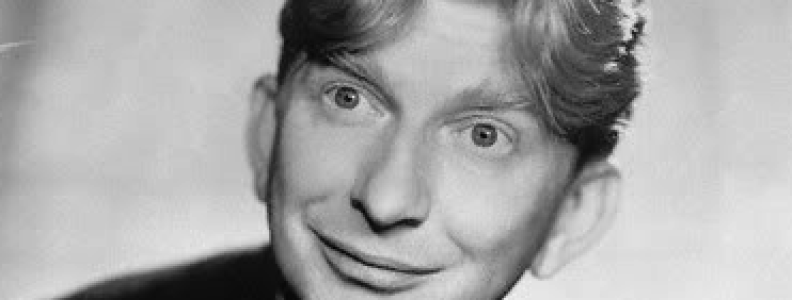
The acting is superb overall, but we ought to take special note of Holloway, whose picture is featured at the beginning of this post. He played comedic, bumbling, movie roles that fit his odd looks and high pitched voice; however, he was an accomplished Broadway actor and singer who introduced the Rodgers and Hart song “Manhattan” in The Garrick Gaieties (1925), produced by the Theatre Guild. Because the copyright owner will not permit the song from the movie to be embedded in other sites, like ours, we will provide the song in a second post directly on our FB page. But not to disappoint you here, we are going to provide a lovely duet between Jo Stafford and Gordon MacRae from 1950.