Ragtime Music Infiltrated Tin Pan Alley
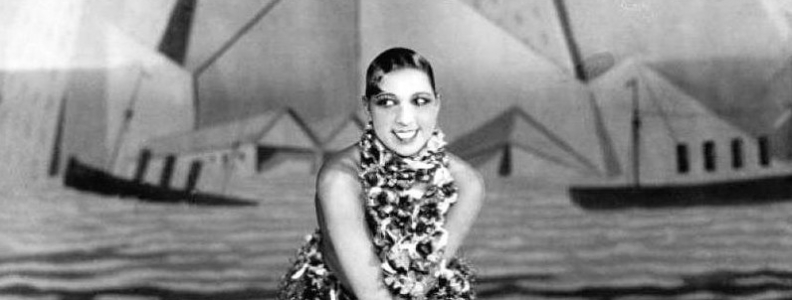
The featured image is that of Josephine Baker (1906-1975), an American dancer and performer who found great fame in Paris. She was in the chorus line in Broadway’s Shuffle Along in 1921 and Chocolate Dandies in 1924. She starred in La Revue Negre in 1925 in Paris, according to Wikipedia, and became an instant success for her “erotic dancing and for appearing practically nude onstage.” She appeared in a silent movie, Siren of the Tropics in 1927, as well as in the better known Zouzou in 1934 and Princess Tam Tam in 1935. She settled in France, where she had greater personal and artistic freedom, where she was known as the “Black Pearl,” the “Bronze Venus” and the “Creole Goddess.” Ernest Hemingway called her “the most sensational woman anyone ever saw.” She learned to sing and acquitted herself with distinction as the lead in a revival of Jacques Offenbach’s light opera, La creole.
Both before and during WWII, Josephine accepted assignments to spy on the Germans and Japanese and passed on her information to the Allies. She also helped obtain visas for the Free French. After the war, her service to France won her the Croix de guerre from the French military and a Chevalier of the Legion d’honneur by Charles de Gaulle.
She has come to epitomize the Jazz Age and represents the transition that America and Broadway were going through, as they moved from non-syncopated song to syncopated music. Going back to our post a week ago, we highlighted popular songs; next we looked at ragtime piano music. Now, it is time that we focus on the infiltration of ragtime music into Tin Pan Alley songs.
It seemed that overnight all of the Tin Pan Alley composers were writing rags. Of course, they weren’t true rags, but they were popular songs pretending to be ragtime piano pieces. An early example comes from Harry Von Tilzer; the song was written in 1905 and is called “Wait ‘Til the Sun Shines Nellie.” We have chosen to embed a clip from a 1941 movie, starring Bing Crosby and Mary Martin. We chose this version of the song because of the swinging arrangement, the fast tempo and the sweet harmony of the two great voices.
The next song is called “Ballin’ the Jack” and was written by Chris Smith in 1913. It is hard to find a song and dance routine from that era; however, in 1942, MGM worked hard to recreate the tempos and styles of the vaudeville music and dance routines. Various songs were chosen, and it is fortunate for us that one of the songs selected for the movie was “Ballin’ the Jack.” Here is Judy Garland and Gene Kelly, as they recreate the vaudeville number for us.
In 1911, Irving Berlin composed “Alexander’s Ragtime Band,” and in 1912, he composed “When the Midnight Choo-Choo Leaves for Alabam’.” While we don’t have a song and dance routine from 1912, we do have a recreation that Berlin supervised for the 1948 movie, Easter Parade. We believe that this recreation is faithful to the style and tempo used in 1912. This time Judy Garland is paired with Fred Astaire.
Next, we have a song by Lewis F. Muir written in 1913, called “Waiting for the Robert E. Lee.” Performers of that era sang this song as though it were a minstrel song; therefore, they used the standard practice of the time, which was to don “blackface.” All performers, black or white, would apply cork to their faces. As Rhiannon Giddens explains on PBS (part of the Carolina Chocolate Drops), often the cork would lighten the skin of the African-American performers. When MGM made another Judy Garland/Mickey Rooney musical in 1941, the performers tried to be historically correct and used cork. Again, if we want the benefit of these older performances, we need to overlook this objectionable practice. In this case, it is even more important because we may never see the likes of Judy Garland again. It wasn’t just her raw talent; it was also her dedication to the discipline of rehearsal and the perfection of her craft. Her performance is bitter-sweet, knowing as we do now, that the toil of her work would come to destroy her mind and body.
If you listen to Muir’s lyrics in “Waiting for the Robert E. Lee,” you will hear a reference to the song, “Jelly Roll Blues.” The reference is to a song written by Jelly Roll Morton in 1910, which was originally titled, “Original Jelly Roll Blues.” It was widely known and very popular, so much so that it was also referenced in the 1917 song written by Shelton Brooks, called “Darktown Strutters Ball.” Here is a 1926 recording of “Original Jelly Roll Blues” by Jelly Roll Morton and his Red Hot Peppers.