
Little Johnny Jones–George M. Cohan’s First Broadway Hit Show
Our prior posts on George M. Cohan covered his life and his life’s work. The featured image captures a young George and his sister, Josie in the 1890’s.
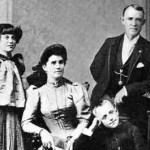 Here is a portrait of all Four Cohans. In this post, we are going to cover the first of George’s great Broadway shows. I wish we could say that we were able to find Youtube clips from revivals of his shows, but most of the time, the best source of information continues to be the Warner Brothers 1942 movie, Yankee Doodle Dandy, starring Jimmy Cagney. We have clips of three of the show’s songs, “The Yankee Doodle Boy,” “Give My Regards to Broadway” and “Life’s a Funny Proposition After All.” However, we also are going to explore music from the movie that has been passed off as music written by Cohan for Little Johnny Jones but that, in reality, was written by another composer.
Before we get to the music, let’s take a trip down memory lane—not, of course, any of our personal memories. These are the memories of Broadway itself. Because we weren’t alive, we need to recreate two Broadway seasons, so that we can put this show into the context of the entire genre.
In earlier posts, we looked at Victor Herbert’s Babes in Toyland, which was the 31st show of the 1903/1904 Season; it opened on October 13, 1903 and closed on March 19, 1904, after 192 performances. The 37th show was Babette, also by Herbert, and it introduced an opera singer named Fritzi Scheff to the Broadway stage.
The next major milestone on Broadway did not come until September 19, 1904 when the 34th show of the 1904/1905 Season opened; it was called Mr. Wix of Wickham. It was a minor show, with one exception: the original program listed twelve songs that were composed by Jerome Kern. It would take another eight years until Kern had a score all his own (The Red Petticoat). But more on that in a later post.
On November 7, 1904, Little Johnny Jones opened at the Liberty Theatre, as the 42nd show of the season, with a book, music and lyrics written by George M. Cohan. George also staged the show, which at the time meant that he directed the dialogue and choreographed the dance routines. Charles Gebest orchestrated the music and conducted the orchestra during its run. Over the period of 1904/1905, the show played in three different theatres, before it closed for the last time on December 2, 1905; in all there were 205 performances.
About one month later, Herbert’s new show, It Happened in Nordland, opened at Lew Fields’ Theatre on December 5, 1904. It contained no memorable Herbert tunes but ran for a total of 254 performances; it did have one song that had been carried over from Babes in Toyland, namely “Beatrice Barefacts.”
The name of this song is a sly reference to a woman named Marie Manning, who wrote a column for the New York Evening Journal, starting in 1898, entitled Dear Beatrice Fairfax. It was the first of its kind and was wildly popular with women until Manning’s death in 1945; it led to other columns, such as Dear Abby.
What is remarkable is the number of times that lyric writers referred to her. Ira Gershwin wrote the following lyrics for the song “But Not for Me” found in the 1930 musical, Girl Crazy:
“Beatrice Fairfax, don’t you dare
Ever tell me he will care.”
In Harold Rome’s 1937 revue, Pins and Needles, Rome wrote these suggestive lyrics for the song “Nobody Makes a Pass at Me.” The song was later made famous by Barbara Streisand:
“Oh Beatrice Fairfax, give me the bare facts,
How do you make them fall?
If you don’t save me, the things the Lord gave me
Never will be any use to me at all.”
But I digress.
According to Wikipedia, Little Johnny Jones has a fairly complicated plot: “A brash, patriotic American jockey, Johnny Jones, goes to England to ride his horse, Yankee Doodle, in the English Derby. Jones falls in love with Goldie Gates, a San Francisco copper heiress, who follows him to Britain, disguising herself as a man to discover if Jones really loves her. Anthony Ansley, an Americn who runs a Chinese gambling establishment in San Francisco, offers Jones a bribe to lose the race deliberately, but he refuses. After Jones loses, Ansley spreads rumors that he threw the race intentionally. Jones’ detective, pretending to be a drunkard, searches for evidence to clear Johnny’s name and finds out that it was Ansley who framed Jones. Jones tells his friends who are returning to America, ‘Give My Regards to Broadway,’ but he stays in London to try to regain his reputation. Jones returns to America with his name cleared, eager to propose to Goldie, but he finds that Ansley has kidnapped her. He and his detective search for her in San Francisco’s Chinatown, eventually finding her.”
The plot is loosely based on the real-life story of Tod Sloan, a successful but flamboyant jockey who traveled with a valet and trunk full of clothes. In 1899, Sloan was riding a horse, named Holocaust, and was neck-and-neck with the eventual winner coming into the last straight, “when his horse stopped abruptly and collapsed on the ground with a shattered pastern [leg].” The horse had to be put down.
Wikipedia continues: “In 1900, Edward, Prince of Wales offered Sloan the job to ride for his stable in the 1901 racing season.” Sloan’s racing career ended in 1901 “under a cloud of suspicion that he had been betting on races in which he had competed. Advised by the British Jockey Club that they would not renew his license, he never rode for the Prince of Wales. The ban in Britain was maintained by American racing authorities, and Sloan’s jockey career came to an end.”
Sloan drank himself to death and was interred in Forest Lawn Memorial Park Cemetery in Glendale, CA in 1933.
Of course, there never was any proof that Sloan had been betting on his races, and “ultimately, British racing historians restored his reputation. He was posthumously indicted into the National Museum and Hall of Fame in 1955.”
On a happier note, the audience didn’t have to wait more than 50 years to find out that Johnny Jones was a true “gent.”
That brings us to the first musical clip. We have shown it before, but this time we are going to break it down into four sections. It starts with Cagney singing the introduction to the song “Yankee Doodle Boy:”
“I’m the kid that’s all the candy
I’m a Yankee Doodle Dandy
I’m glad I am
(So’s Uncle Sam)
I’m a real live Yankee Doodle
Made my name and fame and boodle
Just like Mister Doodle did, by riding on a pony
I love to listen to the Dixey [Dixie] strain
“I long to see the girl I left behind me”
And that ain’t a josh
She’s a Yankee, by gosh
(Oh, say can you see
Anything about a Yankee that’s a phoney?)”
This is Cohan’s music and lasts for about 48 seconds.
The next musical sequence starts with the chorus singing about “Little Johnny Jones” and his great record on the track; it was written by M. K. Jerome (music) and Jack Scholl (lyrics) and goes to about the 1:32 mark.
Then Cagney and the chorus go into the song and dance of the familiar song written by Cohan. This lasts until around 3:01 on the clip, when Cagney exits into the jockey house to change into his silks.
The rest of the clip starts with other jockeys carrying wooden horses onto the stage and is called “Good Luck, Johnny.” It was written by Jerome and Scholl.
Now, watch the clip but keep looking at the time (little red ball at the bottom of the clip).
We will pick up Part Two on Thursday.