
Forty-Five Minutes from Broadway–Part Two
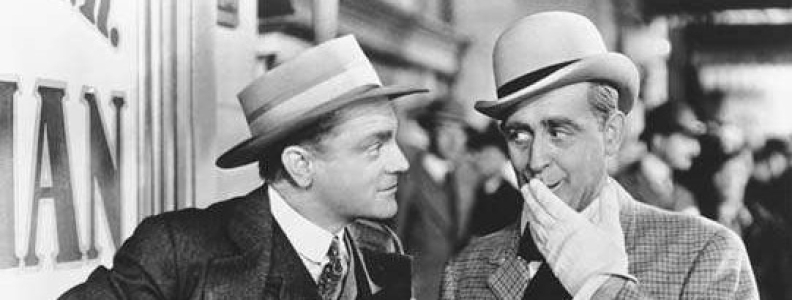
We are featuring James Cagney again in the opening image because we are going to return to the movie, Yankee Doodle Dandy, to play some of its beautifully recorded music. As you know by now, from Part One, none of the Cohan’s appeared in Forty-Five Minutes from Broadway. In this segment, we are going to provide a few more details of the show, some insight into runs on Broadway that led to touring companies and some great music.
In Gerald Bordman’s American Musical Theatre, Bordman quotes some lines to show that Kid has no false modesty, as he refers to the people of New Rochelle as rubes:
Cohan and Moore
Kid: I’m the real noise around this man’s residence, understand? I’m the real noise. I’ll make these rubes around here pay a little attention to me yet. Forty-five minutes from Broadway, Gee, its got some of them towns in Texas tied to a post.
According to Collins Dictionary, the word “rube” probably comes from the word “Reuben” and refers to someone who is a country hick. On the other hand, Wikipedia refers to a “Reuben” as the generic use of the name “Rube.” Further, Wikipedia tells us that the word “jay” is an old-fashioned synonym for “reuben” or “rube.”
As we look at the opening lyric from the song, “Forty-Five Minutes from Broadway,” we see the words reuben and jay:
Only forty-five minutes from Broadway
Think of the changes it brings
For the short time it takes
What a diff’rence it makes
In the ways of the people and things
Oh, what a fine bunch of reubens
Oh, what a jay atmosphere
They have whiskers like hay
And imagine Broadway
Only forty-five minutes from here
Well, you can imagine that the good folks in New Rochelle were not terribly pleased to hear of themselves referred to in this manner. According to David Ewen in The New Complete Book of the American Musical Theater:
“On the morning of the premier of Forty-Five Minutes from Broadway, the New Rochelle Chamber of Commerce called an emergency session to pass several resolutions regarding this musical: (1) to institute a boycott; (2) to send out press releases denouncing the play as libelous to their community and its inhabitants. The Chamber of Commerce objected particularly to the title song, which said that the town did not have a single cafe and which spoke of the males of having ‘whiskers like hay.’ After the show opened, the commotion in New Rochelle died down as the town came to realize that the play was succeeding in making New Rochelle famous.”
Broadway runs were regarded quite differently when Victor Herbert and George M. Cohan were writing shows; performances on Broadway were merely stepping stones to the formation of touring companies. Second, it was not uncommon to have a longer run in a try-out city than one had on Broadway.
For example, Bordman recalls that Forty-Five Minutes from Broadway enjoyed a longer run in Chicago than it had in its initial run on Broadway (90 performances). Actually, according to Cohan, in his autobiography, Twenty Years on Broadway, he produced the show first in Columbus, Ohio.
“After a few try-out performances, we jumped to Chicago and opened at the Colonial Theater (the renamed Iroquios); this was in September, 1905. The piece scored an instantaneous success and brought the playhouse back into the good graces of Chicago’s theatergoers. The ‘Standing Room Only’ sign was displayed in the lobby throughout the entire engagement of four months. After the New York run of the play at the New Amsterdam Theater, we sent the piece back to Chicago again for another four months’ run. A solid year was divided between the two cities, and Fay Templeton scored one of the notable successes of her career.”
On the next page, he continues:
“We organized road companies of ‘Forty-Five Minutes’ immediately and sent them throughout the country, while the ‘number one’ troupe played the high spots. With the extra ‘Johnny Jones’ companies and the ‘Forty-Five Minutes from Broadway’ shows, along with ‘Running for Office,’ which we also sent out on tour, the booking offices were being kept fairly busy taking care of the Cohan attractions.”
Bordman points out Cohan’s delight in writing vaudeville routines into his dialogue. Here is an example of dialogue between Mary and the butler, Andy:
Andy: You know I knew your father, Mary.
Mary: You mean my mother, Mary. My father’s name was Oscar.
Here is a piano roll version of songs from the show, skipping “Gentlemen of the Press” and starting with “I Want to Be a Popular Millionaire.” You get a much better idea of the latter song from this piano roll.
It then goes into songs that we know, namely “Mary’s a Grand Old Name,” “Forty-Five Minutes from Broadway” and “So Long, Mary.”
However, it plays the two last songs, “Retiring from the Stage” and “Stand Up and Fight,” but we cannot tell where these songs came from.
Support for all six songs comes from sheet music from the Lester S. Levy Sheet Music Collection at Johns Hopkins. We can clearly see the front page of the F. A. Mills sheet music, which lists “Retiring from the Stage,” “I Want to Be a Popular Millionaire,” “Mary’s a Grand Old Name,” “Forty-Five Minutes form Broadway,” “Stand Up and Fight Like Hell” and “So long, Mary” as “song successes from George M. Cohan’s latest musical play, Forty-Five Minutes from Broadway.”
However, the best reference work known about Broadway shows, the casts of those shows, the songs (in order) appearing in those shows and the people who sang those songs, is A Chronology of American Musical Theater by Richard C. Norton (three volumes). It notes the opening night musical numbers, the songs subsequently cut after opening night and the songs added on Broadway or on tour. Only five numbers are listed, as noted in Part One, which includes “Gentlemen of the Press,” and there is no mention of “Retiring from the Stage” or “Stand Up and Fight Like Hell.”
Neither Bordman nor Ewen mention these two songs in their books.
Our best guess is that these songs were added at a later date, perhaps for a road company.
We are going to stick with Norton as the authoritative source concerning the songs presented on Broadway in 1906.
Now we can move on to three songs that are from the show and that we have heard before. The first is “Mary’s a Grand Old Name.” There are two renditions in Yankee Doodle Dandy. The first time we hear it is when Jimmy Cagney is teaching it to Joan Leslie (Joan’s voice is dubbed by Sally Sweetland). Later, we see Irene Manning sing it on stage.
Our preference leans toward the intimate scene between Cagney and Leslie, but we are including both.
Finally, there is the medley of “Forty-Five Minutes from Broadway” and “So Long, Mary.” We are including the initial part of the lyrics.
Mary: It’s awfully nice of all you boys to see me to the train
Chorus: So long, Mary
Mary: I didn’t think you’d care if you should ne’er see me again
Chorus: You’re wrong, Mary
Mary: This reminds me of my family / On the day I left Schenectady
Chorus: So long, Mary / Don’t forget to come back home