
It Is 1910 and Time for Naughty Marietta to Take Center Stage
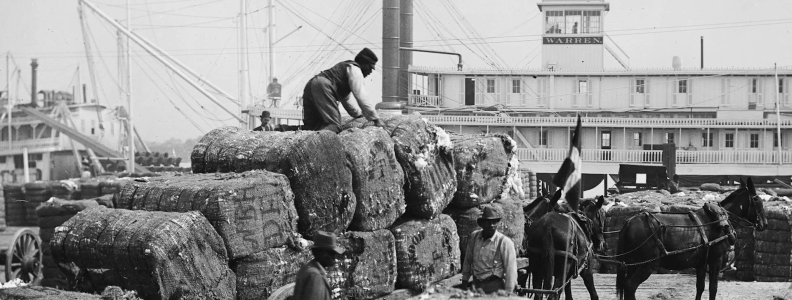
Here is another image of historical New Orleans, and the staple crop of the South, cotton. And, no, it has nothing to do with casquette girls and Naughty Marietta. We just loved the picture.
The plot makes no sense and has no historical basis. But it is what it is:
Captain Richard Warrington and his armed men have come down to New Orleans looking to find and arrest a pirate known as “Bras-Pique.” Captain Warrington is greeted with courtesy by Lt. Governor Grandet and his son, Etienne Grandet. Unknown to the population of New Orleans, with one exception, Etienne is also the pirate, Bras-Pique.
Marietta d’Altena has come by ship from France to be a casquette girl but jumped ship and is hiding in an urn in the Place d’Armes, until she is taken in by Rudolfo, keeper of a marionette theatre, and passed off in men’s clothing as Rudolfo’s son. To make the plot a little more complicated, we learn that Marietta is an Italian woman of royal birth who would not give her consent to her father’s choice of husband in an arranged marriage.
Adah, a slave, is both owned by Etienne and is his mistress, and she alone knows of Etienne’s double identity.
But Etienne falls in love with Marietta; and, not content to just say goodbye, Etienne sells Adah as his way of ending the relationship.
Marietta and Warrington have met in the Place d’Armes, and Warrington has taken Marietta under his protection. They fight the attraction that they feel for one another.
When Etienne sells Adah, Warrington buys her in order to set her free. Historically, there was a large population of Free Negroes in New Orleans, so this idea of freeing a former slave has historical foundation.
We also have a subplot involving Simon O’Hara, Warrington’s servant, who agrees to become Lt. Gov. Grandet’s “whipping boy,” not having the slightest idea of what the duties of a whipping boy are. Later, he learns that, if the Lt. Governor needs to be punished by administration of a certain number of lashes of the whip, Simon will stand in for the Lt. Governor and take the blows. This news diminishes his desire to take on the duties of “whipping boy.”
Etienne plans to marry Marietta, who agrees after seeing Warrington buy Adah. But Adah saves the day by revealing the true identity of Bras-Pique, although Etienne escapes capture.
To end the fairy tale, Warrington is able to finish a song that has been in Marietta’s mind, and they agree to marry.
It is hard to believe that this libretto was presented on Broadway; it is even harder to believe that Rida Johnson Young, its author, was praised for her libretto during the tryout in Syracuse. That said, Mrs. Young did shed some light on the period of the show, as related by Edward Waters, Victor Herbert’s biographer: “We don’t know ourselves. You see, we selected one date, and then the costumer decided that another date would give him more latitude in the designing of his costumes, so it is all a little indefinite, but it is some time during the eighteenth century.”
If the libretto makes no sense, so be it; however, the score is incredibly strong. Some think it is Hebert’s best score; certainly Naughty Marietta and Eileen can both be considered as two of Herbert’s best.
Naughty Marietta ran for 136 performances and might have run longer. Extra matinees were scheduled to satisfy the demand for seats; according to Gerald Bordman, “Herbert’s superb biographer, Edward Waters, states that the duration of the run was limited in advance by contractual commitments and that it could have remained in New York much longer.”
In 1935, the score was dusted off and used in the movie adaptation; it paired, for the first time, two wonderful singers, Jeanette MacDonald and Nelson Eddy. We have never provided a full biography of either person, so let’s rectify that situation now, using material found on Wikipedia.
In 1919, Jeanette MacDonald MacDonald joined her older sister, actress Blossom Rock, in New York, and landed a job in the chorus of Ned Wayburn’s The Demi-Tasse Revue, a musical entertainment presented between films at the Capital Theatre on Broadway. In 1920, she appeared in two musicals, Jerome Kern’s Night Boat as a chorus replacement, and Irene on the road as the second female lead. In 1925, MacDonald again had the second female lead opposite Queenie Smith in Tip Toes, a George Gershwin hit show. MacDonald finally landed the starring role in Yes, Yes, Yvette (1927), and MacDonald also played the lead in her next two shows. Her last musical was Boom Boom (1929), with her name above the title (the cast included young Archie Leach, who later changed his name to Cary Grant).
While MacDonald was appearing on Broadway, film star Richard Dix spotted her and had her screen-tested for his film Nothing but the Truth. Ernst Lubitsch cast her as the leading lady in The Love Parade, his first sound film, which also starred Maurice Chevalier.
In the first rush of sound films, 1929–30, MacDonald starred in six films. MacDonald next signed a three-picture deal with Fox. MacDonald took a break from Hollywood in 1931 to embark on a European concert tour. She returned to Paramount the following year for two films with Chevalier: One Hour with You and Love Me Tonight, both in 1932.
In 1933, MacDonald left again for Europe and while there, signed with MGM. In 1934, she appeared in two MGM films, The Cat and the Fiddle and The Merry Widow. Then, MGM decided to do a movie adaptation in 1935 of Victor Herbert’s Naughty Marietta, with W.S. Van Dyke directing.
In 1924, Eddy won the top prize in a competition that included a chance to appear with the Philadelphia Opera Society. By the late 1920s, Eddy was appearing with the Philadelphia Civic Opera Company and had a repertoire of 28 operas. Eddy performed in Gilbert and Sullivan operettas with the Savoy Company. With the Philadelphia Civic Opera, Eddy sang in a number of American premieres, and at Carnegie Hall in 1931, he sang the world premiere of Maria Egiziaca (Mary in Egypt).
Among his final opera performances were three with the San Francisco Opera in 1934, when he was still “unknown.” Marjory M. Fisher of the San Francisco News wrote of his December 8, 1934, performance of Wolfram in Tannhauser, “Nelson Eddy made a tremendously fine impression … he left no doubt in the minds of discerning auditors that he belongs in that fine group of baritones which includes Lawrence Tibbett, Richard Bonelli and John Charles Thomas…”
Eddy was “discovered” by Hollywood when he substituted at the last minute for the noted diva, Lotte Lehman, at a sold-out concert in Los Angeles on February 28, 1933. He scored a professional triumph with 18 curtain calls, and several film offers immediately followed. After much agonizing, he decided that being seen on screen might boost audiences for what he considered his “real work,” his concerts. Eddy’s concert fee rose from $500 to $10,000 per performance.
Naughty Marietta was the surprise hit of 1935. Its key song, “Ah! Sweet Mystery of Life.” became a hit and earned Eddy his first gold record. MacDonald earned gold records for “Ah! Sweet Mystery of Life” and “Italian Street Song.” The film won an Oscar for sound recording and received an Oscar nomination for Best Picture. It was voted one of the Ten Best Pictures of 1935 by the New York film critics and was awarded the Photoplay Gold Medal Award as Best Picture of 1935.
In September 1978, there was a live broadcast from the New York City Opera on WNCN-FM of Naughty Marietta, with John Mauceri conducting. Here is the Overture from that broadcast.