A Special Request and A Special Performance
In the last few years, I have received a yearly notice from Wikipedia, reminding me of the cost of supplying their services, even though they use volunteers. They also gently remind me of the contribution that they make and how they serve the public.
I receive it once a year; no hard sell; no crisis. Just a simple reminder.
I use Wikipedia a great deal, and I find it to be a very useful tool. It gives me a place to start; it recites key facts; it is well-organized; and it sometimes gives me great insight.
When I receive the reminder, I don’t feel an obligation; I feel gratitude for the opportunity to support a worthy organization.
Those yearly reminders got me thinking about the JMV Art Preservation Foundation and the fact that we operate in the red every year. We need help from our friends come December so that we can pay our outstanding invoices and keep the doors open, so to speak, because we don’t have physical offices. But we do need contributions to stay on FB and keep the website up and running. We need to pay for the web servers, the links and other technical services.
So, I asked one of the friends who helps to keep the lights on each December, “What do you think?”
“Think about what?” he replied.
“Do you think we have the right to ask for donations?”
His answer was firm: “I think you have earned that right.”
Well, with that introduction, here goes our first pitch for funding.
I am going to write this in first person, because I have never felt so self-conscious. By way of background, I started this Foundation shortly after my Mother passed away in 2007. Over the last decade or so, I have donated around $2M in round figures; and in that same short amount of time, we have spent the entire amount.
Looking back, I realize that perhaps we could have done fewer projects or spent less on each project; however, we did manage to establish a high-quality standard for restoring older Broadway scores.
In hindsight, I see my mistake; I thought some other, for-profit projects, were going to supply ample funds for many years. Those projects were quite exciting and appeared to be very promising. They still are. The problem is—those other projects have yet to pay off.
Bottom line: I am personally just getting by, and the Foundation doesn’t have sufficient funds to start another project.
For these reasons, I am extending this well-crafted solicitation: HELP!
I hope that anyone who has a few dollars to spare (after the bills are paid) would donate $10 or $20 to the Foundation. You can go to the donation page on the website or you can send a check to me via snail mail at: 112 Hillside Rd, Wayne PA, 19087. Make it out to the JMV Art Preservation Foundation, a 501c3 charity, in order to get a charitable deduction.
Having said that, I also feel the need to make one more point abundantly clear: some of you don’t have the extra money to donate. You live, as my parents used to say, close to the vest. Please don’t send what you can’t afford. Please.
Now, maybe your children or grandchildren can make a donation in your name, but that is for them to decide.
If you feel compelled to send something to us, please send us a message that warms our hearts: a personal thank-you in the comments section.
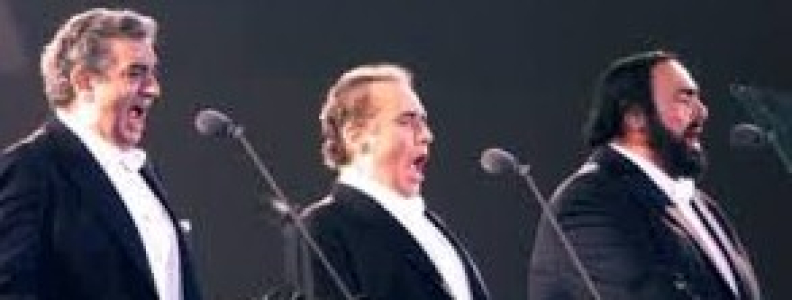
We never want to leave you without some music to warm your hearts. So, here is a special piece of music. Fearing for their friend’s life when Jose Carreras was stricken with cancer, Placido Domingo and Luciano Pavarotti planned a special celebration if Jose survived. The special celebration took the form of a 1990 concert in Rome, commonly referred to as The Three Tenors in Concert. It was recorded as a video and as an audio album; the audio recording went on to become the best-selling classical album of all time.
The three tenors sang together at the end of the concert, each taking turns singing part of an aria called “Nessun dorma” written for the tenor, Calaf, in Puccini’s opera, Turandot. Here is the substance of that aria from the Wikipedia entry:
In the act before this aria, Calaf has correctly answered the three riddles put to all of Princess Turandot’s prospective suitors. Nonetheless, she recoils at the thought of marriage to him. Calaf offers her another chance by challenging her to guess his name by dawn. As he kneels before her, the “Nessun dorma” theme makes a first appearance, to his words, “Il mio nome non sai!” (My name you do not know!). She can execute him if she correctly guesses his name; but if she does not, she must marry him. The cruel and emotionally cold princess then decrees that none of her subjects shall sleep that night until his name is discovered. If they fail, all will be killed.
As the final act opens, it is now night. Calaf is alone in the moonlit palace gardens. In the distance, he hears Turandot’s heralds proclaiming her command. His aria begins with an echo of their cry and a reflection on Princess Turandot:
| Nessun dorma! Nessun dorma! Tu pure, o Principessa, nella tua fredda stanza, guardi le stelle che tremano d’amore, e di speranza! |
None shall sleep! None shall sleep! Not even you, oh Princess, in your cold bedroom, watching the stars that tremble with love and with hope! |
| Ma il mio mistero è chiuso in me; il nome mio nessun saprà! No, No! Sulla tua bocca lo dirò quando la luce splenderà! |
But my secret is hidden within me; no one will know my name! No, no! On your mouth I will say it when the light shines! |
| Ed il mio bacio scioglierà il silenzio che ti fa mia! |
And my kiss will dissolve the silence that makes you mine! |
Just before the climactic end of the aria, a chorus of women is heard singing in the distance:
| Il nome suo nessun saprà, E noi dovrem, ahimè, morir, morir! |
No one will know his name, and we will have to, alas, die, die! |
Calaf, now certain of victory, sings:
| Dilegua, o notte! Tramontate, stelle! Tramontate, stelle! All’alba vincerò! Vincerò! Vincerò! |
Vanish, o night! Fade, you stars! Fade, you stars! At dawn, I will win! I will win! I will win! |