The American Musical Satire And One Satirical Essay (by us)
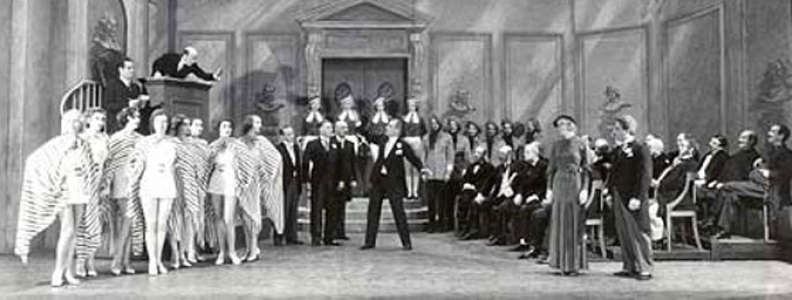
In the 1930’s there were three shows that used satire to achieve fame and fortune. The featured image is taken from one of those shows, Of Thee I Sing.
The first show appeared on Broadway in 1930, Strike Up the Band. The music was by George Gershwin, the lyrics by Ira Gershwin. The book was written by George Kaufman and Morrie Ryskind; the review by William Bolitho was reprinted in David Ewen’s New Complete Book on American Musical Theater stated: “Here is a bitter … satirical attack on war, genuine propaganda at times, sung and danced on Broadway.”
The same team came up with a second show, Of Thee I Sing in 1931; it was the first musical to win the Pulitzer Prize for Drama. It was also the first musical-comedy text to be published in book form. It was the longest running Gershwin show on Broadway with 441 performances. But satire is topical and may not be as funny in another period of time. Revivals in 1952 and 1968 both failed. According to David Ewen, in 1968 Clive Barnes “called the text ‘not just weak’ but “tottering… not just bad, it is terrible.’ ”
What a difference 30 years makes!
By the way, the second musical to win the Pulitzer Prize for Drama was South Pacific in 1950, and it has kept its luster.
In 1937, George Kaufman teamed up with Moss Hart to write a satirical look at the New Deal, called I’d Rather Be Right. The music was by Rodgers and Hart, and starred George M. Cohan, playing the role of FDR. We saw a brief recreation of one of the numbers (“Strictly Off the Record”) in Yankee Doodle Dandy, with Jimmy Cagney playing the role.
The material is dated; we don’t have any historical recordings to share. But we have tried our own hand at writing a satirical piece. It may not be great art but it was a lot of fun to write. We are going to include it here; however, we need to preface this with a big old warning: DO NOT TAKE THIS SERIOUSLY; IT IS MEANT TO BE FUNNY; IF IT ISN’T FUNNY, KICK IT TO THE CURB.
NEWLY FOUND EVIDENCE AS TO THE DEMISE OF OPERETTA
Recently, two unmarked boxes in the basement of the Association of Producers Against Booze on Theatre Premises (“APABOTP”) revealed very strong evidence that the attempt to end drinking alcohol during the intermission between Act One and Act Two in Broadway theaters was primarily responsible for the premature death of the American operetta.
Of course, there were other reasons.
The first and most surprising of the “other reasons” was the fact that plants could not live on stage. Natural soil had ceased to be indigenous to the area surrounding Broadway, making it necessary to import it from Central Park. However, once the soil was placed in urns inside a Broadway theatre, it lost its power to give life and quite literally gave up the ghost. Without decent soil, plants and trees would not grow in Broadway theateres, although evidence does support the fact that a tree grew in Brooklyn.
Without a plant or a tree, operettas were deprived of their most important attribute—the use of scenery to distract the audience from noticing the lack of logic in the plot.
As it turns out, what was once thought to be an “other reason” turned out to be inextricably tied to APABOTB. It turns out that producers actually paid librettists to create a “bloated” first act. As everyone knows, there was a terrible struggle between forces for and against drinking alcohol prior to the passage of Prohibition. Producers on Broadway tended to be advocates for prohibition; therefore, they plotted to keep intermissions short.
Their reasoning went something like this: If intermissions were short, there would be insufficient time to order and drink alcoholic beverages. Broadway ticket holders were slow to catch on; and most drinks that were ordered were left on the bar and tables in the lobby. Of course, this led to a much higher level of drunkenness among the concession staff, an unintended consequence.
In order to keep intermissions short, first acts had to be lengthened. In response to secret payments from producers, librettists developed a technique called the “pause” in their scripts. At first, the “pause” might be dramatic onstage but was rather short and did not elongate Act One in any material way.
However, librettists kept pushing the technique; thus, pauses became longer in order to add time to the reading of the dialogue. In fact, pauses were known to have caused many a show to fail, because patrons were using the pause as a way to engage in illicit love affairs during the periods when no dialogue was spoken (just the violins playing to cover the lack of action onstage). These overly long pauses did the trick, lengthening the first act of operettas by a significant number of minutes. However, these pauses also had the unintended effect of producing a rather large increase in illegitimate children. These pauses therefore became known in the trade as “pregnant pauses.”
Of course, theatre-goers still faced an inescapable reality; the trains for New Rochelle, White Plains and Westport still left on time. This led to half empty houses long before the final curtain. In order to combat the loss of audience in the second act, librettists and lyricists were paid secret fees to shorten the second act. Because most operettas on Broadway were sung in English by 1900, the librettists found it difficult to use a technique that they had successfully used when writing for Italian operas.
Given the number of vowels in Italian operas, librettists tended to cut out about one half of the vowels in second act arias. Most in the audience did not notice the changes because the conductors were paid under the table to increase the tempo in the second act. The combination of cut vowels and increased tempos, for example, were able to cut 30 seconds off of the baritone aria, “Largo al factotum,” from Rossini’s The Barber of Seville. The changes were not noticed until the Concerned Italians for the Preservation of Vowel Accuracy (“CIFTPOVA”) in Padua figured out the secret and filed an injunction against the practice.
Another plot technique attempted at the time was “encirclement.” In the older, more successful operettas, the evil baritone was hunted by individuals at the end of the second act and was confronted on all four side of the stage (upstage, downstage, stage right and stage left). The baritone found himself trapped, although it took many failed attempts before the baritone was finally killed. Once dead, the tenor and soprano could declare their love and the orchestra could burst into the Finale Ultimo. If one was quick about it, one could still catch the last train to the suburbs.
Nevertheless, baritones became craftier and were determined to remain alive for as long as they could. Thus, the second act was being elongated and not shortened, much to the dismay of the APABOTB. The producers decided that the old 4-corner method needed to be updated.
Producers came up with the “encirclement” technique: an angry mob would form a circle around the baritone and shorten the amount to time it took to kill off the evil fellow. However, the initial circles were really semi-circles in order to let the audience see the action. This process was flawed, as baritones were able to escape into the orchestra pits and could continue to sing in protest from there.
Producers then turned to a full circle, with the weightier members of the mob actually sitting on the baritone long enough to end the show. While this proved successful in forcing the air out of the baritone’s lungs, it also led to a large increase in the number of injured baritones, causing many performances to be cancelled.
At this point producers migrated to a practice that had worked on large animals and might work (at reduced serum levels) on large baritones—the use of a tranquilizer dart. As it turned out, the dart was quite effective in silencing the baritone without injuring him. However, baritones were not recovering in time to take their curtain calls, causing the actors union to file grievances on behalf of the aggrieved baritones.
Given all of this turmoil, one would think that producers were happy because less alcohol was served during intermissions. However, the audience had the last laugh here, as flasks became ubiquitous; and patrons drank without “ordering” drinks. At the same time, the unintended consequences were driving up the costs of tickets, as concessionaires went bankrupt, alcoholic concession employees were sleeping in the lobby and unwed mothers had to find creative ways to raise “pregnant pause” children on their own.
In the end, audiences migrated over to musical comedies where the drinking on the stage could not be distinguished from the drinking in the seats. Neither the beginning of Prohibition nor its ultimate demise changed behavior in or around the Broadway theaters. But the attempt to turn Broadway dry did cause many to tell sad stories of the death of operetta.