
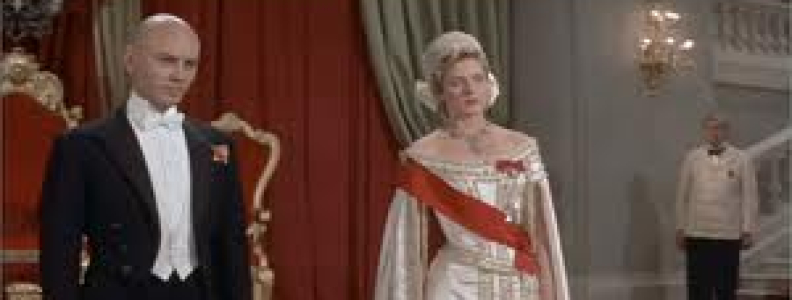
Anastasia (1956)
This will be the third illustration of Alfred Newman’s skill as a composer for Hollywood films. This is probably an appropriate point for us to hit the pause button and to provide an editorial comment; so we will. Newman was just one of many skilled musicians (conductors, music directors or orchestrators) on Broadway who were not major composers for Broadway shows but became, at some point later in their lives, major composers for films. Their music graces the soundtracks of many movies; they have won any number of Oscars and been nominated for many more. What caused this disparity?
While no case is the same and the lives and skills of all of these musicians differ to some degree, one thing remains a constant: the skills required to write a Broadway score are quite different from the skills required to write a film score. A really good Broadway score requires not only songwriting skills (alone, as was the case with Irving Berlin and Cole Porter, or in collaboration with a lyricist) but requires the ability to tie the music into an integrated pattern of song, dance and acting that sounds consistent from beginning to end. Even as we listen to the Overture in a Broadway theatre, we should sense, as the lights dim, that there is a “oneness” to the score as the music moves seamlessly from one theme to the next. In short, we just cannot imagine a song from Brigadoon being used in My Fair Lady.
In a film, we have a very different musical structure to work with. First, most of the time, the music relies on instrumental composition instead of song. The opening credits may serve to introduce a unifying, instrumental theme that lasts throughout the movie, such as the theme from The Big Country (1958) by Jerome Moross; the opening credits can introduce a song such as “Do Not Forsake Me” from High Noon (1952, Dimitri Tiomkin). The movie may shy away from a bold theme, and it may rely on many, different pieces of music, such as those heard in Max Steiner’s score for The Little Minister (1934).
Moross captured the vastness and the grandeur of the American west in his opening theme in The Big Country. This is not to say that the rest of the score is nothing more than a variation on this theme; it isn’t. The rest of the music helps to establish both character and story over the course of the entire movie. However, the opening music by Moross establishes the mood of the movie, much as the opening strains of Beethoven’s 5th Symphony establish the intent of the entire symphony.
In our opinion, the musicians who blossomed into composers in Hollywood were skilled composers of instrumental, symphonic music; and we feel this is the major difference between their success (or lack thereof) in New York and their success in California.
With these introductory remarks finished, it is clear that neither Twelve O’Clock High nor Wuthering Heights had an over-arching theme. What do we make of Anastasia in 1956? Does Newman tend toward thematic diversity? Does he shy away from over-reliance on any one piece of music?
The movie is based up0n historical speculation–there was a slim possibility that the youngest daughter of the Tsar (Grand Duchess Anastasia Nikolaevna) was not killed with the other members of her family in July 1918 but managed to escape. The speculation was reduced to a play by French playwright, Marcelle Maurette, and then was adapted by Guy Bolton into its English version. We know of Guy Bolton through his collaborations with Jerome Kern and P.G. Wodehouse on Broadway in their Princess Theatre productions. More can be read about him in our section on librettists.
The Bolton/Maurette play was in turn adapted for the screen by Guy Bolton and Arthur Laurents. The cast is brilliant; Ingrid Bergman won an Academy Award for Best Actress. The score was also nominated for an Academy Award.