Make ‘Em Laugh
In the previous post, we showed off the talents of the performers, Donald O’Connor and Gene Kelly, and the music director, Lennie Hayton. The song, “Fit As a Fiddle,” was not new, nor was it an important part of the American popular songbook. It “worked” on the screen because it was important to the script and because it had life and energy that leapt off the screen. It “worked” because Lennie brought together a great musical team of arrangers and orchestrators who knew how to breathe life into old material. Among them were the remarkable orchestrators from T.B. Harms, Conrad Salinger and Maurice De Packh. Much of the music was borrowed from other shows, and one number was even “borrowed” from another composer.
In 1948, MGM put together a lavish musical, The Pirate, with Gene Kelly and Judy Garland. It had songs provided by Cole Porter and a score by Lennie Hayton, who was also music director. One of the songs was entitled, “Be a Clown.” When we listen to this song, the music bears a striking resemblance to the song credited to Betty Comden and Adolph Green for the 1952 movie, Singin’ in the Rain, entitled, “Make ‘Em Laugh.” While the lyric certainly is different, one can see the plagerism a mile away. But The Pirate was a flop, and “Be a Clown” was never going to be a big hit, so Cole Porter didn’t make a stink over it.
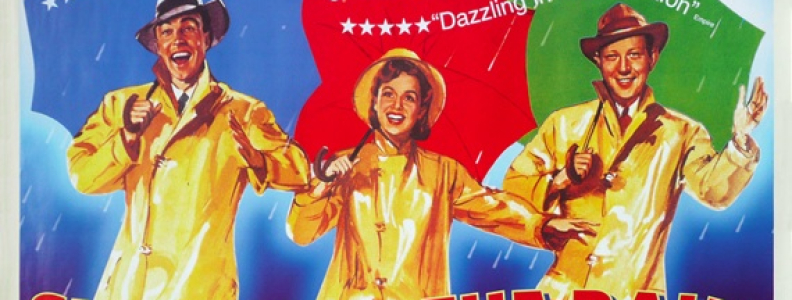
Be that as it may, “Make ‘Em Laugh” is an excellent song and dance number because of the polished performance given by Donald O’Connor. The movie is meant to show us the details behind the painful transition from silent movies to “talkies.” Learning how to synchronize sound and video was hard enough; teaching actors and actresses how to talk and sing into a microphone was even harder. This movie captures both; we learn elocution from the song “Moses Supposes;” we learn about lip synching from a number of songs. What is remarkable is that the movie highlights one practice that continues to this day: dubbing occurs without screen credit.
One historical fact was that, as talkies became the norm in the 1930’s, Hollywood put out a call for Broadway actors and actresses, especially for those performers who had been involved with musicals, revues or vaudeville entertainments. This came at a very good time, because the 1929 crash curtailed new Broadway productions for over a decade.
It is likely that the four minute song sequence was broken into segments, as the camera follows Donald across a number of sound stages. Almost all of the routines came from vaudeville–the pratfalls, the facial contortions, the work with the “dummy,” the acrobatic walks up the walls, the jump through the paper wall. Each routine required specials skills; notice the number of times Donald gets hit with wooden boards or uses his tangled legs to prepare for a pratfall. You will notice that there was no mattress on the floor. He was taking the full brunt of the fall. Notice the timing involved as Donald uses his right hand to flick the dummies’ arm onto his leg; then Donald uses his left hand to shoo the dummies’ arm away. The video interplay and the music increase in tempo throughout the routine. What a pro.