
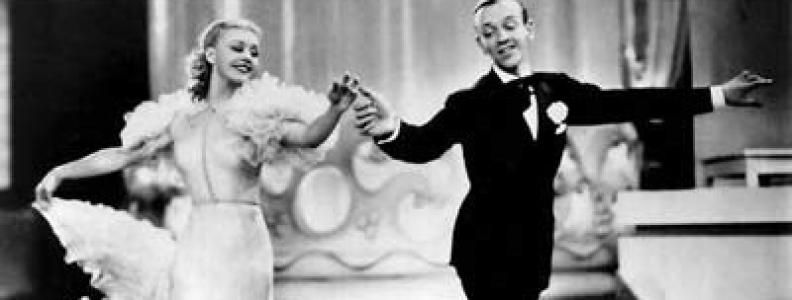
Top Hat Brings Together Fred Astaire and Irving Berlin
Top Hat (1935) was one of a kind; a major Broadway and Tin Pan Alley composer came to Hollywood to write a full score for a new movie production. Irving Berlin was a well-known composer but had not written a full score since 1930. In past productions, composers would submit material that might or might not be used by the studio (Flying Down to Rio); or a Broadway show might be adapted into a movie version (The Gay Divorcee). However, in this case, the creative team would maintain control, just as if they were mounting a Broadway musical. But there was one big difference–the movie would open in many cities and be seen by millions of people. While not greeted well by the critics, Top Hat would go on to be the most successful collaboration (box office receipts) between Fred Astaire and Ginger Rogers. For any number of reasons, we ought to reflect on how this all happened. To do this, we are going to repeat some of what we wrote in one of our recent posts.
There were so many factors involved in making a decision to work on Broadway or in Hollywood. One factor was the medium itself. Movies were made for musicals. Second, many performers, such as Cliff Edwards, Victor Moore, Fred Astaire, Ginger Rogers, George Murphy, Gene Kelly and others, had migrated or were about to migrate west. Third, dancing could be captured by the camera in a way that just was impossible on Broadway. Fourth, after so little success on Broadway, as hard as it is for us to fathom, it is possible that, by 1935, Berlin’s confidence in his own ability was shaken. This is certainly suggested in Wikipedia: “Astaire recalled how this success [Top Hat] helped restore Berlin’s flagging self-confidence. Astaire never met Berlin before this film, although he had danced on stage to some of his tunes as early as 1915. There ensued a lifelong friendship with Berlin contributing to more Astaire films (six in total) than any other composer. Of his experience with Astaire in Top Hat Berlin wrote: ‘He’s a real inspiration for a writer. I’d never have written Top Hat without him. He makes you feel so secure.’ ” According to Ginger Rogers, “the film became the talk of Hollywood as a result of its score.” All five songs used in the movie went on to become major hits.
Again, one of the reasons for the success of the movie was the first rate creative team assembled at RKO. Leaving aside a plot that depended too heavily on mistaken identity, Irving Berlin worked closely with Max Steiner, the music director, and with other former Broadway orchestrators from T.B. Harms, such as Maurice De Packh and Edward Powell. However, Berlin also worked closely with Fred Astaire and Hermes Pan on the lyrics and dance routines. One of the syncopated, tongue-tying lyrics came from the song, “Top Hat, White Tie and Tails.” Astaire was able to break down a complicated rhythm into segments that could be heard and understood by the audience anywhere in the theatre. If you think we are kidding about the “degree of difficulty,” just try to sing the lyric at full speed. It is not as easy as Fred makes it appear on screen.
We are going to include two of the songs from the movie: “Isn’t It a Lovely Day (to be Caught in the Rain)” and “Cheek to Cheek.” While the first song is a flirtation, the second song is very much like “Night and Day;” it is a rhythmic seduction.
Much has been written about the dress that Ginger wore in the number, “Cheek to Cheek,” and some of it bears repetition. Ginger was adamant about wearing a dress she had designed, made of ostrich feathers, even though the feathers shed off the dress at an alarming rate. Soon the sound stage was filled with feathers, making it difficult for the dancers to execute their movements. Fred later recalled in an article on Wikipedia that “It was like a chicken attacked by a coyote, I never saw so many feathers in my life.” According to Hermes Pan, Fred yelled at Ginger, Ginger broke into tears and Ginger’s Mother, Lela, “came charging at him [Astaire] like a mother rhinoceros protecting her young.” The seamstresses worked that night to try to keep the feathers on the dress and not in Fred’s face or on the floor. They were mostly successful, “however, careful examination of the dance on film reveals feathers floating around Astaire and Rogers and lying on the dance floor.”
One bit of humor came later; “Astaire and Pan presented Rogers with a gold feather for her charm bracelet, and serenaded her with a ditty parodying Berlin’s tune: Feathers–I hate feathers/And I hate them so that I can hardly speak/And I never find the happiness I seek/With those chicken feathers dancing/Cheek to Cheek.”
After all is said, the dress works very well on the screen, helping to accentuate the swaying movement of Ginger’s body.