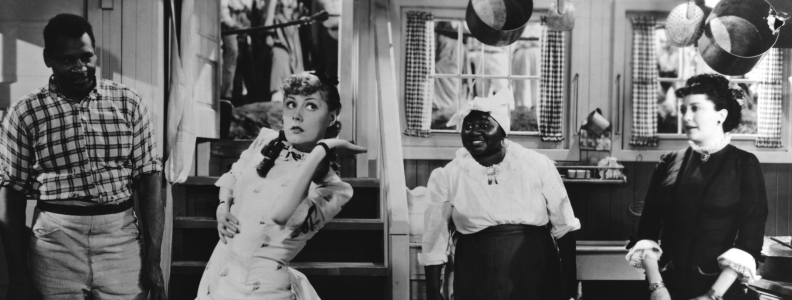
Show Boat (1936)–Part One
One last reminder: after today’s post, we will be posting every other day. So, our next post after today will be July 3d. Now, back to music and theatre and good stuff all around.
We are getting ready to celebrate our Declaration of Independence, so this is probably a good time to take another look at Show Boat. To our ever lasting credit, when we mess up (and we have), we circle back and try all over again. Looking back, it is embarrassing to realize all of the mistakes that we have made. As Nelson Mandela said (and I paraphrase his comments to Miriam Makeba), never forget the “mistakes” others make; always forgive those with whom you want to negotiate a better outcome. The United States had its first chance to extend full and equal rights to all MEN in 1776; after much debate, the signers of the Declaration of Independence kept a fragile coalition united by leaving slavery as it was. During the Constitutional Convention about a decade later, we had our second chance; and for the same reasons, we failed to get it right. We fought a bloody Civil War over whether some states could force other states to abandon slavery; and in the end, we freed black men but kept women enslaved until 1920.
We messed up Reconstruction, forgot Abraham Lincoln’s admonition (“with malice toward none”) and gave birth to Jim Crow.
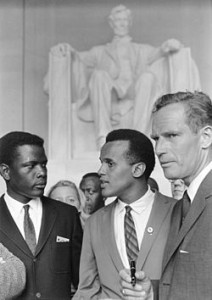
Poitier/Belafonte/Heston 1963 March on Washington
We fought another war for liberation in the 1960’s; and, thanks to Dr. Martin Luther King, Jr. started to bring our citizens together, as one nation under a God of Love. We seem to have forgotten much of what Dr. King taught us, but anytime we want to, we can go back and read his writings (The Essential Writings and Speeches of Martin Luther King, Jr., edited by James M. Washington). In fact, in our humble opinion, we had two great philosophers in the Twentieth Century–Dr. King and Oscar Hammerstein II. Unfortunately, Dr. King did not write musical plays, so we will have to concentrate on Oscar in these posts.
Using today’s jargon, Oscar would probably be called a progressive, especially for his day. He enjoyed taking the side of the underdog, whether it took the form of siding with the Riff’s in Morocco (The Desert Song, 1926), the Indians in Canada (Rose-Marie, 1924), former slaves in the Jim Crow South (Show Boat, 1927) or the Tonkinese in the South Sea Islands (South Pacific, 1949). He championed women’s rights by depicting women as champions. He urged us to oppose tyranny without abandoning the principles that differentiate us from the tyrants we oppose. He was an all-around good philosopher. He has made it relatively easy to study his philosophy by watching or reading his plays.
The musical, Show Boat, opened on Broadway in 1927 and was considered to be a very dangerous show for its time. It dealt with serious issues in a serious manner, similar to the Edna Ferber novel from which it was adapted. It dealt with a modified form of slavery practiced in the Jim Crow South; it dealt with the second class status of women before emancipation in1920. Whereas Edna Ferber’s novel is dark and unforgiving, Oscar’s libretto tried to address the same issues without using the same tone. For us, the key to the musical in 1927 (and all of the movies and stage adaptations produced since then) remains constant: the role of Joe as philosopher. As Oscar said in his book on Lyrics, “Here is a song sung by a character who is a rugged and untutored philosopher. It is a song of resignation with a protest implied.” We would disagree with Oscar’s last characterization; we think it is a song of universal struggle to survive against all of the obstacles life puts in our way. The implication of protest is present anytime we refuse to give in and give up. What is even more interesting is the genesis of the song. It takes the form of a spiritual.
As we said back on February 17, 2017, spirituals at one time were only sung inside a church. However, George L. White, the Treasurer of Fisk University in Nashville, Tennessee, had a financial hole to fill and decided that all people “might be interested in the poignant music of his race.” Therefore, he formed a choral group of 12 students (the “Jubilee Singers”) and started to tour in October 1871. While it took a while for the concerts to catch on, once they did, the result was historic. “At the Gilmore Music Festival in Boston in 1872, an audience of some 20,000 rose to its feet and shouted: ‘Jubilee Forever!’ When the Jubilee Singers returned to Fisk University in 1878, they returned with over $150,000 in cash.”
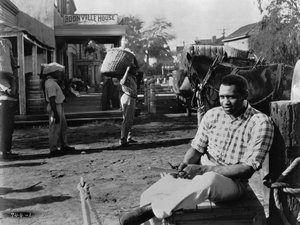
Paul Robeson Show Boat (1936)
For a long period of time, the singing of spirituals was once again confined to the church. Then, in the 1920’s spirituals returned to the concert hall, thanks to Paul Robeson, a 1919 graduation of Rutgers and only the third African American to attend the school. While at Rutgers, he successfully competed in four sports, earned All-American honors, was elected to Phi Beta Kappa and Cap and Skull and was named by his class as valedictorian. Because he was a gifted performer and because his chosen profession (law) was effectively closed to him, he turned to the stage and the concert hall. In 1925 and 1926 he collaborated with a gifted accompanist, Lawrence Brown, and presented critically acclaimed concerts of African-American folk songs and spirituals in New York. It is likely that Jerome Kern and Oscar Hammerstein II attended a concert by Robeson and Brown on November 14, 1926 and were so impressed by Robeson that they decided to create a hybrid of a spiritual and a Broadway song for their new musical, Show Boat. The song they created was “Ol’ Man River.” This song and this show changed the Broadway musical forever, because it started to ask the key questions about why we are alive and what our purpose on earth might be.
Before we get more deeply into the music in Show Boat, we thought we would bring you some commentaries about the show from others in two video clips.