
Easter Parade–Part Two: “Putting the Act Over” in Vaudeville
Before we get back to the storyline of Easter Parade, let’s recall how Irving Berlin and Fred Astaire met. In our post on Top Hat (1935), we focused on the fact that Berlin had been shaken by his lack of success since 1930 and that Astaire gave Berlin the confidence to write a great score for the 1935 movie. They became good friends and worked together on a number of projects, including Follow the Fleet (1936), Carefree (1938), Holiday Inn (1942) and Blue Skies (1946). Astaire was a versatile performer, who could sing, dance, play the piano and the drums. Fred used a piano to help set up a number in Follow the Fleet and used drums to help him set up a dance in Damsel in Distress (1937), here in Easter Parade (1948) and in Daddy Long Legs, the 1955 film with Leslie Caron.
Back to the story. In our last post, we said that Nadine Hale left Don Hewes, her dancing partner; “Don is broken-hearted and goes to a bar to drown his sorrows. He brags that he doesn’t need Nadine; he can turn any dancer into a star. Turning to the girls dancing on the stage, he picks out Hannah Brown (played by Judy Garland), gives her his card and asks her to come to a rehearsal the next day. And that is where we will pick up again on Friday.” Well, believe it or not, it’s Friday; and as we pick up the narrative, Don doesn’t remember much about the night before when Hannah shows up to rehearse. He cannot recall Hannah singing “I Want to Go Back to Michigan,” the first of Berlin’s older tunes that was reused for the movie. It was written in 1914 for an actual vaudevillian, named Belle Baker, to sing at the Palace Theatre in New York.
The fact that this is a real vaudeville number, combined with a wonderful performance by Judy Garland, cements in our minds that Hannah can sing to a crowd. Thus, we know something that Don doesn’t–Hannah can relate to her audience in the bar and really “put over a song.” The phrases “put over a song” or “sell a song” are show business slang used to describe a “real pro,” a successful performer. [One tidbit to watch for: Judy stays next to the trombone player with her arm on his shoulder while he does a solo accompaniment with her. In the comments on Youtube, Andrea Barker informs us that the trombone player was her grandfather, who passed away in 2009.]
Now, on the surface, the fact that Don doesn’t remember the song seems to be an insignificant matter–after all, he was drinking heavily. But it is a very important plot twist. Not remembering how well Hannah can sing and put over the song, Don feels that he has to try to remake Hannah into Nadine. It is an experiment that ends in disaster–Hannah can never remember which leg is her left leg. Hannah could never be a ballroom dancing star like Nadine, but Hannah has a strength. And she demonstrates this to Don as she wows everyone with her rendition of “I Love a Piano.” This is the second of Berlin’s older tunes, written in 1915 and introduced by Harry Fox in Berlin’s Broadway revue, Stop! Look! Listen!
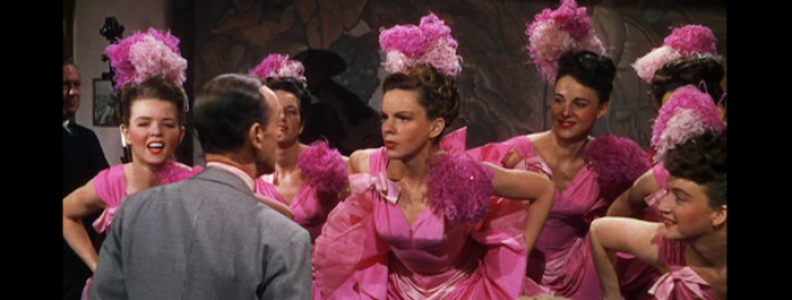
Don was a true blue vaudevillian, and to such a man, the act is what matters. Watching Hannah put over the song, he starts to rethink his approach and starts to create something new and special. In the following medley of Berlin tunes, watch as the names on the “card” change. Hannah’s ability turns the two individuals into a real team–Hannah & Hewes. They keep getting better and start moving up the billing to become headliners.The medley starts with the end of “I Love a Piano” and moves into a parody of the little terms of endearment that newly married couples use, called “Snookey Ookums.” Written in 1913, the song was introduced by Natalie Normandy. One thing that we should note is the way a vaudeville act entered and exited the stage: BIG. It was necessary to enter with a great deal of energy in order to make the audience forget about the last act and focus on the new one. At the end, performers would wrap up the act with a big finish as they exited, in the hopes of getting called back on the stage to take an extra bow. Watch Fred and Judy as they hit their harmonized high notes on the exit.
The next number has been called “Ragtime Violin!” and “The Ragtime Violin.” It was written in 1911, but we don’t know when it was first introduced on the stage. The top-selling recording at the time was by the American Quartet. It was used in the 1938 movie, Alexander’s Ragtime Band, where it was sung by Alice Faye, Dixie Dunbar and Wally Vernon. The medley ends with a great performance of Berlin’s 1912 hit, “When the Midnight Choo-Choo Leaves for Alabam’.” The recording hit number one; and the song was reused in Alexander’s Ragtime Band and the 1954 movie, There’s No Business Like Show Business. The name of the movie is a reference to the homage to Broadway (of the same name) written for Annie Get Your Gun (1946).
One thing that may stay with you (as it has stayed with us over the years) is Fred Astaire’s expression as he looks at Judy. While it is only natural for one character to look fondly at the other character in these kind of situations, we believe that Fred was genuinely fond of Judy and was thoroughly enjoying himself. Judy was only 26 years old when the movie was made; neither of them knew it, but Judy’s career with MGM would end two years later. This is as good a place to pause; we will wrap up our coverage of Easter Parade on Sunday.