Easter Parade: Part Three–Mostly 1948 Irving Berlin
Here is how we left you on Friday at the end of Part Two: “One thing that may stay with you (as it has stayed with us over the years) is Fred Astaire’s expression as he looks at Judy. While it is only natural for one character to look fondly at the other character in these kind of situations, we believe that Fred was genuinely fond of Judy and was thoroughly enjoying himself. Judy was only 26 years old when the movie was made; neither of them knew it, but Judy’s career with MGM would end two years later. This is as good a place to pause; we will wrap up our coverage of Easter Parade on Sunday.” Well, it is Sunday; and, in today’s post, we will cover most of the Berlin songs written in 1948.
But we have found that we cannot finish our study of Easter Parade today, so we are going to provide an Epilogue on Tuesday. In Tuesday’s post, we will combine the remaining Berlin music with music from other composers to contrast and compare dance and ballad concepts. We think this will give you a better understanding of the movement toward modern dance and away from tap in the 1940’s and 50’s, as well as a look back at what we used to refer to as the “torch song.” The term came from a phrase used a lot in the 1920’s and 30’s–“carrying a torch” for someone. We saw an example when Helen Morgan sang “Bill” for us from Show Boat.
But for now, let’s concentrate on four Berlin songs; three represent music and lyrics written in 1948; one comes from a 1917 melody, with new music and lyrics for the Broadway show, As Thousands Cheer (1933). The song started its life as “Smile and Show Your Dimple,” and it was recorded by Sam Ash with that title by Columbia Records. In 1933, the song was retitled and was used in the Act I finale, titled “Rotogravure Section–Easter Parade on Fifth Avenue–1883.” It was introduced by Marilyn Miller (famous on Broadway for her performances in Jerome Kern’s Sally and Sunny) and Clifton Webb, who would go on to record the song with the Leo Reisman Orchestra. The song was used in Alexander’s Ragtime Band, Holiday Inn, and this movie. Here is Judy and Fred singing “Easter Parade.”
Ann Miller was given two solo dances: one that we are not providing (“The Girl on the Magazine Cover”) and one that we are providing, “Shaking the Blues Away.” Miller dances but Richard Beavers sang “The Girl on the Magazine Cover.” It gave Miller a good solo number, but we don’t really think it fit the vaudeville theme of the movie. On the other hand, “Shaking the Blues Away” has a wonderful jazz feel to it and could have been written at the same time “Alexander’s Ragtime Band” was written. Studio publicists claimed that Miller could tap at a rate of 500 taps per minute. Whether this true or not, Ann could tap faster than any other woman in Hollywood and displayed her long legs to great advantage.
Berlin’s third song called for a Fred to do a production number with a large chorus. “Stepping Out with My Baby” certainly could have fit into Berlin’s core compositions in the 1912 era; however, the MGM production orchestrations and choreography are out of touch with the rest of the movie. It really doesn’t matter who made the decision to go large on this song and dance; in our humble opinion, it was a mistake. Less would have definitely been more here; with a simple dance routine, Fred would have looked more like a “hoofer” from the vaudeville era. Ok, it may have been an anachronism for 1912, but today it stands as one of the great MGM production numbers.
It is strange that MGM would have chosen not to use Judy’s solo dance, “Mr. Monotony,” because it was “too sexy” for 1912 but chose to use the very suggestive “Stepping Out with My Baby.” Perhaps there was a double standard back in 1912 that allowed a man to do what a woman could not; however, we are lucky because we have a copy of her performance as an outtake. We will look at this performance in the Epilogue.
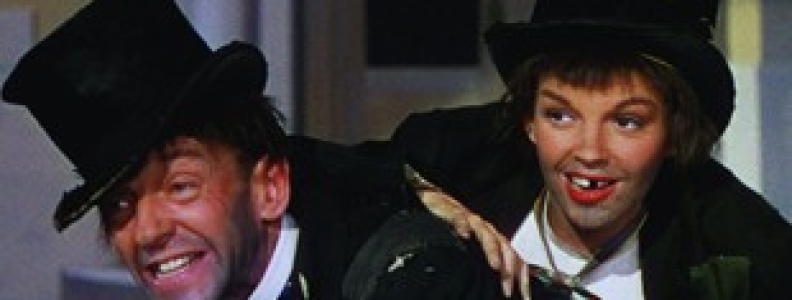
We are going to end this post with one of the best comic routines ever performed in a movie. It represents the essence of the vaudeville era. While Donald O’Connor’s performance in “Make ‘Em Laugh” was a one-man tour de force, the duet by Fred and Judy, dressed as hobos with big floppy shoes, feature some of the most delicious moments on film. First note her late entrance, as Fred has to shuffle back to bring her onstage; then watch for the twinkle in her eye as she looks over at him. Was there a mishap that caused her to miss the entrance; or was it planned? We don’t know the answers to these questions. We just know that it is 100% wonderful.