MGM and Mario Lanza Part Ways–The Student Prince
Ann Blyth co-starred with Mario Lanza in The Great Caruso, a blockbuster hit for MGM in 1951. Looking for another project for them to star in, MGM decided to produce a modern version of Sigmund Romberg’s great 1924 hit, The Student Prince; but when it was released in 1954, it did not star Mario Lanza as Prince Karl.
Mario recorded the songs first but was met with criticism from the director, Curtis Bernhardt. Mario ignored the criticism and sang as he always did. Both men went to Louis B. Mayer to have the other man replaced. In the end, both men were replaced. Edmund Purdom, a British actor was brought in to play Prince Karl (and lip sync the songs sung by Lanza), and Richard Thorpe replaced Curtis Bernhardt.
In the fictional account, Prince Karl goes to Heidelberg to pursue his studies but hides his identity from the rest of the students. He has rooms at an inn, and the inn-keeper’s daughter is the beautiful Kathie. They fall in love and try to run away to elope. But Karl’s grandfather dies, and Karl must assume his responsibilities as King. Kathie is a commoner and cannot be his wife. In the end, honor and duty force Karl to enter into a loveless but politically arranged marriage and abandon Kathie.
We have seen this same story in The Prisoner of Zenda, as the British look-alike must quietly leave the country and his beloved Princess Flavia, in order to preserve the throne for the real king Rudolf. If you haven’t seen this movie before, please watch the 1937 version with Ronald Coleman and Madeleine Carroll.
When we see movies or shows like this, we always wonder if love could have found a way. If there are any doubts, read up on the real life story of King Edward VIII, who abdicated the throne of the United Kingdom in 1936 in order to marry Wallis Simpson, an American commoner. That story did not end well for anyone. Hard facts dictate affairs of state.
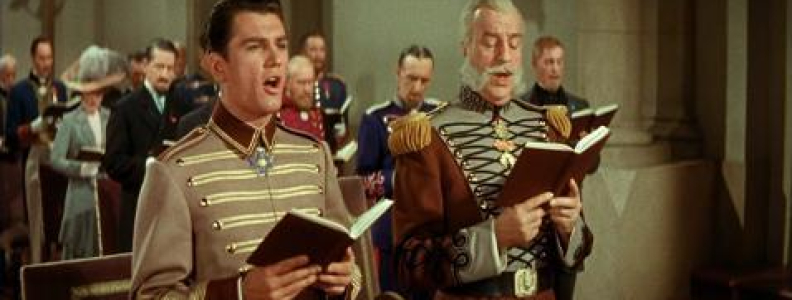
That said, The Student Prince provides us with a few moments of fantasy, gives us the brief hope that love will prevail–all while listening to one of the greatest scores ever written for the Broadway stage. Thirty years after the operetta opened on Broadway, the movie version was released. In this first song, Karl meets his fellow students and joins in singing the school song.
As Karl learns to be just “one of many” students at the University, he also learns that he must endure certain rites of passage, including downing a stein of ale in one drink. If you have to do it, you might as well drink to the music of “Drink, Drink, Drink.”
In the Broadway show, a trio of students (including Karl) sing about love and the moon (“Overhead the Moon Is Beaming” or “Serenade”); and later Kathie and Karl declare their love in “Deep in My Heart, Dear.” However, in the movie, both songs are used as love songs. Let us start with “Serenade.” With soaring notes of this song ringing in our ears, we have hope that all will end well.
Now, let’s turn our attention to “Deep in My Heart, Dear.” In this case, the deep overtones of this song reminds us of a bell tolling the hours before we must depart. The song insists that our day in the sun is coming to an end, no matter how much we might struggle against the inevitable.
In the next post, we will try to complete our look at the work of Mario Lanza.