
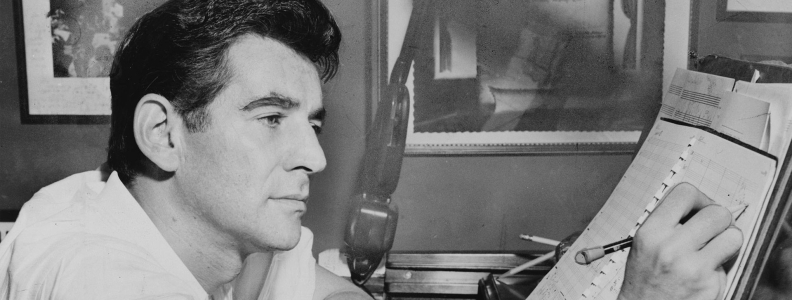
The Incredible Career of Leonard Bernstein
It is hard to define Leonard Bernstein; he was a famous pianist, conductor, composer, author and teacher. He was so good at so many things; how can we put a box around any part of him and say–this is Leonard Bernstein?
The truth is–we can’t. However, if we were forced to choose his single greatest legacy, we would have to say it was his gift of explanation. Starting in 1954, a decade after his successful Broadway debut with On the Town (1944), he set a standard of excellence in explaining musical composition, orchestration and performance that may never be equaled. It started in 1954 with a 33 minute television special called Omnibus, hosted by the legendary Alistair Cooke. Using members of the old NBC Symphony Orchestra (now named Orchestra of the Air), Bernstein set out to explain the First Movement of Beethoven’s majestic 5th Symphony.
We all know the first four notes that open the first movement of Beethoven’s 5th Symphony—three G’s thunder out, followed by a lower E flat. Bernstein acknowledges these notes but reminds us that they are just a “springboard for the rest of the symphonic continuity.” In about 33 minutes he gave us a lifetime of musical education. It is a gift that just keeps giving; the words never grow stale or trite, no matter how many times we view it.
Bernstein defined form for us “as taking us on a varied and complicated journey and to do that the composer has to have a corresponding inner road map; he has to know what the next destination is going to be. In other word, he has to know what the next note has to be. He must convey to us a sense of rightness—the only note that can possibly happen at that instant.” (Emphasis added)
When we think about Ludwig von Beethoven, we think about a man tortured and tormented by the search for perfection. Yet, Beethoven produced some of the greatest music ever heard. The theme of the first movement of the 5th Symphony may be elegantly simple; however, it was anything but obvious. Bernstein tells us that Beethoven created fourteen versions over a period of eight years to find the theme. Then, Bernstein guides us through any number of rejected passages to convince us of the difficulty of the search. “He altered passages as many as twenty times.”
With regard to one rejected sketch in the coda, Bernstein explains that it is interesting because it has a little pain and mystery to it. However, in order to use it one would have to “come down from a high point to a low point so that we could build back up again to a still higher point. This is not unacceptable dramatic structure; it happens all the time in plays and music; but this isn’t the moment for it. Beethoven wants to maintain this high level to the bitter end. And this he does do, a very difficult thing to do. And he does it with astonishing brilliance. It is this genius of his, going forward, always forward that guides his hand in every case when he is struggling with his material.”
His lecture had intensity, depth of content and incredible insight into the art of composition and orchestration. It had to, because I saw it in 1954 on a small television set; and, sixty-three years later, it is still indelibly etched on my mind. He was and is unique in that regard.
He went on to write the score for the movie, On the Waterfront, in 1954, the opera, Candide, in 1956, the musicals Wonderful Town in 1953 and West Side Story in 1957 and to become the music director at the New York Philharmonic Orchestra in 1958. He also started an educational outreach program for children in 1958, called the Young People’s Concerts. In all, there were fifty-three televised programs that were broadcast over the years. Today, those concerts could form the basis of an advanced degree in music. In 1978 he delivered a series of six televised lectures on music, as Professor of Poetry at Harvard, called The Unanswered Question. In this incredible body of work, he taught from the stage, using the piano, his voice and the orchestra to explain musical concepts. He never condescended to his audience, even though he had to define a number of terms for them. He would preface an explanation by saying something like, “You probably already know…”
There have been other composers who wrote more shows for Broadway and more scores for movies. There have been other conductors from Toscanini to Solti who have left their mark on recording history. There have been other great pianists. But there has never been (and we doubt there ever will be) any teacher like him.
We are going to end this initial discussion of Bernstein with a song from his 1944 Broadway show and his 1949 movie, On the Town. Because of the cast in the movie (Gene Kelly, Frank Sinatra and Jules Munshin), we are going to include that first.
On the other hand, we are seeing renewed interest in the entire score and will provide you with a 2015 recording of the same song in Part Two.