
Back to George M. Cohan and Forty-Five Minutes from Broadway
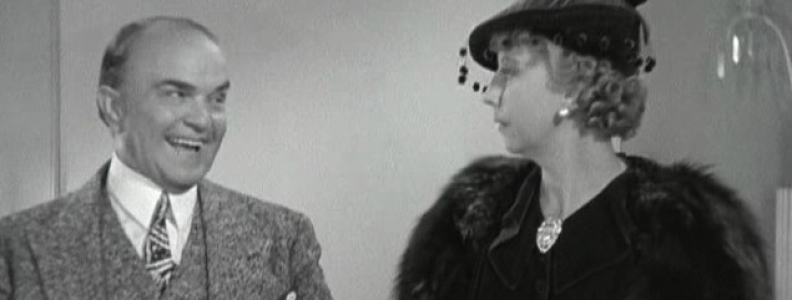
The featured image is from the 1936 RKO Pictures movie, Swing Time, and shows Victor Moore and Helen Broderick as the comic sidekicks to Fred Astaire and Ginger Rogers in this splendid Jerome Kern musical. Thirty years earlier, with a full head of hair, Moore had been chosen to be the romantic lead in George M. Cohan’s second great musical hit show. As usual, we are going to mix in a little bit of Broadway history, stories of the stars and some great music.
First, let’s set the record straight; Forty-Five Minutes from Broadway has a plot that is not anything like the excerpt seen in the movie, Yankee Doodle Dandy. In the 1906 show, the action takes place in New Rochelle and involves the affairs of Old Man Castleton, a miserly millionaire, now deceased. The rumor around town is that, in his will, Castleton left everything to his long faithful servant, Mary Jane Jenkins. The people of the town are gathered at the Castleton home, but no will can be found. If the old man died without a will, the estate will go to his nephew, Tom Bennett.
In the opening number, “Gentlemen of the Press,” Tom announces that he is waiting for his fiancee, actress Flora Dora Dean, to arrive; when she does, they will be married. Tom goes on to explain that “I Want to Be a Popular Millionaire.” Accompanying Tom, is his secretary, Kid Burns, whose aggressive personality and wise-guy comments endear him to no one in town.
As we get into the third act, Mary discovers that Burns’ mother was also named Mary, leading her to sing “Mary’s a Grand Old Name.” Burns starts to warm up to Mary and wants to take her out for a night on the town, but has the sneaking suspicion that a night out in New Rochelle might not be as exciting as a night out in Manhattan; he sings “Forty-Five Minutes from Broadway.”
Kid Burns has found the will in one of Castleton’s old suits and shows it to Mary. Mary is wary of men who might love her for her money and not for herself; when Burns swears that he will marry her without any of Castleton’s money, she tears up the will. As Mary and Kid take the train to Manhattan, the townspeople and Mary say goodbye to one another, in “So Long, Mary.”
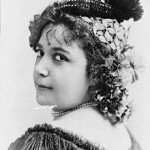 Fay Templeton was cast as Mary and was a hit with audiences. She was born in Little Rock, Arkansas in 1865, just after the end of the Civil War. She was 41 at the time she played Mary on Broadway. She had had an undistinguished career, bouncing around from operettas to Weber and Fields comedies. But when she was working with Weber and Fields as a member of a stock company, she won over audiences with her “comedic versatility, long dark hair, sultry smile and throaty-voiced singing.” She was buxom by nature; but by 1900, Wikipedia states that “she was now buxom even by Gay Nineties standards.” By 1913, she had retired from the stage, although she did an occasional performance in 1925 and 1926. However, when her husband died in 1932, she was force to return to the stage. Her last appearance was in 1933, when she played Aunt Minnie in Kern’s musical, Roberta, and it was probably her best role in a Broadway show (she sang the hauntingly beautiful ballad, “Yesterdays”); but by then she was terribly overweight (reportedly over 250 pounds) and had to play the part mostly from a chair. She passed away in 1939.
Victor Moore, on the other hand, was born in 1876 and first appeared on Broadway in Rosemary in 1896 when he was 20. Ten years later, at the age of 30, he made a big impression as Kid Burns in Forty-Five Minutes from Broadway, before returning in The Talk of New York, Cohan’s sequel in 1907. He went to Hollywood for ten years and then returned to Broadway. He 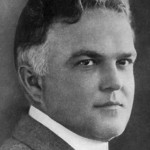 starred in George Gershwin’s Oh, Kay! in 1926 and in Ray Henderson’s Hold Everything! in 1928. Starting in 1930, he alternated between Broadway and Hollywood. He then teamed up with William Gaxton in Gershwin’s twin shows, Of Thee I Sing in 1931 and Let ‘Em Eat Cake in 1933; in Cole Porter’s Anything Goes in 1934 and Irving Berlin’s Louisiana Purchase in 1940.
Between 1915 and 1925, he appeared in 34 silent films; then he appeared in 30 talking pictures from 1930 to 1955, his last appearance as the plumber in The Seven Year Itch (yes, the movie with Marilyn Monroe in the white dress standing over the subway grating).
We are going to complete our look at this wonderful Cohan show in our next post on Thursday; however, before we end this post, we want to provide you with an audio recording from Victor Talking Machines in 1906. The orchestra plays music from the show and is conducted by Walter B. Rogers. For some reason that I cannot understand, it excludes “So Long, Mary” and includes one song that I cannot find as ever having been in the show, “Stand Up and Fight Like Hell.”