
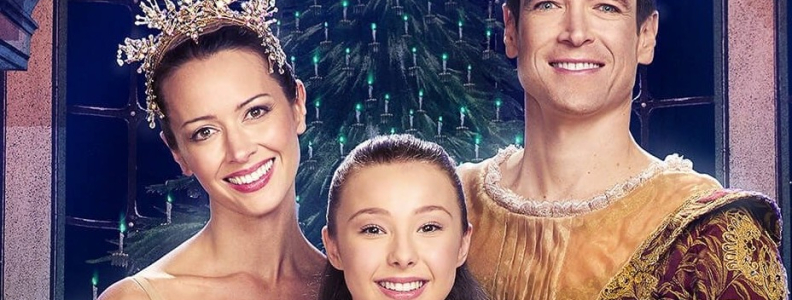
A Temporary Nutcracker Diversion
As you know from past experience, we sometimes see something that is so powerful (as art or as a teaching experience) that we feel impelled to break away from our planned “programming.” Something just occurred that moves us to make a left-hand excursion back into the world of dance. You were very responsive to our posts on dance, but you may not know the names of Sasha Radetsky or Sophia Lucia. We hope you enjoy their performances as we highlight the last 22 minutes or so of a Hallmark Movie, aptly named A Nutcracker Christmas (2016). While the plot is fairly predictable (two sisters, Beth and her younger sister Lily, grow up in Marietta GA; Lily makes it to New York as a ballerina and is about to dance the role of the Sugar Plum Fairy when Beth dies and Lily rushes home to take care of Beth’s daughter Sadie; 8 years later, Sadie is invited to dance the role of Clara in Philadelphia, bringing Lily back into contact with her old flame, Mark, who is now directing the Philadelphia ballet company; injuries force Lily and Mark to dance their original roles from 8 years earlier), the dance sequences are both fun and enlightening. This is not a full length ballet; but it uses the Tchaikovsky music and some interesting choreography to get the point across. Right at the outset, we need to acknowledge the two main competing approaches: the original Marius Petipa libretto and the Alexander Gorsky staging.
In the original Petipa choreography, we have two dancing couples: the young Clara and her Nutcracker-Prince, who come from the parlor of her home; and the Sugar Plum Fairy and Prince Coqueluche, who we see in the fantasy world. In terms of preference, we are drawn to the Mikhail Baryshnikov/Gorsky version with Gelsey Kirkland, his partner at American Ballet Theatre from 1974 to 1978. According to Wikipedia, CBS brought the ABT production of The Nutcracker to television in December 1977; it was subsequently moved to PBS and shown every Christmas season for many years. In this version, the Nutcracker is turned into a handsome prince and he and Clara ride to his magical kingdom in a sleigh. They watch the festivities, only to return to Clara’s home as dawn is breaking. In a heartbreaking farewell, Drosselmeyer separates the two (who are now in love) as they dance the Grand pas de deux.
In the Hallmark movie, we are treated to the Petipa version, where the Sugar Plum Fairy and her cavalier dance the Grand pas de deux together (to the same music). If you start at minute 59, you get to see the rehearsal/walk through of the Sugar Plum Fairy role (pas de deux), especially as the two dancers map out the diagonal (1:01). The actual performance (starting at 1:10) features many of the dancers from the National Ballet of Canada (filmed in Canada), along with Sophia Lucia who plays Clara. Sophia has been called a “Dance Prodigy;” she also holds the Guinness World Record of 55 Consecutive Pirouettes. She was born September 7, 2002, so she was 14 when she played the part of Clara in the movie. She is not currently a member of a dance company but works professionally as both a dancer and an actress.
As the evening’s performance in the movie unfolds, we see the transformation of the Nutcracker toy into the Nutcracker-Prince by Drosselmeyer (1:11), the war with the Mouse King (1:12), the pas de deux between Clara and her Nutcracker-Prince (note the use of the diagonal in the dance around 1:13) and then the exquisite work of the corps as they provide the Snowflakes, especially in the overhead shot (1:14). We see the “rocky” rehearsal of the “Big Lift” between Lily and Mark (1:16), which is executed with precision in the subsequent performance (note in the final version how he bends lower and takes one step back in order to execute the lift properly).
In the second act, we get to see the Spanish dancers (three female soloists at 1:17) and then the Russian dancers (three male soloists). Finally, at 1:18 we see the introduction of the Sugar Plum Fairy and then the pas de deux between the Sugar Plum Fairy (played by Amy Acker) and her cavalier (played by Sascha Radetsky). The music (that we referred to earlier) starts just before 1:19, and the diagonal comes just after the 1:19 mark. The two lifts come shortly thereafter, and the ballet is completed at the 1:21 mark, as the audience applauds the performance.
Unlike most dance sequences, we see close-ups of Amy and Sascha in the pas de deux. Amy is able to convince us that she was a dancer; she danced as a child until an illness forced her to abandon ballet. Sascha was a soloist at ABT until he retired in 2014 to concentrate on acting. He is still teaching ballet, running the ABT/NYU Master’s in Ballet Pedagogy Program.
We think you will learn a lot about ballet and enjoy yourselves at the same time.