
America Joins the Second Era–The Birth of American Operettas
The first American composer who tried his hand at writing an operetta was Ludwig Englander, an Austrian-born composer of more than 30 musicals. According to Norton’s catalogue of shows, Englander’s first project on Broadway was Der Prinz Gemail in 1883.
Next came Reginald DeKoven (1859-1920), who wrote 20 light operas for the Broadway stage, the first being The Begum in 1887. His next show in 1891 was also his most famous show–Robin Hood. The show had one outstanding song, one that is still sung today–“Oh, Promise Me.” One can almost sense the loneliness of Sherwood Forrest and the promises that can only come from deep in our soul. The lyric was not written by Harry B. Smith but by Clement Scott. Here is the great tenor, Jan Peerce, singing this song with accompanying chorus.
Another man, born in the same year of 1859, was Victor Herbert. He was born in Dublin and lost his father around the age of two; he was raised in Stuttgart by his Mother and step-father from the age of seven until he emigrated, with his wife Theresa, to the United States in 1886. An expert cellist and member of the Metropolitan Opera Orchestra, he also learned to compose instrumental music, German lieder and operettas. In fact, he left a lasting legacy of cello and piano music, two cello concertos, over 100 songs and 46 operetta scores. Not all of his operettas were of equal quality, but the ones that stand out are priceless. His first show was Prince Ananais in 1894; however his first hit show was his sixth show in 1898, The Fortune Teller; and we have played the czardas from that show for you previously.
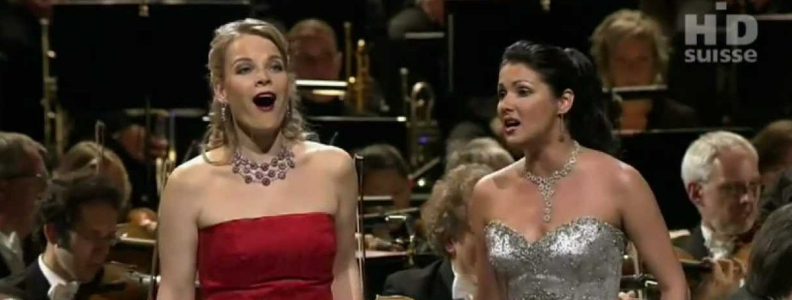
His tenth show, Babes in Toyland, suddenly showed, in 1903, that the promise hinted at in the first nine shows was real. The songs in Babes in Toyland, from lullabies to parodies, are still enchanting. The lullaby, “Go to Sleep,” is reminiscent of the Barcarolle from Offenbach’s Les Contes d’Hoffmann, known as “Belle Nuit, O nuit d’amour.” Here is the most compelling recording we have found of “Belle Nuit;” we have included it previously but its quality makes it irresistible. The orchestra starts in a slow and melancholy mood, then is joined by the mezzo-soprano, Elina Garanca, on the left of the screen. The soprano, Anna Netrebko, joins Elina; and the duet is both gentle and nuanced, with many crescendos and decrescendos to keep the two women in sync. About half way through the aria, the chorus, standing in the balcony, gently joins the duet. It is so beautiful; we never want it to end.
While not the same, because the Tree Spirits carry the melodic line in “Go to Sleep,” we have the exquisite counterpoint of Jane and Alan to balance the chorus. The compositions are quite different, and yet the impact is the same–we are entranced by the gentle waves of music.
Herbert continued with a string of hits–Mlle. Modiste in 1905, The Red Mill in 1906, Rose of Algeria in 1909, Naughty Marietta in 1910, Sweethearts in 1913, Princess Pat in 1915 and Eileen in 1917.
In 1911, Herbert was the only successful composer of operettas on Broadway; then Rudolf Friml wrote the score for The Firefly in 1912 and elbowed his way into the circle of operetta writers. He would go on to write lovely scores for Rose-Marie in 1924 and The Vagabond King in 1925.
Sigmund Romberg would join Friml as the next great composer of operettas with The Student Prince in 1924, The Desert Song in 1926 and The New Moon in 1928.
But 1928 marked the end of the Era of Operetta, as once again the well dried up. Just as the Era of Opera ended in 1910, the Era of Operetta ended eighteen years later.
Looking at the other founding ASACAP members who were composers on Broadway (from the previous post), we see that Ray Hubbell was born in 1879 and would live until 1954; but while Hubbell was a prolific composer on Broadway, his main body of work ended in the 1920’s and only “Poor Butterfly” from the 1916 edition of The Big Show would become part of the American Songbook.
Here is the Benny Goodman Sextet playing “Poor Butterfly.”
Lou Hirsch was another prolific composer on Broadway, but his last show was produced in 1924; and we have no lasting musical legacy from his many shows.
Gustave Kerker was approximately the same age as Herbert (born two years earlier and died one year earlier) and was a prolific composer for Broadway but most of his work was done prior to the founding of ASCAP and is not memorable.
Silvio Hein was a minor composer on Broadway.
According to Wikipedia, in addition to its nine founders, ASCAP’s earliest members included composers Irving Berlin, George M. Cohan, Rudolf Friml, Jerome Kern, John Philip Sousa, Alfred Baldwin Sloane, James Weldon Johnson, Robert Hood Bowers and Harry Tierney.
No memorable scores were produced by Sousa, Sloane, Johnson, Bowers or Tierney.
On the other hand, George M. Cohan would have his first major success in 1904 with Little Johnny Jones; and Berlin would have his first major international hit in 1911 (“Alexander’s Ragtime Band”). By 1914 Berlin would have his first major show on Broadway, Watch Your Step.
Of these early members, Kern stands out as one of the leaders of the new Broadway sound. In 1914, Kern was 29 years old, having been supplying songs for Broadway shows since 1904. Kern’s first full score came in 1912 with The Red Petticoat and was followed in 1914 with The Girl from Utah with its evergreen song, “They Didn’t Believe Me.” His Princess Theatre shows were only a few years away. His career was still in front of him.
When we look at major trends, we need to make the connection between Victor Herbert and Jerome Kern; and then between Kern and Richard Rodgers and George Gershwin. These connections are based on the statements made by the composers themselves, as they explained how the music of their predecessors influenced them.
At the same time, it is important to realize that musical progression is not a straight line but more a series of concentric dots in musical notation on old scores and sheet music. While this is an oversimplification, we believe that we are essentially correct when we say that there were two great influences on Broadway: classical European training in composition and African-American rhythms.
On the one hand, Herbert, Kern, Rodgers and Gershwin were all aware of and able to use European theory in their work. You can hear it in their vocal music and in their instrumental music.
However, they all were deeply influenced by African-American rhythms. More than any other composer, Gershwin was able to marry European theory with African-American jazz rhythms, especially in his symphonic works (covered last summer). While Gershwin may have been the most obvious melting pot of old school form and new school sound, Herbert, Kern, Berlin and Rodgers all were affected by both schools. The best example for Herbert is his Pan-Americana Morceau characteristique in 1901, Kern’s score for the 1936 movie Swing Time, Berlin’s popular songs and Rodger’s ballet, Slaughter on Tenth Avenue from his 1936 Broadway show, On Your Toes.
We are about ready to show how the American Era of Operetta and American popular music grew up side-by-side, until popular music took over on Broadway.