Annie Get Your Gun–Part One
We know from our previous post that Dorothy Fields wanted to do this project; she was the driving force behind the musical about Annie Oakley. What we don’t know is why she was so enamored with the project.
Her father, Lew Fields, was a major Broadway producer, but he refused to let her act or work in the theatre. She persevered on her own and made major contributions (lyrics) to the music of Jimmy McHugh and Jerome Kern. However, like her brothers, Joseph and Herb, she also started to write librettos (three for Cole Porter).
We can guess that Dorothy wanted to prove to her father (and others like him that) women could do anything a man could do in the theatre. Dorothy must have read about Annie Oakley and had to be impressed with Annie Oakley’s rise from poverty; impressed that Annie could provide for her family at 7 or 8 years old. Dorothy also had to be impressed with Annie’s softer side; Annie met Frank and the two fell in love. Frank was dedicated to Annie and not just because she was talented. There must have been something about her character that led him to support her career over his.
Thus, we speculate that Dorothy felt two powerful emotions when she contemplated the life of Annie Oakley: an admiration for the great professional sharpshooter and an affection for the woman. When Irving Berlin took over as composer and lyricist, he had read the first act of Dorothy and Herb Fields’ libretto—twice. Berlin admitted that his songs and his lyrics were based upon the words used in the libretto. Let’s recall Berlin’s recollection once again: “I read the first act again and over the weekend wrote two songs, ‘They Say It’s Wonderful’ and ‘Doin’ What Comes Natur’lly.’ ”
Dorothy first won over Richard Rodgers and Oscar Hammerstein II; then Irving Berlin. Now, it was time to take on the very strong personality of Ethel Merman. Ethel was known as a “belter,” someone who stayed in the lower register of the voice and gave tremendous volume to the notes she sang. In fact, one could think of her as the female version of “Johnny One-Note.” My guess is that Berlin knew that Merman needed to be both strong and feminine; that there had to be pride and vulnerability running side by side.
The first song that Berlin wrote was a conditional love song; neither Annie nor Frank are willing yet to say that they are talking about themselves. Yet, they are imagining what it would be like if they were in love. Later, Merman admitted that “Irving Berlin made a lady out of me.” Nor was this fact lost on the critics; Robert Garland of the New York Journal-American wrote that what he saw on the stage was “the erstwhile song-and-dance show lady who is [now] an actress, a comedienne and a singer rolled quite magically into one… a new and exciting Ethel Merman. She was no longer Miss Merman playing Ethel Merman. She was Miss Merman acting like—and being—Annie Oakley, a real and historical human being.”
We think that Dorothy’s original vision affected every one of the members of the creative team responsible for making the musical a success.
Of course, the 1946 libretto is not the story of Annie Oakley and Frank Butler. The historical account was fairly routine compared with the ups and downs invented by Dorothy and Herb Fields.
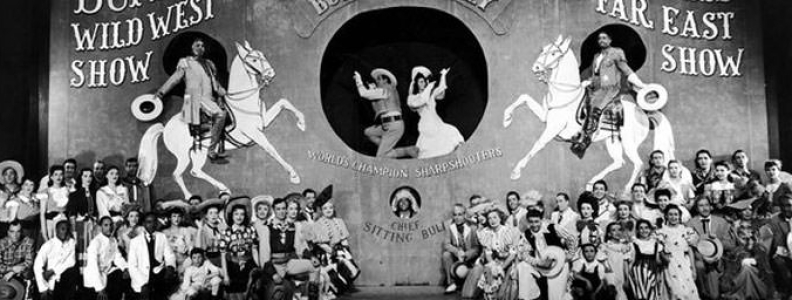
Coming back to the 1946 musical, the first scene in Act One starts with Annie staying at a summer hotel, called The Wilson House, on the outskirts of Cincinnati. She is already the star of Buffalo Bill’s Wild West Show and is proud of that fact. We know about the show from the first song, “Colonel Buffalo Bill.” We also are introduced to Frank Butler, a sharpshooting star with the Pawnee Bill Show, a rival to Buffalo Bill’s outfit. He is also staying at the same hotel and warns the ladies that he is known for loving and leaving ladies all across the country in “I’m a Bad, Bad Man.”
At the same time, Annie admits to the hotel owner, Foster Wilson, that she is not an educated woman. Nevertheless, she does okay and is able to care for herself and her four siblings. She reveals her philosophy in the song, “Doin’ What Comes Natur’lly,” with the help of Wilson and her four siblings.
Here is an audio clip from the 1946 Ethel Merman Decca recording.
In addition, we have a clip from the 1950 movie, staring Betty Hutton. As you watch the clip, remember that the movie plot was quite different and that Annie was still hunting game for the hotel in this version.
Finally, we have the Judy Garland outtake from an earlier version of the movie. To our mind, Judy was miscast here; nevertheless, listen to the artistry with which she delivers the song.
At the hotel, Annie meets and is immediately attracted to Frank Butler, played by Ray Middleton; however, there are some impediments to the affair. Not only does Frank work for the Pawnee Bill Show, he has very definite ideas of the woman that he will marry. She “will wear satins and laces and smell of cologne.” Irving Berlin inserted the song, “The Girl That I Marry,” in order to set up Annie’s lament. Berlin told an interviewer for the New York Herald Tribune in 1954 that “I needed something for Frank Butler to sing to Annie Oakley telling her the kind of woman he wanted.” In the interview, Berlin explained that “The Girl That I Marry” was meant to be an introduction to another song, “You Can’t Get a Man with a Gun.”
Here is Ray Middleton, singing “The Girl That I Marry” in an audio clip from the 1946 Decca recording.
We also have the movie version with Howard Keel and Betty Hutton.
Frank’s ode to womanhood results in Annie’s lament; she admits that her skill with a gun is not the kind of skill needed to win a man like Frank, as she sings “You Can’t Get a Man with a Gun.”
First, we present an audio clip from Ethel Merman’s 1946 Decca recording.
Next, we present a clip from the movie, with Betty Hutton.
Before the day is over, however, Buffalo Bill, his manager, Charlie Davenport, Frank and Annie all agree on one thing that they have in common–they love playing to an audience in a live show (“There’s No Business Like Show Business”). No one realized at the time that this song would become an anthem to show business; but it did.
The first rendition is an audio clip from the 1946 Decca recording, with William O’Neal as Buffalo Bill, Marty May as Charlie Davenport, Ray Middleton as Frank and Ethel Merman as Annie.
The second clip is from the movie, with Louis Calhern as Buffalo Bill, Keenan Wynn as the manager, Howard Keel as Frank and Betty Hutton as Annie.
In Part Two, we will explore the second half of Act One of Annie Get Your Gun.