Babes on Broadway–Connection to Minstrel Music
Like Einstein Block Time, music keeps folding back into itself. The more we learn, the further we go, the more the past creeps back in, demanding that we listen. The past keeps saying, “Don’t forget about me. I am an important part of your present and future.” If we want to understand the music of Broadway, Tin Pan Alley and Hollywood, we need to understand the music of African-American slaves and how that music was developed by black and white musicians in the fifty years that followed Emancipation. We need to hear work songs; they developed into the blues. We need to hear Minstrel music; out of this music came ragtime piano music. We need to hear Gospel and spirituals; out of this music came “Ol’ Man River,” “You’ll Never Walk Alone” and “Climb Every Mountain.” When composers want to write inspirational music, they must return to its source.
Babes on Broadway was released in January 1942, shortly after Pearl Harbor was bombed by the Japanese (December 7, 1941). The movie tried to show that Broadway honored vaudeville, just as vaudeville honored Minstrel Shows. However, this is no longer 1942; and if we want to enjoy and learn from these old movies, we need to understand why Minstrel Shows and vaudeville acts were part of the Broadway fare. Let’s take a quick look at the stylized form of entertainment called a Minstrel Show. After the Civil War ended in 1865, formalized Minstrel Shows, utilizing three comic characters (Mr. Interlocutor, Mr. Tambo and Mr. Bones), were produced, introducing American audiences to syncopated music and dance.
We should not glance over the minstrel show too quickly, or we will lose an important thread, the thread of syncopation. Use of the banjo by slaves introduced into the minds and tapping feet of every audience the infectious rhythms of syncopation. Along these lines, it has been noted that: “Thomas Jefferson was probably the first white man to make note of the musical nature of his slaves. ‘In music, they are more generally gifted than the whites,’ he wrote in the Notes on Virginia, ‘with accurate ears for tune and time….’ They also imported from Africa various kinds of African drums, and an African instrument that came to be known in the Colonies as a ‘banjo.’ Finally, they introduced into the music of the Colonies stylistic accents, variety of rhythm, and the ‘call and answer’ format of the chants.”
One of the major composers of Minstrel tunes was Stephen Foster. In 1847, he wrote “Louisiana Belle.” Foster’s “Oh! Susanna” (also in 1847) became the theme song sung by Forty-Niners on their way to California to pan for gold. Then came “Old Uncle Ned” (1848), “Camptown Races” (1850) and “The Old Folks at Home” (1851). When he wrote “The Old Folks at Home,” Foster was down on his luck; and, in order to survive, he sold the rights to the song to The Christy Minstrels for $15. In the midst of slavery, a cruel practice that seemed would last forever, we can sense profound suffering creeping into Foster’s music, which seems to parallel his own unfortunate experiences. What other voice than Paul Robeson’s can best deliver the pathos of this music.
Foster’s “Ring De Banjo” (1851) is a good example of harmony centered around the syncopated sound of banjo music. Foster published “Massa’s in the Cold, Cold Ground” in 1852 and “My Old Kentucky Home” in 1853. Foster’s last great “Negro” song was “Old Black Joe” which was also known as “Gone Are the Days.” It was published in 1860 and represents a final transformation in the words and music Foster used, especially as sung by Robeson in a Gospel style. Listening to Robeson’s voice, we can hear the weary acceptance of loss and pain as the only rewards one can expect in this mortal existence. Yet, listen more attentively the second time you play it, and you will sense the unbowed head, the spirit that was never touched by mortal strife; the dignity of a man whose soul is still intact. Can you hear the “gentle voices calling?”
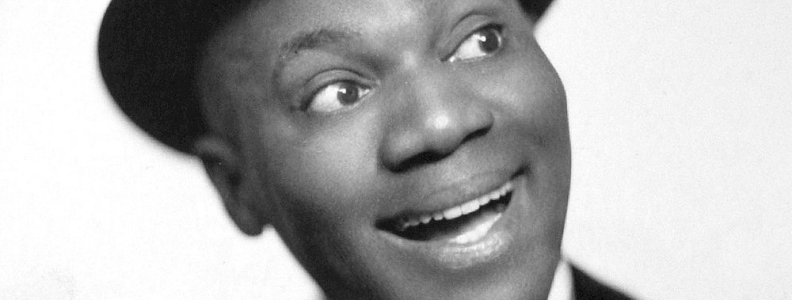
We think this music expresses how Foster felt when he wrote the song. Between the two men, composer and singer, we begin to understand what the lack of freedom felt like in 1860. Yet, even with the death of slavery, the music did not die. The music lives, perhaps in part, to remind us of the mistakes of the past, as a gentle reminder of what not to do again. And at the same time, the music also reminds us of the irrepressible spirit of a grand group of Americans. There is no better way of seeing the transformation from 1860 to 1934 than through the artistry of one of America’s greatest dancers, Bill “Bojangles” Robinson, for many years the unofficial Mayor of Harlem. (For more information, please see the biography of Bill Robinson, Mr. Bojangles, written by Jim Haskins and N.R. Mitgang, William Morrow, 1988.)
We have highlighted some of Mr. Robinson’s dancing in earlier posts (including the stair dance with Shirley Temple in 1934’s The Little Colonel); now we would like to focus on his dance routine for a Minstrel Show that is captured in the movie, King for a Day (1934). The music is a medley of tunes, starting with Stephen Foster’s “The Old Folks at Home” and then moving into Foster’s “Gone Are the Days.” We can recognize “Smiles” written in 1917 by Lee S. Roberts (music) and J. Will Callahan (lyrics) and introduced in The Passing Show of 1918 (Schubert revue meant to compete with Ziegfeld Follies on Broadway; in a bit of trivia, Fred and Adele Astaire sang and danced in The Passing Show of 1918). Starting with Robinson’s lyrics “In the Mornin'” there is some music that follows until the end that we cannot identify, although it is credited to Jame L. Molloy (music) and G. Clifton Bingham (lyrics) as being “Love’s Old Sweet Song.”
Of course, this video clip also brings us back to one of the distasteful aspects of Minstrel Shows, the fact that actors, black or white, were required to “cork” their faces in order to perform. “Blackface” is an integral part of the Minstrel Show format, but in hindsight, it is also degrading and totally unnecessary. Of all of the actors asked to use cork, only one refused: Bill Robinson. When Robinson danced with Shirley Temple, they treated each other as equals, as friends and became the first “integrated” dance team, although their scenes (holding hands) had to be deleted when the movie was shown in the South. We must understand that, in her day, Shirley Temple was box office magic; her movies were able to keep Twentieth Century Fox afloat. Thus, their friendship was one of those rare moments when only artistic truth and true affection mattered.
Unfortunately, the old movies are what they are, and we need to accept “blackface” routines in these movies if we want to watch them. However, if we can forgive the bad practices of the Minstrel Shows, we will be able to enjoy the singing, the dancing and the music–the melody, the syncopation, the style and the tempo. If imitation is the most sincere form of flattery, admiration or respect, then we should listen to the ebullient music that came out of the African-American community and forget the rest. We urge you not to throw out the precious baby with the dirty bath water. Part II is coming soon.