
Biting off More Than We Can Chew–The Need for a New Schedule
At one time, there was an ad on television in which a man sat at his desk and kept saying into the phone something along the lines of: Tuesday in Buffalo–I can do that; Wednesday in Columbus–I can do that; Thursday in Atlanta–I can do that. Then he gets off the phone and stares at the camera and asks–How am I going to do that? Of course, there was a travel service to help him “do that.”
Sometimes, we put ourselves into situations where the project appears to be fun and exhilarating at the time we agree to take it on, only to find out later that we cannot sustain the project over time. When we started this page early last year, we published a post once a week; then, emboldened by success, in March, we published once a day. By the summer, we had to admit that once a day was too much. So, we published every other day.
Today, we have to make an announcement once again: we need to go back to a schedule that calls for a post to be published once a week.
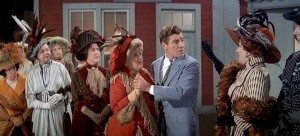 Of course, we often have a subject that requires the post to be broken into pieces, so a “once-a-week” schedule doesn’t always mean just one post each week. If we use The Music Man as an example, we would publish the first post on Tuesday and the second post on Thursday. If we had a third post, we would have scheduled its release for Saturday. But from our point of view, the next new topic would be scheduled for release on the following Tuesday. This new schedule permits us to continue our work on the page while permitting us to pursue other aspects of musical theatre.
One of our “other” projects (a personal project, involving Sean O’Donoghue and myself) has been on our minds for many years. We want to write about the musicals that touch on matters of the soul. We call the project: A Spiritual Journey Through Musicals and Movies. It will take years to complete the project, although we hope to have the first volume in paperback out later this year. We will cover musicals that ask us to ponder what is real and what is fool’s gold. These kind of questions permeate Brigadoon, for example. Is the Scottish village real; or is it just a part of Tommy’s imagination? Why did he have such a hard time when he returned to New York City? What forced him to return to Scotland?
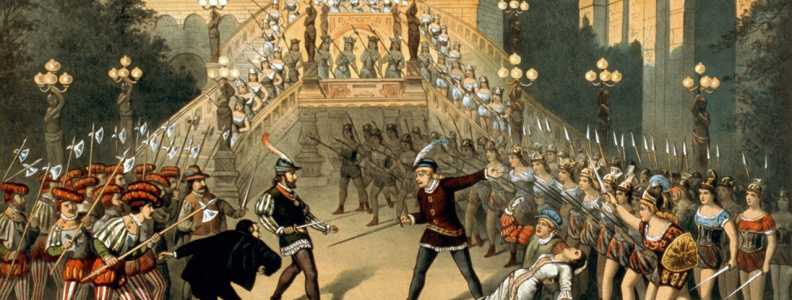
At the same time, we also want to follow up on the educational premise of our website. The image at the top of the page is a poster from The Black Crook, one of the earliest musicals produced in America (1866). In reality, it was nothing more than a large spectacle, an extravaganza that feted the eyes and ears, but contained little value. Until the 1890’s most of our musical entertainments came from Europe, usually in the form of symphonic works, chamber pieces, operas and operettas. Europe was not a monolith; opera moved from Germany to Italy to France and then back again. It grew; it changed; it developed in both form and substance.
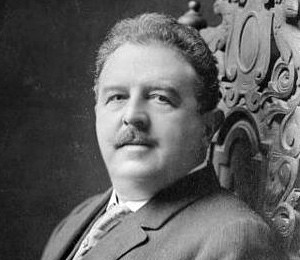 Operettas came from England, Austria and France. They were a bit brighter and gayer forms of entertainment; less death and destruction taking place on the stage. But operettas did not exist in a vacuum; they incorporated trends in dance music that were being adopted into vocal entertainment. Verbunkos and Csardas/Czardas were heavily influenced by the Romani style of violin music and were featured in the music of Franz Lehar and Victor Herbert. The Romani (also known as Gypsies) came from Northern India. If you lived in Europe in the Eighteenth and Nineteenth Centuries, you would have witnessed a a major change from the precise elegance of the Baroque period to new forms of music. In fact, the new forms were occurring with such rapidity that music critics had a hard time developing the proper vocabulary with which to describe the new works.
We want to spend more time explaining the foundations of musical theatre, as we moved from operettas to melodramas (George M. Cohan) and then to musical comedies, such as the jazz-laden scores of George Gershwin. To understand

Laurence Stallings
these transitions, we also need to make sure we understand the powerful music coming from the slaves and former slaves in the south. In the Twentieth Century, the most powerful forms of native, American music were spirituals, blues and ragtime. Without their influence, we could not have created modern musicals. Music is foundational; Negro Spirituals heard during the Harlem Renaissance of the 1920’s influenced Laurence Stallings and Frank Harling and led them to write the “Native Opera” Deep River in 1926. That music deeply affected Jerome Kern who used that musical form to create the score for 1927’s Show Boat. Show Boat deeply affected George Gershwin, who created Porgy and Bess in 1935. All of this music seeped into the consciousness of Richard Rodgers and influenced his compositional style, leading to all of the great Rodgers and Hammerstein musicals, starting in 1943 with Oklahoma!
The connections never end, as one form of music influences the next generation of composers.
Our musicals are also part of our musical heritage as Americans, just as the Germans dominated symphonic music with Bach, Mozart and Beethoven centuries ago.
We may write these posts; but, honestly, we still have a lot to learn. Looking at the bright side of this learning process, it also means we still have a lot to share with you. So, please stay with us as we struggle through the coming year of discoveries.
Our next post will be scheduled for release on Tuesday, January 16th.