
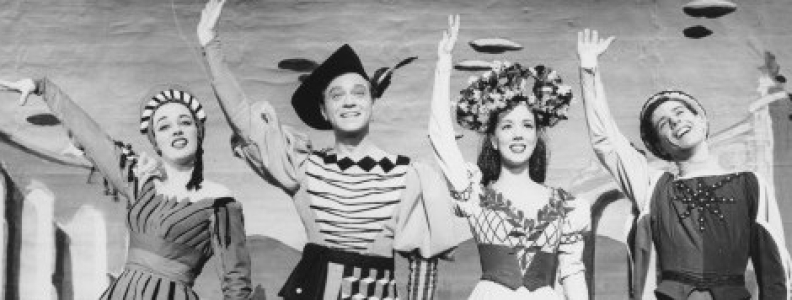
Cole Porter Finds His One Great Hit–Kiss Me, Kate
We now are going to move forward two years to another MGM hit, this time from 1953. Conrad Salinger worked on the movie adaptation of the 1948 Broadway hit, Kiss Me, Kate. This is one of the great Broadway book musicals, and the only one written by Cole Porter. Click on the following link to read more and to listen to some of this glorious music.
Porter wrote any number of wonderful songs for Broadway and the movies; yet the big one always seemed to slip through his fingers. Just as Irving Berlin took his place in the sun, with the 1946 production of Annie Get Your Gun, Porter finally had his show two years later in 1948. The book was by Sam and Bella Spewack, and it was excellent. Porter managed to match the book by producing magnificent songs that seemed to spring out of the dialogue and which added significant insight into the emotions and intent of the characters, whether they were the stars or were secondary players. It all fit; it all worked to perfection. Because we have so much material to provide to you, we are able to stay with the libretto from the Broadway show.
The essence of the Broadway musical is the longing that a Broadway star (Fred Graham) has for his former wife, Lilli Vanessi. In order to win her back, he manages to get her cast as Kate in his musical version of Shakespeare’s Taming of the Shrew. If you would permit us an opportunity to mangle Shakespeare, Fred thinks that the play’s the thing to capture the heart of his queen.
Of course, the best laid plans of man will be ruined by one smart woman; thus, we are in for a roller coaster ride, as Fred and Lilli fall in and out of love with each other. The one thing that is out of step with modern mores is the end of Shakespeare’s play, all the stuff about honor and obey. However, we get to know Lilli well enough by the end of Kiss Me, Kate to know that the word “obey” is not in her dictionary.
Normally, the two main leads have lives completely separate from the two secondary leads, who may have more comedic roles. However, in this case, Lois Lane and Bill Calhoun are much more than sidekicks. They are members of the cast in the show, but Bill has a gambling problem. He signs Fred’s name to a $10,000 marker (IOU); this permits the librettists to introduce two of the best-song-and-dance-men-cum-gangsters since Damon Runyon started to write stories about New York City and its more shadowy denizens.
From the original cast album in 1948, here is the Overture to the show.
The wonderful nature of the book is that it permits everyone to have their moment in the sun. In Act One, Scene 1, as Fred and Lilli exit after the first of their many fights, Hattie and the chorus get to tell the audience about how a show gets to Broadway in “Another Op’nin’, Another Show.” The Porter lyrics tell us that tryouts, such as the one now in Baltimore, get their start in “Philly, Boston, or Baltimo’e.” We get educated, while we enjoy a wonderful opening chorus. We also see an opening from the eyes of the cast, who hope that this opening will lead to a successful run on Broadway and thus a steady job.
One of the recordings that we found is a partially restored video of a Hallmark television special from 1958. It has “Another Op’nin,’ Another Show” and “Wunderbar,” a little ahead of schedule.
In Scene 2, we learn about Bill’s gambling habit and the fact that he has signed Fred’s name to the latest IOU. Lois complains that she will never forgive Bill if something happens to Fred (Spewack humor) before she becomes a star on Broadway. Bill’s IOU also gives Lois a chance to sing the enchanting lament, “Why Can’t You Behave?” Here is the very deep voice of Lisa Kirk from the original cast recording.
In Scene 3, we get more of the Spewacks’ oddly formed sense of humor. Lilli has taken a call from her fiancé, Harrison Howell, who has financed the show and is calling from the White House. Recall that this was during the Truman presidency. Harrison puts the President on the phone to talk with Lilli, but Fred snatches it away to ask “Is it true, Mr. President, you’re serving borscht at the White House?” Lily snatches the phone back and apologizes, then says “I beg your pardon? … With sour crème.”
There is a reference to The Barter Theatre in Virginia. This is an actual venue, and it also is the State Theatre of Virginia. They start to recall their early experiences in show business, in this case an operetta. This gives Porter a chance to introduce a waltz from the operetta, “Wunderbar.” We have already heard Patricia Morrison and Alfred Drake sing “Wunderbar.” Now, here is Howard Keel and Kathryn Grayson from the 1953 movie.
As soon as Fred closes the door to Lilli’s dressing room, two men enter and start admiring Fred’s appearance and diction. They speak in a very elemental form of a Brooklyn accent. They are there to collect on the IOU signed by Bill. Fred, of course, knows nothing about the marker.
“First Man: The minute a man signs an IOU everything goes dark.
Second Man: The doctors call it magnesia.
First Man. We cure it.”
As they exit, Paul, Fred’s assistant, enters to let Fred know that he delivered the flowers to Lilli. Fred blows up, because they were meant for Lois and there is a card attached. Lilli thinks Fred remembered his old habit of sending her flowers before each opening and sings this enchanting song to an empty stage: “So in Love.” We are going to start with Patricia Morrison’s rendition from 1948.
We also have the heavenly recent recording of Yvonne Kenny with the Melbourne Symphony Orchestra.
Finally, we have the clip from the movie, where MGM decided to perform the song as a duet between Keel and Grayson. While it is not accurate (in the show both leads sing the song at different times, alone), the duet is so beautiful that we thought we would include it.