Dancing Onstage and in the Movies–Part Seven: The End of Tap
One minute you’re on top of the world; the next minute you are a footnote in history. For a brief period of thirteen years, syncopated tap dance ruled the screen. We are enjoying the cream of these tap dance routines, starting with the production number of “Top Hat” in 1935, and ending in 1948 with the ensemble number of “Steppin’ Out with My Baby.” For this brief period of time, we had magic–composers, choreographers, orchestrators/arrangers and performers who fed on each other’s creativity and left us with a visual legacy that will never be equalled. If you think that we are engaging in hyperbole, watch the videos embedded in the first seven parts of this series on dance; then show us a better set of examples of the art of syncopated tap dancing. What hurts so much, whenever we review this body of work, is that we know how this story ends. It is like watching old clips of the Titanic leaving the harbor on its maiden voyage. We want to shout at them, turn back, turn back before its too late. But to whom will we shout, for these are just flickers of images from the past.
Does this mean that dancing died along with the death of tap dancing? Of course not. One dance form ended; others took its place. It is just that the death of syncopated tap marked the end of a precious era, when our feet tapped with theirs, when the rhythm of the music invaded our bodies and took control of our very being. It was special.
In this segment, we will examine three Irving Berlin movies that ushered in the end of this era: Holiday Inn, Blue Skies and Easter Parade. While we are going to provide some highlights, we need to mention that it is worth every penny to buy DVD’s of these three movies, so that you can go back and enjoy each routine, whether song or dance or both, over and over again. However, before we start, we have a confession to make. We messed up Part 4 of this series. We meant to include two songs and managed to include two clips of the same song. We omitted “Let Yourself Go.” To remedy our error, we are going to include it here in Part Seven.
As long as we are already in the confessional, we thought we would also admit that the tap dance era included non-tap dance routines. For example, we have already included the “Waltz in Spring Time” and “Let’s Face the Music and Dance.” Not even the tap dance era dedicated itself solely to tap dancing. It is just that when this era ended, so did syncopated tap dancing. You will see and hear this when we cover “Good Mornin’ ” from Singing in the Rain. The taps are, for the most part, in time with the melody, not in counterpoint to the melody.
OK. Enough of the soul-searching. On with the show.
One of the most difficult things for a good dancer to do is to pretend to be drunk. Either the dancer lets the acting get in the way of the dancing or the dancer forgets about being drunk and dances normally. One of the things that a great dancer can do is to pretend to be drunk and still dance with grace, albeit drunken grace. Let’s take a look at Fred Astaire as he finds Marjorie Reynolds in the movie, Holiday Inn. The next morning he realizes that he was too drunk the night before to remember who he danced with, which gives rise to a lot of movie mischief. In this clip, we start with the music from the New Year’s Song (“Start the New Year Right”) and segue into “You’re Easy to Dance with.”
Holiday Inn – Drunk Fred Astaire Film Cip by Flixgr
Next, we are going to look at “Puttin’ on the Ritz” from the 1946 movie, Blue Skies. It is a wonderful solo and production number at the same time, with Big Fred in front and the many little Fred’s in the background. We beg you to listen carefully at the beginning of the song, as Fred sings the syncopated lyrics in short bursts, making it sound much easier than it really was. This is very similar to his phrasing of the lyrics of “Top Hat.”
Fred Astaire – Puttin’ On The Ritz from Evgeny Demchenko on Vimeo.
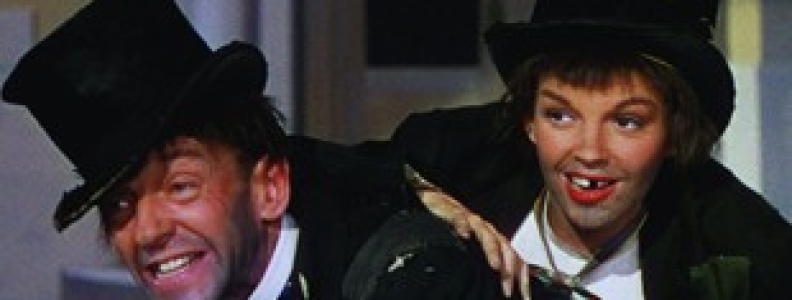
Finally, we are going to end with “Steppin’ Out with My Baby” from the 1948 movie, Easter Parade. Again, we have some movie overlays, which were quite innovative for the time.
In the next segment, we are going to look at the introduction of ballet into movie choreography.