Finian’s Rainbow–Part Three
In David Ewen’s book, The New Complete Book of the American Musical Theater, published in 1970, David had this to say about Finian’s Rainbow: “This delightful fantasy about a crock of gold, an Irishman and his young daughter, and a leprechaun is neatly combined with social-conscious conflicts in America involving sharecroppers, labor exploitation, race prejudice, the poll tax, right-wing reaction, and the greed for gold that lurks in most men’s hearts. It was not an easy feat to accomplish–this marriage of an Irish-like fantasy with stern American political and social realities. Somehow, E.Y. Harburg and Fred Saidy made the whole thing jell into a thoroughly unified concept combining sentiment with satire, tenderness and compassion and humanity with pointed social criticism.”
David continues with some background on the genesis of the crock of gold: “E.Y. Harburg confesses that he first thought of the idea for this unusual text because he could never understand how the gold standard works and why it was necessary for the United States government to keep a stockpile of gold in Fort Knox. He discussed this question one day with his collaborator, Fred Saidy (with whom he had just written Bloomer Girl), only to learn that Saidy was as much puzzled by the problem as was Harburg. ‘Gold made us think of a pot of gold,’ Harburg recalls. ‘The pot of gold reminded us of leprechauns, those mythical shoemakers who repaired only left shoes, and their legendary crock of gold, which was good for three wishes. Then it occurred to us that it would be funny if an ambitious but naive Irishman imitated America’s way to get rich by taking the leprechaun’s crock of gold and burying it near Fort Knox under the logical (for him) assumption that it (like the country) would grow. The three wishes gave us our conflict and a chance to kid both the credit system and the social system. It’s credit that makes people wealthy, you know. The only question is, who gets the credit?’ Thus came about the idea of combining fantasy with reality, romance with social and political satire. In their research, Harburg and Saidy read Gaelic fairy tales and poetry until they, too, almost came to believe in creatures like leprechauns and mythical places like Glocca Morra.”
Back to the plot.
As Og increasingly becomes human, he starts to experience a new sensation–the love of a woman. He is intensely shy as he tries to tell Sharon of his new-found feelings for her in the song, “Something Sort of Grandish.” We have two versions of this song. First is an audio clip of Tommy Steele and Petula Clark from the 1968 movie. Tommy is not well-known today, although he is still active in his native country, England. He started out as a “rocker” and then created memorable roles on the West End theatre district in London in Half a Sixpence and Singin’ in the Rain. His film performances in Half a Sixpence and Finian’s Rainbow were less well-received, as his strong personality was thought to be a better fit on the stage.
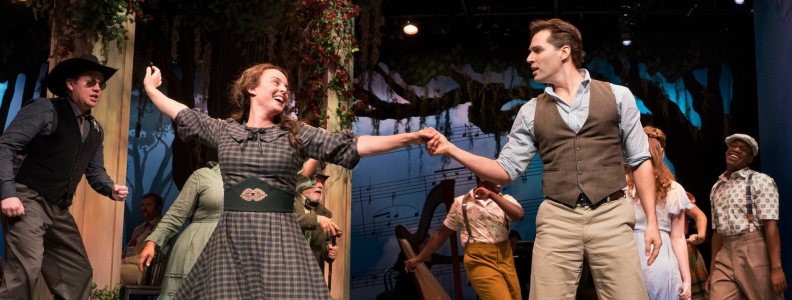
The second is another audio clip, this time from the 2016 Irish Repertory production.
Og may be in love with Sharon, but Sharon has fallen in love with Woody. It is always true that the two lovers are the last to know; the rest of the citizens of the Valley already know that Sharon and Woody are in love. In mid-America, that can only mean one thing–pretty soon we’re going to have a wedding. In a very innovative way, Harburg avoids the cliche of saying “I love you” by reversing the logic. He declares that if what Woody and Sharon are experiencing isn’t love, then “the whole world is crazy.” We are going to provide two versions of the song. First, we have what Encores! calls a “sneak peak” at a song; in this case it is a one minute video clip of Cheyenne Jackson singing “If This Isn’t Love.”
The second version is the full song in an audio clip from the Irish Repertory production. Notice that the song starts with the chorus singing that Woody and Sharon are betrothed. Next, note the use of a double chorus in the middle, which gives both depth and brightness to the piece. Finally, the tempo is fast and unrelenting, as we get to the finale, when everyone agrees that this is love.
In a throwback to 1927 and Joe’s lament about the harsh realities of life (“I’m tired of living and scared of dying”) in Show Boat, Lane and Harburg came up with a modern, blues-like version, called “Necessity.” Here we need to listen to deep, rich harmonies of the choral arrangement to see how different this song is from the hopeful opening, expressed in “Woody’s Comin’.” Our choice here features Terri White in a terrific performance in the Encores! 2009 production; here is the “sneak peak” video clip.
Finally, the news that gold has been discovered on the land in Rainbow Valley has spread to Chicago, leading to a free charge account set up in the names of the citizens of the Valley by Shears-Robust (a not so subtle reference to Sears Roebuck). Woody and Finian convince everyone that credit is better than gold; therefore, everyone should leave the gold in the ground and celebrate their new found wealth by using their free credit. In a Gospel-like song, the people celebrate their good fortune in the song “That Great Come-and-get-it Day.” We have been able to find three audio clips of this song; one from the original cast recording, one from the 1968 movie (a little slower in tempo and not as true to the original) and one from the 2016 Irish Repertory production (that is very good, down to the double chorus near the end).
Here is the first recording by Ella Logan, Donald Richards and the Lyn Murray Singers (with perhaps just a bit too much accent by Ella Logan).
Now, let’s listen to the 1968 movie version with Don Franks, Petula Clark and the Ken Darby Singers.
Finally, let’s listen to the cast of the 2016 Irish Repertory production.
We will explore the last four songs, all of which come from Act Two of the musical, tomorrow, Sunday January 21st.