
Following Donald O’Connor
We have had quite a lot of good entertainment, riding along with Alfred Newman; we have experienced the beauty of his compositional skills and the art of his musical direction and musical supervision. He served as the music director and music supervisor for Call Me Madam, and his skills were needed to record successfully the dual melody embedded in “You’re Just in Love.” Little has been said or written about Donald O’Connor, one of the great performers of his era (1925-2003). He grew up in vaudeville (parents performed there) and progressed to movies at age 12, opposite Bing Crosby in Sing You Sinners (1937) and as the young Beau in the movie, Beau Geste (1939). When he outgrew child roles in movies, he returned to vaudeville (1940). He went back into movies in 1941 until he went into the Army in 1943. Until he joined the cast for Singin’ in the Rain in 1952, his most important role was that of a soldier who could talk to a mule (Francis, 1949).
O’Connor usually played the sidekick to the star of the movie, including his appearance with Jimmy Durante in The Milkman (1950). The role of the loyal, but wise-cracking buddy, was especially important in Singin’ in the Rain, where comedy kept the film moving at a brisk pace. The movie uses visual overlays at the beginning, as Gene Kelly tells the radio audience that his motto has always been “dignity.” Of course, the reality was quite different.
The music director for Singin’ in the Rain was a man named Lennie Hayton (1908-1971).
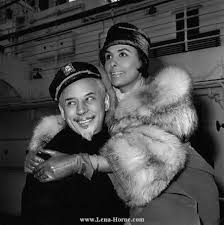
Lennie Hayton and wife, Lena Horne
He was a friend of my Father’s when they were still in high school; according to wikipedia, Lennie dropped out of high school to play piano for another boyhood friend of his, Cass Hagen. My Dad explained to me that most of the time, bands cropped up and dropped out, depending on who was able to get a gig. When Dad got a gig, Lennie would serve as his piano player. As best I understood the world of musicians in the depression, everyone knew everyone else in New York City; Dad was especially fond of Joe Venuti, a jazz violinist. Lack of regular work led to strange alliances. For example, when”Red” Nichols was not getting work, he hired out his band to the producers of Girl Crazy (1930), with orchestrations by Robert Russell Bennett. Nichols got a billing in the show of “Red” Nichols and His Orchestra. You will recognize many members of the pit orchestra: Benny Goodman, Gene Krupa, Glenn Miller and Jimmy Dorsey. Jimmy was a close friend of my Father and Lennie; and, after the show closed down for the night, most of the guys went “uptown” to Harlem, where many of the orchestra musicians would sit in on sets until closing time around 2am to 3am. If they were having a good session, they might go back to someone’s apartment, such as Willie “the Lion” Smith (stride piano), to continue playing. Guys, like my Dad, who were lucky enough to have day jobs, then showered, shaved and went to work.
Lennie also picked up piano and arranging work with Charles Previn and his radio orchestra in 1930, where Bing Crosby was the featured singer. Lennie continued to work with Bing and conducted the orchestra for one of Bing’s biggest recordings, “Brother, Can You Spare Me a Dime?” When Bing went to Hollywood to star in the movie, Going Hollywood (1933), Lenny followed. That movie started a relationship with MGM, where Lennie eventually became a music director in 1940 (until 1953). He was nominated for best score for The Harvey Girls (with Judy Garland in 1946), The Pirate (with Gene Kelly and Judy Garland in 1948), On the Town (with Gene Kelly and Frank Sinatra in 1949), Singin’ in the Rain (1952), Star! (with Julie Andrews in 1968) and Hello, Dolly! (with Barbara Streisand in 1969; he won the Award in 1949 and 1969.
Let’s listen to Lennie’s upbeat arrangement of “Fit as a Fiddle (And Ready for Love),” performed by two lovable Irishmen, Kelly and O’Connor.