Going Back To Kiss Me, Kate–Why Was Shakespeare’s Ending Wrong
There will be no music in this post; no attempt at any insights into musical composition. Instead, this should be viewed as a brief intermission between the musicals that we have examined and the musicals we will look at in the future. This short post was prompted by a comment by Marilyn Curtis; and her comment deserves a better answer than the one we gave her originally.
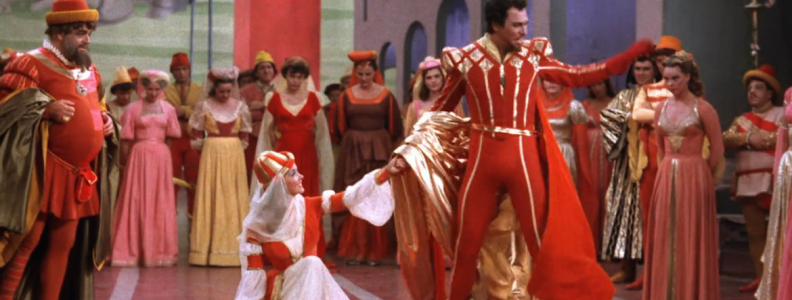
At the end of Kiss Me, Kate, the libretto reverts to Shakespeare’s Taming of the Shrew in order to show that Kate, the shrew, has morphed into Kate, the sensible. It substitutes stubborn willfulness with meek subservience. Both extremes are wrong in a moral and philosophical sense and would betray the one key strength found in all great musicals–a moral truth that the show illustrates for us. Let us quote the words that Shakespeare put into Kate’s last speech:
“I am ashamed that women are so simple
To offer war where they would kneel for peace,
Or seek for rule, supremacy, and sway,
When they are bound to serve, love, and obey.”
If we look at this concept of “obey,” it ignores the concept of truth. Who says that a husband is always right? If he is wrong, must his wife obey? For the rest of this discussion, please click on the link provided here to continue.
In T. H. White’s great novel, The Once and Future King, the author uses Arthurian myths and legends in order to pose one simple question: is might or right more potent? He concludes that “right makes might,” not the other way around. Power has always been used to subjugate and dominate the ordinary citizen. However, if power is not combined with logic, reason and moral veracity, power leads down the path to totalitarianism.
For example, even in the hierarchy of the U.S. military, no member of the armed forces has to accept an order that violates the U.S. Constitution. Take another example: when members of Congress or the President are sworn into office, the oath that they take requires them to preserve and protect the U.S. Constitution. We don’t swear allegiance to a person; we swear allegiance to a principle.
If we look at every great musical, there is usually a moral concept that underlies the show. In Oklahoma! we see the transformation of a lawless territory, where the farmer and the cowman are at war with each other, to a state, where reasonable accommodation for both ways of life is enshrined. In Carousel, Billy can only be at peace if he can bring peace and happiness to his earthly family. In Finian’s Rainbow, only just treatment of all citizens will ensure a good result for each citizen.
In Taming of the Shrew, Shakespeare saw the need to temper unruly conduct with reason and responsibility. Unfortunately, he ended up substituting one moral evil for another. In a marriage, as in any relationship, the only lasting basis for friendship is built on a foundation of an honorable search by both parties for truth. It may well be that neither party is initially correct; but the use of logic and reason should guide them to discuss and find the best path forward. In The Band Wagon, the movie shows that one man’s vision is not always right. The bad notices from the critics force the entire troupe of players to rethink the basis of the show, to return to the initial concept and find a better way to express that concept.
In Kiss Me, Kate, we have a very simple theme that is at the center of the story: two people with big egos love each other. They have drifted apart because their personalities clash. If they are to reconcile (and the audience fervently hopes they will), they must find a way to temper their willfulness with reason. The one jarring note at the end would have us believe that Fred is always right. Instead, what we should have been told is that the success of the show depends upon the ability of both Fred and Lilli to join forces. Collaboration in the theatre, as in life, provides a good result.