Guys and Dolls–Part One
If it’s Tuesday, it must mean that we are getting ready to visit another show. One of Frank Loesser’s big hits was the musical Guys and Dolls. It was based on stories by Damon Runyon, so it is only right and proper that we learn a little bit about Runyon.
Runyon was born in Kansas in 1880, enlisted in the Army to fight in the Spanish-American War and then returned to Colorado to start a career as a journalist. He married and moved to New York City, where he covered sports primarily. However, what made the man special was his inclination to drink, smoke and mix with gangsters in the Broadway area of Manhattan. Because he had a good ear for the speech patterns and inflections, he was able to write short stories that captured the narratives of colorful people who used to live large in the Big Apple. His “characters” were fictional versions of the people he met.
According to Wikipedia, his stories celebrated the world of Broadway that grew out of Prohibition and speakeasies. “To New Yorkers of his generation, a “Damon Runyon character” evoked a distinctive social type from the Brooklyn or Midtown areas. “The adjective ‘Runyonesque” refers to this type of character as well as to the type of situations and dialog that Runyon depicted. He spun humorous and sentimental tales of gamblers, hustlers, actors, and gangsters, few of whom go by “square” names, preferring instead colorful monikers such as ‘Nathan Detroit,’ ‘Benny Southstreet,” ‘Big Julie,’ ‘Harry the Horse,’ ‘Good Time Charley,’ ‘Dave the Dude,’ or ‘The Seldom Seen Kid.’ His distinctive vernacular style is known as ‘Runyonese:’ a mixture of formal speech and colorful slang, almost always in present tense, and always devoid of contractions.”
In 1929, Runyon wrote a short story known as Madame La Gimp, featuring an older woman who sold apples on the street to Dave the Dude. It was picked up in 1932 by Columbia and was made into a 1933 movie, called Lady for a Day, starring May Robson and Warren William. Frank Capra was assigned to direct, Robert Riskin wrote the screen play (nominated for an Academy Award for Best Adapted Screenplay), and $300,000 was budgeted to make the movie. Capra had misgivings about making a movie about a heroine who was 70 years old. Harry Cohn, the head of Columbia, responded: “All I know is the thing’s got a wallop. Go ahead.” Robson was actually 75 when she played the role (nominated for an Academy Award for Best Actress), and she will be forever remember as “Apple Annie.” Frank Capra also earned recognition (Academy Award as Best Director) from this experience; and he and Riskin would go on the make a number of successful pictures together, including It Happened One Night (1934), Mr. Deeds Goes to Town (1036), Lost Horizon (1937) and Meet John Doe (1941).
In 1932, Runyon wrote a story about a little girl left as collateral (a marker) for a loan made to her father so that he could bet on a horse race. His horse did not win, and the man committed suicide, leaving the bookie, Sorrowful Jones, with the collateral. In 1934, the story was adapted into a movie (Little Miss Marker) by Paramount Pictures, with Shirley Temple as the little girl, Adolphe Menjou as Sorrowful Jones and Charles Bickford as Big Steve Halloway.
It wasn’t until 1950 that Cy Feurer and Ernest Martin adapted three Runyon short stories into a Broadway show. The short stories were The Idyll of Miss Sarah Brown, Pick the Winner and Blood Pressure. However, the show also borrows characters from a number of Runyon stories.
George Kaufman was hired to direct, but Jo Swirling’s initial book was rejected, causing the producers to reach out to Abe Burrows to rewrite the libretto. The musical numbers had already been written by Frank Loesser to match the first libretto, thus putting Burrows into a very tight box. He recalled: “Frank Loesser’s fourteen songs were all great, and the libretto had to be written so that the story would lead into each of them. Later on, the critics spoke of the show as ‘integrated.’ The work integration usually means that the composer has written songs that follow the story line gracefully. Well, we accomplished that but we we did it in reverse. Most of the scenes I wrote blended into songs that were already written.”
According to Larry Stempel in his splendid book, Showtime, A History of the Broadway Musical Theater, “However Burrows got there, he created in Guys and Dolls as close to a masterpiece of musical comedy writing as Broadway is likely to produce.”
The plot covers two sets of lovers: Sky Masterson/Sarah Brown and Nathan Detroit/Miss Adelaide; however, it also combines these two love stories with one over-riding goal–finding a spot for a crap game big enough to include all of the high-rollers in town. As the lyrics attest, there are problems finding the right spot now that Lt. Brannigan is applying “the heat.”
The Biltmore Garage wants a grand
But we ain’t got a grand on hand
And they now have a lock on the door
Of the gym at Public School Eighty-four
There’s the stock room behind McClosky’s Bar
But Missus McClosky ain’t a good scout
And things bein’ how they are
The back of the police station is out
The plot keeps revolving around these three themes.
We are going to break up our discussion of the show into pieces so that we can first acquaint you with the music from audio clips of the original cast recording and then get into the performances from the 1955 film and the 1992 Broadway revival.
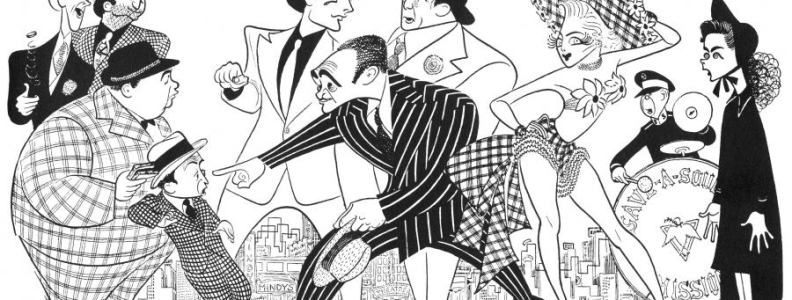
When the curtain opens, we see a depiction of the Broadway scene, done in pantomime to the music, “Runyonland.” The crowd disappears as the scene concentrates on the day’s big race and which horse is going to win. Nicely-Nicely Johnson, Benny Southstreet and Rusty Charlie argue over the outcome and their three “sure winners” in “Fugue for Tinhorns.” Here is an audio clip of Stubby Kaye, Johnny Silver and Douglas Deane from the original cast recording.
Sgt. Sarah Brown of the Save-a-Soul Mission tries to convince the denizens of sin city to repent and come to the Mission in “Follow the Fold,” but it is not just a hard sell, it is impossible.
Nathan Detroit and his colleagues discuss the difficulty in finding a spot for the crap game in “The Oldest Established,” a song that featured a cappella harmonies arranged by Herbert Greene. Here is Sam Levene, Stubby Kaye, Johnny Silver and the men’s chorus from the original cast album.
In the “Fugue for Tinhorns,” Loesser gives the three mugs a song sung in three-part counterpoint, suggesting a high degree of musical appreciation. In “The Oldest Established,” according to Stempel, “Loesser virtually exults in the clash of lowbrow content and highbrow form–the use of learned, elevated, or pious musical styles to house ignoble sentiments.”
Sky Masterson has been conned into a dubious bet by Nathan Detroit: one thousand dollars says that he can’t get Sarah Brown to go to dinner with him in Havana. Sky makes every effort to get Sarah to go with him, but she refuses, telling him that she already knows the kind of man who will be right for her in “I’ll Know.” Here is Isabel Bigley and Robert Alda (Alan’s father) from the original cast album.
The plot then reverts to a nightclub setting (and I am just quoting–“The Hot Box”), where Adelaide and female chorus sing “A Bushel and a Peck.” Here is Vivian Blaine and the female chorus from the original cast album.
After the song is over, Nathan Detroit disappoints Adelaide on two counts: one, he puts off their marriage once again (they have been engaged for fourteen years); and she suspects that he is still running a crap game. After he leaves, she complains about her current medical condition in “Adelaide’s Lament.” In one of the great lyrics of all time, Adelaide observes: “If she’s getting a kind of a name for herself and the name ain’t his… a person can develop a cough.” Here is Vivian Blaine from the original cast recording.
The next day, as Sky pursues Sarah and Nathan tries to win back Adelaide, two “philosophers,” Nicely-Nicely Johnson and Benny Southstreet, create a list of sacrifices a guy will make in order to impress a doll. Here is the song, “Guys and Dolls,” sung by Stubby Kaye and Johnny Silver in the original cast album.
In order to keep the Mission open, Sarah reluctantly agrees to accept Sky’s promise to deliver one dozen genuine sinners to the Mission if she will go with him to Havana. They go; she gets very drunk and falls in love with Sky, to the tune of “If I Had a Bell.” Here is Isabel Bigley from the original cast recording.
Back in New York, Sky breaks down and admits that he has never shared so much with any other person and thinks he is in love with Sarah. Here is Robert Alda singing “I’ve Never Been in Love Before” from the original cast album.
Unbeknownst to Sky, Nathan learned that the impossible has happened, that Sarah Brown went to Havana with Sky and that the 100% sure thing has turned into a debt nuts loser. Without the thousand dollars, Nathan had to find a new spot. Unfortunately for himself and Sky, he chose to use the Mission. Thus, when Sarah and Sky return, they are met with fleeing gamblers, tipped off that the police were on their way. Sky pleads with Sarah, but her mind is made up. As the curtain falls, Sarah declares that her love affair with Sky must end.