
How To Succeed–Part Four
We are now back together again for this last installment of the wonderful musical, How to Succeed in Business Without Really Trying. We left the show on Tuesday at the end of Act One, with Rosemary wondering if she would ever be able to compete with Finch’s ego; with Finch wondering if the painter would be able spell his name correctly; and Frump wondering if he would ever be able to exact his revenge on the hated Finch.
As the curtain rises on Act Two, Rosemary is once again unhappy that Finch is spending more time plotting out his career than on her and threatens to quit. Her friends urge her to reconsider, because she is a beacon of hope to them all. In a forerunner to An Officer and A Gentleman, the secretaries all believe that their future is tied to finding an executive who will marry them. Right or wrong, they need a leader who can show the way. Here is an audio clip from the original cast album featuring Scott and Sutherland, singing “Cinderella, Darling.”
We now find Finch, who is now trying to undo his first mistake. Without consulting the book, he has accepted Ovington’s spot as the head of Advertising. As he reads the book, Finch learns that the Vice-President of Advertising is a bad position and that the only way out is to come up with a brilliant idea. Of course, brilliance is not Finch’s strong suit. Devious, yes. Manipulative, yes. Brilliant, no.
Into the garden crawls the snake, otherwise known as Bud Frump. Listen to me, whispers the snake. Use a treasure hunt as your big, new idea. Finch is blinded by the snake’s razzle-dazzle and forgets that Frump is not his friend. Great idea, says Finch, not knowing that Biggeley has turned down this idea once before.
In preparation for his presentation of the Treasure Hunt, Finch confides his misgivings to Rosemary who promises to stay by his side, no matter what the outcome is.
On the other hand, Biggeley is having his problems with LaRue, who is unhappy as a secretary and threatens to leave and go to California. Biggeley convinces her to stay because he loves her. He tells her of his undying love in the song, “Love from a heart of gold.” Here is an audio clip of Vallee and Martin from the original cast recording, singing their love duet.
In one of the most inventive scenes in musical theatre, the washroom scene, Finch tries to give himself courage by talking to the mirror as he washes his hands. Of course, there is no mirror, and he is in reality staring out into the audience. Thus, the staging of the number gives the illusion that Finch is talking to somebody else. Second, Loesser used the other executives as a men’s chorus in musical counterpoint to the beautiful main melody. You will hear them sing the words, “gotta stop him before he stops me,” while Finch is singing “I Believe in You” to himself. First, let’s listen to an audio clip from the 1961 original cast recording.
Now, let’s watch the same scene played in the 1967 movie.
Finch presents his idea, Biggeley scolds, Finch realizes he is in danger and then blurts out that the Treasure Hunt will be led by hints on TV from the Treasure Girl—no other than Hedy LaRue. This solves two problems for Biggeley, and he approves the plan. What nobody anticipates is that Hedy is honest; and when she is asked on TV to swear on a Bible that she does not the secret location of the treasure (5,000 shares of company stock in each of the ten company offices in the US), she freezes. Not only can’t she swear to a lie; she actually tells the truth and reveals the 10 locations.
As she does this, the office lobbies are swarmed under, and the shares are taken by frenzied mobs of people. In a paraphrase from the Great Bard, what we have here is a real, 24 carat disaster. Looking for guidance from his book, Finch learns that, if he was the cause of the disaster, it is best to review the first chapter of the book—how to apply for a job.
The one great thing that has happened to him, if he will only realize it, is Rosemary’s love and loyalty. Once again she promises to stay with him, no matter what. This is done in a reprise of “I Believe in You,” this time sung by Rosemary to Finch. In a very moving portrayal of Rosemary in the movie, Michelle Lee sings the reprise in this video clip from the movie.
The Chairman of the Board, Wally Womper, and the other executives are waiting in Biggeley’s office for Finch to arrive and offer his resignation. Finch arrives and is about to hand over his resignation when he mentions that he may just have to go back to his first job, washing windows.
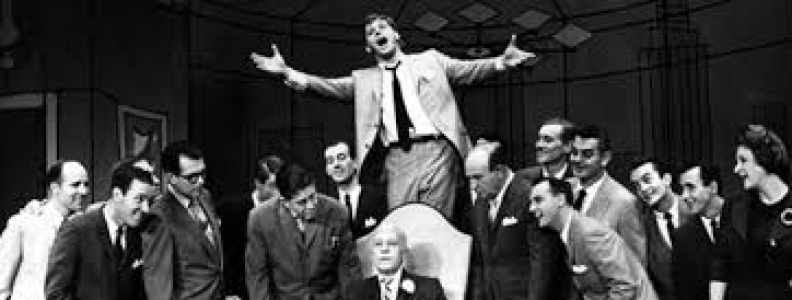
Lightening is about to strike again. Under the heading that it is better to be lucky than to be smart, Wally turns to Finch and admits that he started as a window washer and that he had a book too—a book of betting records. Finch turns to Frump and blames the Treasure Hunt on him, the nephew of the President, J.B. Biggeley. As Womper is about to “clean house from top to bottom,” Finch reminds Womper that we are part of a larger fraternity. Loesser provides Finch with a wonderful, show-stopping, revival meeting production number, reminiscent of Nicely Nicely Johnson’s “Sit Down, You’re Rockin’ the Boat” from Guys and Dolls. In this show, the song is the “Brotherhood of Man.” As an aside the actor who played Mr. Twimble in Act One returns to play Wally in Act Two. Here is a video clip of the number from the 1967 movie.
We also have a video clip of Daniel Radcliffe leading the 2011 revival cast at the Tony Awards in the same ensemble number.
As the musical comes to an end, Womper retires as Chairman to travel the world with his new wife, Hedy LaRue; Finch takes his place as Chairman; and all of the others, except for Frump, will stay with the company in their current positions. Rosemary makes a terrible error and inadvertently inspires Finch to think about becoming the President of the United States, and Frump gets a job washing windows and swearing revenge against Finch. All is captured in the “Act Two Finale,” provided here as an audio clip from the original cast album.
While we come away from this show believing that the success of an upstart is better than rewarding entrenched villains, we never really have anyone to root for, except Rosemary. It is a shame that the best musical numbers are done in parody; if they had been part of a more honest, dramatic musical, “I Believe in You” and “Brotherhood of Man” could have reached greater heights. “Coulda, Woulda and Shoulda,” three of the best companions an armchair critic can have.
Join us next Tuesday for more adventures.