
Hugh Martin–From Richard Rodgers to Meet Me in St. Louis
We are continuing to look at movie scores that involved Conrad Salinger as orchestrator and/or arranger. In November of 1944 the movie, Meet Me in St. Louis, was released to movie theaters around the country. The June invasion at Normandy had been successful, and the Allied forces were pushing back German forces all along the Western Front. The Battle of the Bulge would not come until December. The Soviet troops were decimating the Germans along the Eastern Front. The tide had turned in Europe, and Germany was playing defense. In the Pacific, the Battle of Leyte Gulf had just ended, with major losses to the Japanese fleet, from which the Japanese would never recover; but the horrific invasions of Iwo Jima and Okinawa were yet to come in 1945. Nevertheless, the dark days in 1942 in the aftermath of Pearl Harbor were receding, leaving the country open to celebrate its past.
Oklahoma! hit Broadway in 1943, in what was intended to be a low key adaptation of Green Grow the Lilacs. It hit a nerve with American audiences and opened up all kinds of possibilities. One of those possibilities was a nostalgic look back at the 1904 Louisiana Purchase Exposition, also known as the St. Louis World’s Fair. The fair’s 1,200 acre site was located at the present-day location of Forest Park and Washington University. Wikipedia informs us that there were over 1,500 buildings, over 75 miles of roads and walkways and exhibits from about 50 countries and 43 of the 45 states that existed. Over 19M people attended the fair. In short, it was a very big deal for St. Louis.
How better to celebrate the fair and advertise it at the same time than to write a song, which is just what Kerry Mills (music) and Andrew B. Sterling (words) did in 1904. Forty years later, the song was made famous once again by Judy Garland with help from Louise Bremer.
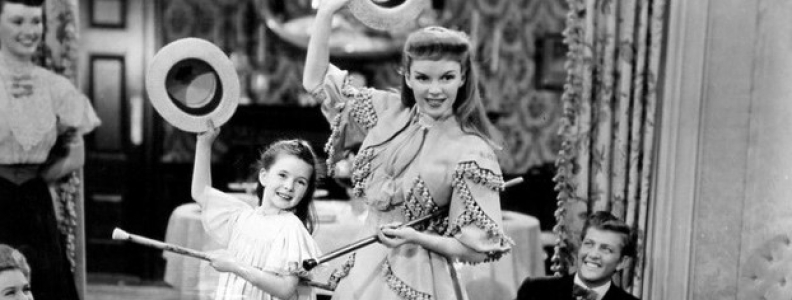
Not only was the marque song not written specifically for the movie, neither was a delightful song and dance routine, performed by Judy Garland and little Margaret O’Brien, playing Tootie. Tootie kept her smile throughout the song, but she kept very little else in sync with the words, the music or the choreography. If you watch her closely at the outset, you can see her confusion. Luckily, she had Judy as her older sister, and Judy helped get her through the number. With all of that said, it is still a great performance, largely because the writers understood the difficulty that Margaret was having and created a subterfuge–that this was not planned, just a spur-of-the-moment piece of entertainment. The ploy worked to perfection; its flaws make it even more lovable. The music for “Under the Bamboo Tree” was written by Robert Allen “Bob” Cole, a ragtime composer who tragically committed suicide at age 43 from clinical depression, with lyrics by Rosamund Johnson and J.W. Johnson. We think it was written in 1901 or 1902 and was interpolated into a Broadway show, Sally in Our Alley, a 1902 musical composed by Ludwig Englander. Marie Cahill had a good sense of popular music; her interpolation became so popular that she put it into her next show, Nancy Brown (1903), and made it part of her vaudeville act. The movie lyrics were slightly altered to fit the new situation.
Well, then; what music was written for the movie? The answer is that three songs were written for the movie, all of which became popular hits: “The Trolley Song,” “The Boy Next Door” and “Have Yourself a Merry Little Christmas.” And that brings us back to Hugh Martin. Born in 1914 in Birmingham, Alabama, he began studying classical music at the age of five at the Birmingham Conservatory of Music. Ten years later, when George Gershwin’s Rhapsody in Blue was released, Martin changed his mind about studying classical music; a decision cemented when he heard Gershwin’s “The Man I Love” being played as background music for a silent movie. Then he heard Jerome Kern’s music from Show Boat, and he made the switch to Broadway and popular music. In an interview, Martin related the following:
In the mid-1930s Martin moved to New York, where he made his Broadway debut as a singer in Hooray for What! (1937), directed by Vincente Minnelli with songs by Harold Arlen and EY Harburg. Kay Thompson, who was to become a major influence and lifelong friend, was the show’s vocal arranger. Ralph Blane was also in the chorus, and the two men became friends and collaborators, forming a vocal quartet with sisters Jo-Jean and Phyllis Rogers. Calling themselves The Martins, and featuring arrangements by Hugh, they became regulars on comedian Fred Allen’s radio show, and appeared along with Thompson on the radio series Tune-Up Time.
Richard Rodgers then asked Martin to see if he could write a close-harmony arrangement of “Sing for Your Supper” in the style of the Boswell Sisters, for his upcoming musical The Boys from Syracuse (1938). “I was working so could not go to New Haven where the show tried out, but I got a telegram saying, ‘Your arrangement stopped the show, and they had to do it all over again twice.’ It really took off, and it took off in New York too. So then Dick gave me ‘I Like to Recognise The Tune’ in his next show, Too Many Girls (1939), and again it was a show-stopper.”
The “Sing for Your Supper” arrangement is still used in revivals, and always stops the show. Other productions to benefit from Martin’s vocal arrangements included Du Barry Was a Lady (1939), Very Warm for May (1939), Pal Joey (1940), which made Gene Kelly a star, and Cabin in the Sky (1941), for which Martin gave singer Ethel Waters a celebrated obbligato for the second chorus of the title song. He provided the arrangements for Irving Berlin’s Louisiana Purchase (1940).
With a partner, Martin and Blane now headed for Hollywood, based on a chance encounter with Van Johnson:
The course of Martin’s career changed when Van Johnson, who had been in the chorus of Too Many Girls, told Blane that the director George Abbott was looking for new composers to write the score for a musical to be cast with fresh young talent. “Ralph came to me and said, ‘Why don’t we?’, so we wrote a song each, played them for Richard Rodgers, who was co-producing the show, and he loved them and gave us the job.”
Their show, Best Foot Forward (1941), its numbers staged by Gene Kelly, was a hit, with each composer writing both words and music (“I wrote seven songs, Ralph wrote six, and we wrote one together”). When MGM purchased the screen rights they brought many members of the cast to Hollywood along with Martin and Blane.
The team’s first assignment for the studio was to write a song for Judy Garland to sing in For Me and My Gal. Titled “Three Cheers for the Yanks”, it was a patriotic piece that was cut from the final print. Another song for Garland, “The Joint Is Really Jumpin’ Down at Carnegie Hall”, became her speciality number in the all-star musical, Thousands Cheer (1943), after which the team were assigned to write the score for Meet Me in St Louis, a heart-warming turn-of-the-century tale in which Garland experiences the pangs of first love as the family faces an impending move from St Louis to New York to further the father’s career.
Martin and Blane worked as arrangers on the show that we just studied, Girl Crazy. While we can never be sure who did what, when two men who write both music and lyrics work together, most of the initial composing seems to have come from Martin. Further along in the interview with Martin, he recalled working on Meet Me in St. Louis with Judy Garland:
Martin described the “ecstasy” of hearing Garland sing “The Boy Next Door”: “Conrad Salinger was such a gorgeous arranger, and Judy sang it with such perfection.” The buoyant “Trolley Song”, with its rousing opening line, “Clang, clang, clang went the trolley…”, was performed as Garland wove her way through a crowded streetcar looking for her swain.
Martin wrote both words and music for “Have Yourself a Merry Little Christmas”, but his original version was so dark that it almost failed to get into the film. It started “Have yourself a merry little Christmas / It may be your last / Next year we may all be living in the past”, and Garland wisely refused to sing it.
Martin said that his resistance to changing it was broken by Tom Drake, who played the boy next door. “He told me, ‘Hugh, this is a great and important song. Don’t be a stubborn idiot. Write a lyric for that beautiful melody that Judy will sing.’ I did, and I thank Tom from my heart.”
In our view, “The Trolley Song” is one of the best songs to capture the thrill of discovering a new love. There is something “breathless” about the song; our hearts are beating in time with hers. (By the way, the same Vincente Minnelli who had directed Hooray for What! on Broadway in 1937 was now directing the movie, Meet Me in St. Louis. He would later marry Judy, and they would sire Liza.)
But…of course, the best song written for the show was “Have Yourself a Merry Little Christmas.” It fits the story line perfectly, thanks to the intercession of Tom Drake. The story line is simple and direct; the Smith family is headed by an autocratic male, Alonzo Smith, played to the hilt by Leon Ames. He has been offered a promotion in his law firm, the chance to open the New York office and head it up. The news is greeted with a sense of shock and deep disappointment by his family, much to his incomprehensible chagrin. It may have been 1944 but the tension between business success and family happiness stretch from 1904 to today: is financial success more important than family happiness? Judy Garland tries to console her little sister, Tootie. The song is meant to do that; however, in what we consider to be one of the finest performances by a child actress, Tootie goes down to the yard to destroy all of her snowmen. It still breaks our heart when we see the child who cannot be consoled by any rationalization. Oh, wow.
One last thought on the song; we started with a brief contextual explanation of how the movie fit into the sequence of WWII events. In the Youtube comments, we saw the following explanation by Daisy Ann and felt that we needed to repeat it to all of you:
my dad used to hate this song because he thought it was too cutesy sounding (‘merry little christmas’), until I explained the context of the song being written during WW2, and the original lyrics of ‘someday soon we all shall be together if the fates allow, until then we’ll have to muddle through some how’ make the song have so much more depth, and ‘little christmas’ is probably very literal in the sense of people not having much because of rationing and doing what they can with what they have. he totally changed his mind about it then.
Amen, Daisy Ann, Amen.