
Irving Berlin and New York City–Easter Parade Part One
Irving Berlin wrote more music for the movies than he did for Broadway. He also wrote more popular songs for publication than for a specific Broadway show. We don’t think it was an intentional choice, because Berlin continued to live in New York City all of his life and loved the excitement of Broadway. Instead, we think that life just unfolded differently for Berlin than it did for other major composers. In comparison to Jerome Kern, whose songs were almost always written for a specific show, Berlin started writing popular songs. His first great hit came in 1911 with “Alexander’s Ragtime Band.” Thanks to Robert Kimball, we learn that it was published on March 18, 1911 and was probably introduced by Emma Carus on April 17, 1911 in her vaudeville act at Big Easter Vaudeville Carnival (Chicago’s American Music Hall). Berlin was quoted in a 1914 article in Theatre Magazine, “the melody came to me right out of the air. I wrote the whole thing in eighteen minutes surrounded on all sides by roaring pianos and roaring vaudeville actors.” Of course, this “roaring” was the normal environment found on Tin Pan Alley. In 1911, Berlin was working for Ted Snyder at Snyder’s music publishing house. A popular song, like “Alexander’s Ragtime Band” might be written solely for publication or it could be interpolated into a Broadway show or revue. On the other hand, a composer could be sought out and commissioned by a Broadway producer to put together an entire score, as was the case with writers such as Victor Herbert (Naughty Marietta in 1910) or Jerome Kern (The Girl from Utah in 1915). In this case, “Alexander’s Ragtime Band” made it to Broadway on May 28, 1911 in the Friars Frolic of 1911 at the New Amsterdam Theatre.
This is not to say that Berlin focused exclusively on the movies or on publishing popular songs. He wrote extensively up to 1925 for musical revues on Broadway, such as Watch Your Step (1914), Stop! Look! Listen! (1915), Yip, Yip Yaphank (1918), Ziegfeld Follies of 1919 and 1920 and his own Music Box Revues in 1921-24. He wrote the score for the Marx Brothers vehicle, The Cocoanuts in 1925 and then the Ziegfeld Follies in 1927. He wrote music for the 1930 movie, Reaching for the Moon (none of which was used); then wrote the music for the Broadway shows Face the Music (1932) and As Thousands Cheer (1933). Some of the music was good, but none of these shows contained music of great note. However, that all changed in 1935, when Berlin started writing what he called “dance music” for Fred Astaire’s movies Top Hat (1935) and Follow the Fleet (1936). We have previously covered those movies in the posts on Max Steiner.
Berlin followed those movies with two movies produced by Daryl F. Zanuck at 20th Century Fox: On the Avenue (1937) and Alexander’s Ragtime Band (1938). With regard to the movie, Alexander’s Ragtime Band, Zanuck had wanted Berlin to create a movie musical around Berlin’s life; however, Berlin refused to do that. According to Robert Kimball, Berlin wrote a story about a songwriter’s work, using thinly disguised episodes from his professional life to weave into the storyline. Berlin received two Academy Award nominations: Best Original Story and Best Song (“Now It Can Be Told”). In all, Berlin wrote three new songs and used 26 of his previous songs to tell the story.
Berlin wrote the music for Carefree at RKO in 1938, the last Astaire/Rogers musical at that studio. We featured his hit song “Change Partners” in a previous post. He wrote music for Music Box Revues (1938-39) and a score for a book musical, Louisiana Purchase (1940), before writing some songs for a Sonja Henie movie, Second Fiddle, in 1939. To illustrate the point about the conflict between Broadway and Hollywood productions, let’s take a specific example of a revue written for Broadway that was eventually produced in Hollywood.
In 1939, Berlin wrote an outline for a Broadway revue called Happy Holiday (musical numbers for each holiday on the calendar), which sat on the shelf until Berlin bumped into Mark Sandrich in Washington DC. Berlin had worked with Sandrich on the RKO movies for Fred Astaire, but Sandrich was now with Paramount, where Bing Crosby was the star singer. Berlin and Sandrich re-wrote the story around Crosby, a singer who only wanted to work on holidays. They then brought in Astaire for the dancing, but Astaire’s role in the original storyline (as narrator) wound up on the cutting room floor. All of the music was new, except for “Lazy,” which had been written in 1924. And that is how Holiday Inn (1942) was produced as a movie instead of as a Broadway revue.
Berlin then worked on the patriotic movie, This Is the Army (1942), and resurrected the original idea of Astaire as narrator for the movie, Blue Skies (1946). Nevertheless, 1946 will always be known as the year that Berlin wrote his one great Broadway musical, Annie Get Your Gun.
Whereas Holiday Inn and Blue Skies were written about nightclub singers and dancers, Easter Parade was intentionally written in 1948 to highlight vaudeville. For this reason, the story is set in 1912.
We do not understand the reason, but it is clear that Hollywood producers were more receptive to Berlin’s music than Broadway producers. In a final irony, had Kern not died in 1945, Berlin would never have been given the opportunity to write the score for Annie Get Your Gun. Lately, though, Broadway producers seem to be realizing their past mistakes and have been adapting Berlin’s movie scores for Holiday Inn and White Christmas into the Broadway shows.
All of this is prologue to our study of Easter Parade, but it is a necessary introduction to the movie score. Why? The primary reason is that the MGM musical could just as easily have been produced on Broadway. The fact is that no Broadway producer was interested; on the other hand, Arthur Freed and Louis B. Mayer showed interest and put up the money to produce the show. It may have been as simple as that. However, the secondary reason is almost as important–the show is all about vaudeville and the hope of every vaudevillian to become a headliner who could get the chance to perform on Broadway. Eight songs were written for the movie; eight songs had been previously written. We are going to take a look at almost all of them.
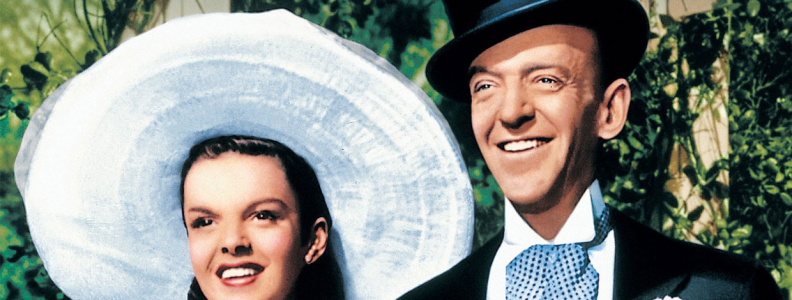
We need to start with three songs that open the show, all of which were written for the movie: “Happy Easter,” “Drum Crazy” and “It Only Happens When I Dance with You.” Fred Astaire plays a successful vaudevillian now performing on Broadway, named Don Hewes, who is out shopping for gifts for his dancing partner, Nadine Hale (played by Ann Miller in her MGM debut). As part of the song, “Happy Easter,” a number of MGM beauties model hats for him, until he picks the one for Nadine.
In the next sequence, he sees the perfect Easter rabbit in a shop window but a young boy beats him to it; in order to pry it out of the child’s hands, Astaire explains why a drum set would be much better for the boy. Of course, Fred explains best with a song and dance routine (“Drum Crazy”).
Finally, gifts in hand and hoping to turn their professional relationship into a more romantic one, Astaire arrives to find Nadine considering an offer for a solo act in a new show. He tries to persuade her to stay with him, using love as the bait in “It Only Happens When I Dance with You.”
Nadine is firm; Don is broken-hearted and goes to a bar to drown his sorrows. He brags that he doesn’t need Nadine; he can turn any dancer into a star. Turning to the girls dancing on the stage, he picks out Hannah Brown (played by Judy Garland), gives her his card and asks her to come to a rehearsal the next day. And that is where we will pick up again on Friday.