
KIss Me Kate–Part Three
As we told you in the first part of this series, we now are going to move on to the 1948 Broadway hit, Kiss Me, Kate. This is one of the great Broadway book musicals, and the only one written by Cole Porter. Click on the following link to read and listen to some more of this glorious music.
Just to refresh your recollection since the last posting, Porter wrote any number of wonderful songs for Broadway and the movies; yet the big one always seemed to slip through his fingers. Just as Irving Berlin took his place in the sun, with the 1946 production of Annie Get Your Gun, Porter finally had his show two years later in 1948. The book was by Sam and Bella Spewack, and it was excellent. Porter managed to match the book by producing magnificent songs that seemed to spring out of the dialogue and which added significant insight into the emotions and intent of the characters, whether they were the stars or were secondary players. It all fit; it all worked to perfection.
The essence of the show is the longing that a Broadway star (Fred Graham) has for his former wife, Lilli Vanessi. In order to win her back, he manages to get her cast as Kate in his musical version of Shakespeare’s Taming of the Shrew. If you would permit us an opportunity to mangle Shakespeare, Fred thinks that the play’s the thing to capture the heart of his queen.
Of course, the best laid plans of man will be ruined by one smart woman; thus, we are in for a roller coaster ride, as Fred and Lilli fall in and out of love with each other. The two secondary leads, Lois Lane and Bill Calhoun, complicate the lives of the main stars. Lois and Bill are members of the cast in the show, but Bill has a gambling problem. He signs Fred’s name to a $10,000 marker (IOU) that permits the librettists to introduce two of the best-song-and-dance-men-cum-gangsters since Damon Runyon started to write stories about New York City and its more shadowy denizens.
The wonderful nature of the book is that it permits everyone to have their moment in the sun. In Act One, Scene 1, as Fred and Lilli exit after the first of their many fights, Hattie and the chorus got to tell the audience about how a show gets to Broadway in “Another Op’nin’, Another Show.” The Porter lyrics tell us that tryouts, such as the one now in Baltimore, are only important if they turn into a long running show and therefore a steady job for members of the cast.
In Scene 2, we learned about Bill’s gambling habit and the fact that he has signed Fred’s name to the latest IOU. Lois complains (Spewack humor) that she will never forgive Bill if something happens to Fred before she becomes a star on Broadway. Bill’s IOU also gives Lois a chance to sing the enchanting lament, “Why Can’t You Behave?”
In Scene 3, we received more of the Spewacks’ oddly shaped sense of humor. Lilli has taken a call from her fiancé, Harrison Howell, who has financed the show and is calling from the White House. Recall that this was during the Truman presidency. Harrison puts the President on the phone to talk with Lilli, but Fred snatched it away to ask “Is it true, Mr. President, you’re serving borscht at the White House?” Lily snatched the phone back and apologized, then said “I beg your pardon? … With sour crème.”
Fred and Lilli recalled their early experiences in show business, giving Porter a chance to introduce a waltz from the operetta, “Wunderbar.”
As soon as Fred closed the door to Lilli’s dressing room, two men entered and started admiring Fred’s appearance and diction. They spoke in a very elemental form of a Brooklyn accent. They were there to collect on the IOU signed by Bill. Fred, of course, knew nothing about the marker.
“First Man: The minute a man signs an IOU everything goes dark.
Second Man: The doctors call it magnesia.
First Man. We cure it.”
As they exit, Paul, Fred’s assistant, let Fred know that he delivered the flowers to Lilli. Fred blew up, because they were meant for Lois and there was a card attached. Lilli thought that Fred remembered his old habit of sending her flowers before each opening and sang “So in Love” to an empty stage.
As we entered Scene 4, we were let in on a wonderful inside joke, as the musical being staged used the real-life opening number (“Another Op’nin’, Another Show”) as a model for the show-within-a-show. Thus, we were treated to the tongue-in-cheek song about performing shows on an Italian circuit, instead of in Philly, Boston or Baltimore. We heard the original cast from 1948 singing “We Open in Venice.”
We moved into Scene 5, where three suitors were trying, without success, to woo Bianca, Kate’s younger sister. However, Kate is the oldest and must be wed first before Bianca can tie the knot. The dialogue moved from Shakespearian iambic pentameter to pure Cole Porter, as the three suitors advanced their cases to Bianca to be her husband. We listened to “Tom, Dick, or Harry,” sung by the 1948 cast and the movie cast.
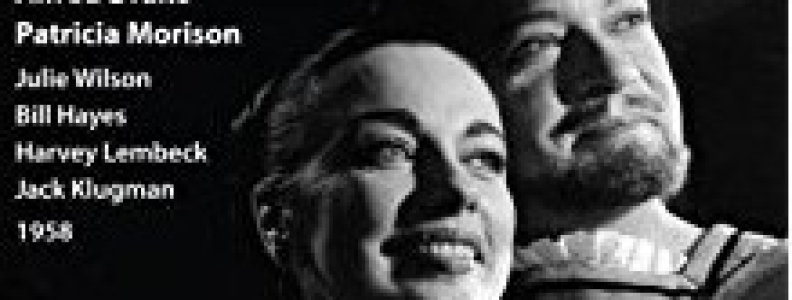
Fred then entered as Petruchio, a man willing to marry any woman as long as the dowry is large. “I’ve Come to Wive It Wealthily in Padua” is both witty and Shakespearian, thus blending the wit of the Bard with the wit of the Porter. “I shall not be disturbed a bit/If she be but a quarter-wit,…” We viewed the video clip from the 1958 restoration and listened to the 1948 original cast recording, both of which were sung by Alfred Drake.
Kate then came on stage to express her opinion of men (hint: she did not come to praise Caesar–“He may have hair upon his chest but, sister, so does Lassie”), establishing the difficulty that Petruchio faced in wooing her. Morrison sang “I Hate Men” with heart-felt gusto in the 1958 special.
While Fred was negotiating Kate’s dowry with her father, Baptista, Lilli was heard offstage—uttering one shriek. Fred knew what had happened (Lilli read the card) but gamely continued with the scene, launching into the glorious tune, “Were Thine That Special Face.” Drake sang the song on the 1948 original cast recording.
Lilli came onstage to finish the scene and started after Fred, not Petruchio. It ended with Fred giving Lilli an onstage spanking. This is where Part Two left off; we now start with the narrative for Part Three.
We start off stage in Scene 6. While the spanking may have been in character and well-deserved, Lilli has had enough, slaps Fred offstage and threatens to leave the show.
In Scene 7, Lillie phones Harrison to come get her; she is bruised and ready to leave. Fred has another visit from the two collectors and seizes upon a plan to keep Lilli in the show. He admits that he signed the IOU but cannot pay because the show is folding. Fred suggests that the two men talk to Lilli, “heart to heart.”
The cast sings a less known song in scene 8, called “I Sing of Love.” In the Brian Stokes Mitchell/Marin Mazzie revival, the song is called “Cantiamo D’amore.” You will notice that the music is the same as the music for the verse that leads into “Where Is the Life That Late I Led.” Here is “Cantiamo D’amore” from the Mitchell/Mazzie recording on DRG in 2000. (While the title of the song is singular, the lyric actually is written in the plural, “we.”)
We now move to Scene 9, the finale of Act One, with the two gangsters onstage, dressed in costumes, constantly prepared to keep Lilli from leaving. In this scene, Petruchio weds Kate to the music of the title song, “Kiss Me, Kate.” Fred throws Lilli over his shoulder, kicking and screaming, as the curtain descends on Act One. Here is the Mitchell/Mazzie recording of the Act One finale.
Act Two opens much like Act One did; this time Paul, not Hattie, leads the chorus. The opening number (“Too Darn Hot”) is a great tune with a jazzy, swinging orchestration and dance as a bonus. The scene takes place just outside the stage door at the rear of the theatre and accentuates the Baltimore heat. The directions in the stage notes indicate the Spewack sense of humor once again: “We must assume that it’s never too hot to dance.” Here is the original cast from 1948, singing “Too Darn Hot.”
Scene 2 is quite short, as Fred announces to the audience that a scene must be omitted tonight: “It’s the scene on the mule where I, Petruchio, take Katherine, my wife, to Verona. We have a slight accident where my wife rolls off the mule into the mud and then proceeds to revile me. Miss Vanessi is unable to ride the mule this evening. We are, therefore, continuing with the next scene, which takes place in Petruchio’s house. Thank you.”
In Scene 3, we return to Shakespeare, as Petruchio seeks to starve Katherine by declaring that her food is not properly prepared. The scene’s dialogue moves seamlessly into one of Cole Porter’s most famous “list” songs. Because he is now married, Petruchio must literally go through and throw away the names he has in his little black book of female companions. Porter uses locales in Italy to recall the women of his past. The internal rhymes, the allusions, the out-of-context characters (“I miss-ed her gangs-ter sis-ter from Chicago.”) all serve to make an instant classic out of “Where Is the Life that Late I Led?” We are going to start with the version that is probably closest to the 1948 Broadway performance; it is Drake’s performance in the 1958 television revival.
However, we also have a video clip from the 1968 Robert Goulet television revival.
Finally, we have a video clip from the 1953 movie version, sung by Howard Keel.