Lerner and Loewe’s Brigadoon–Part Two
As we mentioned in the last post, we have often discussed the work of Lerner and Loewe in previous posts; but, as we look back, the comments were fragmented over many posts. We thought it would be best to go back and look again, this time in a unified manner, much like we did for Annie Get Your Gun, The Band Wagon and Kiss Me, Kate. Please click on the following link to learn more about Lerner and Loewe’s first great hit, Brigadoon.
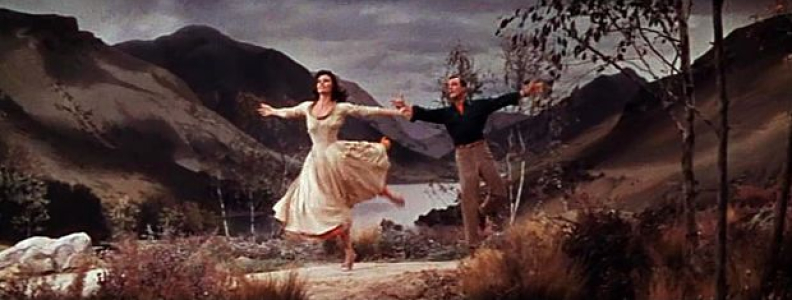
Brigadoon opened on Broadway in 1947 and was turned into a movie and released in 1954, with a wonderful cast that included Gene Kelly and Cyd Charisse. It has become an icon of the musical movie heritage from MGM; however, from the standpoint of our Broadway heritage, we will rely heavily on the John McGlinn restoration recording in 1992.
In our post on April 10, 2017, we noted that we are indebted to music theatre historian, Miles Kreuger, for his explanation that Brigadoon is based upon an old Wilhelm Gerstacker story from 1862. You can read Miles Kreuger’s recollections in the liner notes for the John McGlinn recording, released by EMI/Angel in 1992. While the story developed by Alan J. Lerner for Brigadoon is quite different, the basic theme remains the same: a town, not found on modern maps, appears once every 100 years to human sight but for one day only. The rules are fairly simple; the people of the town must remain within its boundaries or the spell will be broken and all will die. A stranger can come into the town and stay or leave, as long as it is within the one day. But if the stranger stays, he or she must abide by the rules of the town and can never leave again.
In the musical Brigadoon, two Americans, Tommy and Jeff, are lost in Scotland and stumble on the “lost” town of Brigadoon. As they wander through the town, they are surprised by the ancient styles of the clothing and the friendliness of the people. Tommy falls in love with a girl in the town, named Fiona, but decides at the end of the day that he is not prepared to give up his life in New York to stay with Fiona in Brigadoon.
However, once Tommy returns to New York, he finds his life and the lives around him to be inconsequential and without meaning. He packs his bags and drags Jeff back to the spot in the forest where they got lost. Of course, nothing is there. Jeff can’t believe the village ever existing, while Tommy discovered something: he found that sometimes “what you believe in becomes more real to you than all the things you can explain away or understand. God! Why do people have to lose things to find out what they really mean?”
Of course, the musical doesn’t end here, for Tommy’s love of Fiona is so strong that it wakes up Mr. Lundie from his sleep; the chorus starts to sing Brigadoon; and Tommy is welcomed back to Brigadoon, where he crosses over the bridge into the eternal mist.
In our original post on April 10, we focused on Charlie, one of the townspeople, who is about to wed Jean, Fiona’s younger sister. We concentrated on his second song, “Come to Me, Bend to Me.” Loewe had been raised on Viennese operettas, so it should be anticipated that his song is reminiscent of the lyric strains of Victor Herbert’s “Kiss Me Again.”
There are no weak numbers in Brigadoon; the entire score is beautiful from beginning to end. In this first post on our series of posts honoring Brigadoon, we are going to provide you with the first 15 minutes of the McGlinn recording; in it, you will hear the Overture, “Once in the Highlands,” “Brigadoon,” “Down on MacConnachy Square,” “Waitin’ for My Dearie” and “I’ll Go Home with Bonnie Jean.”
There are other recordings of this score. Why do we insist on using this recording? Quite simply because it captures the lively tempo of the original Ted Royal orchestrations for the show. McGlinn specialized in restoring orchestrations and in capturing the style of and tempo of the original production, to the maximum extent possible. While there are many excellent recordings, most tend to drag a bit, trying to find a “perfect sound.” When that happens, the air is let out of the balloon, and we keep thinking that the batteries must be out of juice.
After the overture ends, one normally expects the curtain to rise and the cast to start the show. However, given the special circumstances of the mystical town of the show, there is a Prologue:
“Once in the Highlands, the Highlands of Scotland,
Deep in the night on a murky brae;
There in the Highlands, the Highlands of Scotland,
Two weary hunters lost their way.
And this is what happened,
The strange thing that happened
To two weary hunters who lost their way.”
Note the use of the off-stage chorus to sing the first four lines of the Prologue; then we hear the clear sound of the male tenor warn us that what we are about to hear is going to sound incredible on its face but that, even if we don’t believe it, this is what happened. Novelists use this technique quite often; for example, Somerset Maugham used it in The Razor’s Edge and James Hilton used it in Lost Horizon and Random Harvest.
The curtain rises on Jeff and Tommy, two American hunters who find themselves between locations on the map. When asked what lies between the two locations, Tommy replies: “Nothing.” Thus, we are prepared to find a town that is not on the map.
Second, and equally important, is the dialogue between the two friends:
Tommy: You don’t believe in anything, do you?
Jeff: Of course I do.
Tommy: Really? What?
Jeff: Practically anything I can understand; you know—anything that’s real to me. Like things I can touch, taste, hear, see, smell, and … (indicates the flask)…swallow.
Tommy: What about the things you don’t understand?
Jeff: I dismiss them.
Of course, this conversation is central to the show, because we are going to be asked to believe in a town that appears one day out of every hundred years. If we don’t believe in the central premise of the show, we will be disappointed.
Their dialogue continues until it is interrupted by the faint strains of music (arranged by Loewe). Again, the same off-stage chorus introduces them and us to the existence of a town, named Brigadoon:
Brigadoon, Brigadoon
Blooming under sable skies,
Brigadoon, Brigadoon,
There my heart forever lies.
Let the world grow cold around us;
Let the heavens cry above!
Brigadoon, Brigadoon,
In thy valley there’ll be love.
Tommy points out something on the horizon; Jeff says “It looks like a village.” As they go off to seek guidance from the villagers, Tommy notes “a peculiar heavy fog all around it.” All of this foreshadows the mystery of the story.
As the two men enter the village, the townspeople are gathering in the morning light to sell their wares. They explain what they are doing in the delightful song from Act One, Scene 2, “Down on MacConnachy Square.” I once proudly played Sandy, whose candy was making him mighty sick.
Fiona is introduced to the audience as Jean’s older sister and is asked by her neighbors about her own situation, as the older daughter. We are still in Scene 2 as Fiona replies that she is “Waiting’ for My Dearie.” If you do nothing but listen to one of the great Broadway sopranos (Rebecca Luker) sing this lyrical song (McGlinn recording), you will have done much to satisfy the yearnings of your soul.
On the other hand, we also honor the movie version (Cyd is dubbed by Carol Richards), which is a bit slower but has magic all its own.
Tommy and Jeff regard the townspeople as being quite strange, and the townspeople view the two strangers as being from another world. Tommy meets Fiona, learns that her younger sister, Jean, is to be married that night and meets the bridegroom, Charlie Dalrymple, admits that his roving days are over and that he is settling down with Bonnie Jean.
Still in Scene 2, we end this post with the lovely lyrical tenor song, “I’ll Go Home with Bonnie Jean,” which shifts from song to dance in the clip in the McGlinn recording. But there is also the beautiful recording from the 1957 Jack Cassidy/Shirley Jones studio recording, starring Frank Porretta, an opera tenor, who played the role of Charlie.
Stay with us, because we are about to present the next set of songs.