
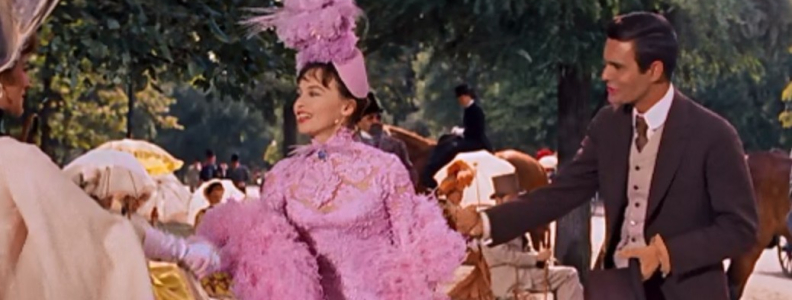
Lerner & Loewe’s Gigi–Part Four
As we mentioned in our last post, one of the last MGM musicals to be produced by the Arthur Freed unit (including Conrad Salinger) is 1958’s Gigi. Colette painted a picture of 1900 Paris. Paris society demanded that its eligible bachelors be seen in public; but in order to be seen, the bachelors must be accompanied by fascinating women. Thus, the bachelor is not wooing, he is preening in public. Part of his allure is his ability to attract and discard mistresses.
Yet, Colette found her inspiration in throwing sand in the gears and stopping the choreographed dance. Her novella posed the ultimate challenge to an orderly but antiseptic society–true love. For this reason, any adaptation had to preserve the reverence for societal norms as a baseline, while at the same time introducing a newness and freshness that only innocence and true love could inspire.
The movie is entirely dependent on the performance of Leslie Caron. Once cast as Gigi, we, the audience, are as susceptible to the child-like charms of the young Gigi as Gaston, who finds that his only truly happy hours are the ones spent with Gigi and her grandmother. Louis Jordan is a perfect Gaston, bored to death with society but happy in the company of Gigi. Hermione Gingold is wonderfully cast as Madame Alvarez, Gigi’s grandmother, a mix of stern discipline and motherly indulgence.
We are introduced to Paris through the the wisdom and charm of Honore, Gaston’s uncle, played with such grace by Maurice Chevalier that we overlook his many faults. He sings the song that keeps all men young, “Thank Heaven for Little Girls.” It is an anthem to the blossoming of the human roses of spring and summer, the transformation from youth to womanly beauty. He is also a master at the game of musical mistresses.
We see the attention lavished on bachelors by society in the chorus (“The Gossips”), balanced against Gaston’s disgust (“She’s Not Thinking of Me”).
But time is passing, and Gigi is growing older. Her innocence of love, correlated to her age, starts to change into a reverence for love and marriage, as she blossoms into womanhood. Gaston realizes that his friendship with a child has also blossomed into the love of a woman, as he thinks through all of the changes Gigi is going through (in a spoken/sung number, called simply enough “Gigi”).
Unfortunately, Gaston is also a creature of habit and offers to make Gigi his mistress. Gigi immediately sees the folly associated with this offer and turns him down. She loves him and knows that all mistresses are showered with gifts so that they can be flung aside when men tire of them. If she could play the game with a man she did not love, it would be one thing; but how could she become the mistress of a man she did love. Gaston doesn’t fully understand the end game of the charade and still insists on the proffered arrangement. Gigi eventually gives in because she cannot bear to be separated from Gaston (“I would rather be miserable with you than without you.”).
Honore watches from a distance, as his nephew struggles with his situation and admits, “I’m Glad I’m Not Young Anymore.”
The night of Gigi’s introduction to Paris society has come, and they dine at Maxim’s. Gigi plays her part perfectly, perhaps too perfectly; or perhaps she plays her role so perfectly that Gaston finally sees the hypocrisy of his offer. In the following clip, you will see both the silent version of the scene at Maxim’s and the better one (with the chorus added).
He has exchanged the real Gigi for a superficial replica. Angry at himself, he humiliates her by dragging her forcibly from the restaurant back to her grandmother’s apartment.
Gaston storms off to walk the streets of Paris in anger and despair, mixed together in wild array. Finally, there is a moment of clarity, and he returns to the apartment to propose marriage to Gigi. We know the ending long before Gaston does, but it is the only logical way for him to end a life of endless superficiality and boredom and find true happiness.
As an added treat, we first provide the movie version of “Say a Prayer for Me Tonight,” dubbed by Betty Wand.
Now, here is the clip with Leslie Caron’s own voice.