
Lerner & Loewe’s Gigi–Part Two
As we mentioned in our last post, one of the last MGM musicals to be produced by the Arthur Freed unit (including Conrad Salinger) is 1958’s Gigi. Colette painted a picture of 1900 Paris. The promenade was intended to watch and be watched. The courtesan was trained to provide her escort with discriminating taste in everything from jewels to cigars. Paris society demanded that its eligible bachelors be seen in public; but in order to be seen, the bachelors must be accompanied by fascinating women. Thus, the bachelor is not wooing, he is preening in public. Part of his allure is his ability to attract and discard mistresses.
Yet, Colette found her inspiration in throwing sand in the gears and stopping the choreographed dance. Her novella posed the ultimate challenge to an orderly but antiseptic society–true love. For this reason, any adaptation had to preserve the reverence for societal norms as a baseline, while at the same time introducing a newness and freshness that only innocence and true love could inspire.
The movie is entirely dependent on the performance of Leslie Caron. Once cast as Gigi, we, the audience, are as susceptible to the child-like charms of the young Gigi as Gaston, who finds that his only truly happy hours are the ones spent with Gigi and her grandmother. Louis Jordan is a perfect Gaston, bored to death with society but happy in the company of Gigi. Hermione Gingold is wonderfully cast as Madame Alvarez, Gigi’s grandmother, a mix of stern discipline and motherly indulgence.
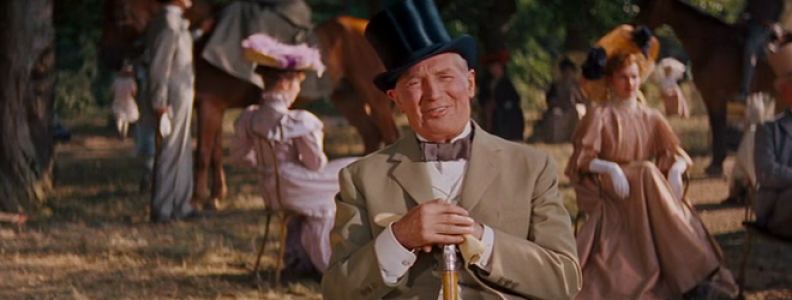
We are introduced to Paris through the the wisdom and charm of Honore, Gaston’s uncle, played with such grace by Maurice Chevalier that we overlook his many faults. He sings the song that keeps all men young, “Thank Heaven for Little Girls.” It is an anthem to the blossoming of the human roses of spring and summer, the transformation from youth to womanly beauty. He is also a master at the game of musical mistresses.
Gaston is a creature of the Parisian culture and societal norms, which demand that he have mistresses who he does not love and who do not love him in return. It is a sophisticated public dance that Honore enjoys and Gaston dislikes. He finds the entire charade distasteful (“It’s a Bore”).
It’s not just Gaston who is tied to the customs of Paris society; Gigi is being raised to become a sophisticated courtesan by her great-aunt, Alicia, played to the hilt by Isabel Jeans, so that some day she can be mistress to a man like Gaston. The problem is that Gigi finds all of the training to be a stylish waste of time (“The Parisians”) and would rather act like a slightly disreputable imp otherwise known as a Parisian “gamin.”
The first clip is the theatrical version of “The Parisians,” with Caron’s voice dubbed by Betty Wand.
For those fascinated by outtakes, here is a clip of Leslie Caron, singing the same song.
We will continue the music in the next post.