Looking Forward and Back–Musical Connections in the Soft Lullaby
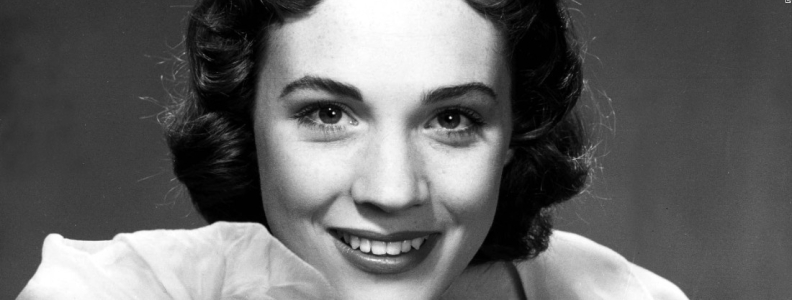
Our feature image captures a young Julie Andrews; and if you read this entire post, you will learn why we have chosen her photo. What a tease!
We are wending our way through operettas and musicals performed on Broadway in the first decade of 1900. Lately, we have been bouncing back and forth between Victor Herbert and George M. Cohan, very different composers who were both very popular in this early era.
Our first look at similarities across genres involves the lullaby. We need to be careful now. We are not suggesting that the lullaby needs to be defined narrowly as a song used to put children to sleep, although it can be use that way. We want to use the term more broadly to include those instances when the singer is seeking to set a mood or tone that can lull the audience into a particular state of mind, a susceptible state of mind.
Take for instance the case of Nemorino in Donizetti’s opera L’elisir d’amore (The Elixir of Love). He is in love with Adina; she is indifferent. Along comes a traveling salesman, selling phony potions to unsuspecting townspeople. Nemorino buys a bottle of cheap red wine, thinking it is a love potion and gives some to Adina. She drinks; he observes. He sees her get emotional and believes that the potion is working and that she is falling in love with him. He sings this soliloquy from his hiding place–“Una furtiva lagrima.”
We have chosen to provide Caruso’s 1904 restored version with just a piano accompaniment, because it best captures the tenderness of the moment.
They eventually do fall in love and marry, but not because of a potion.
The Italian text is taken from score and libretto at Indiana University.[2] This source does not include the last line “Si può morir! Si può morir d’amor”, which is however heard in most performances of the romanza.
| Literal translation | Poetic translation[3] | |
| Una furtiva lagrima negli occhi suoi spuntò: Quelle festose giovani invidiar sembrò.Che più cercando io vo? Che più cercando io vo? M’ama! Sì, m’ama, lo vedo, lo vedo.Un solo istante i palpiti del suo bel cor sentir! I miei sospir confondere per poco a’ suoi sospir! I palpiti, i palpiti sentir, confondere i miei co’ suoi sospir.Cielo, si può morir; di più non chiedo, non chiedo. Ah, cielo! Si può! Si può morir! Di più non chiedo, non chiedo. Si può morir! Si può morir d’amor. |
A furtive tear in her eyes appeared: Those festive young girls she seemed to envy.What more need I look for? What more need I look for? She loves me! Yes, she loves me, I see it, I see it.For a single instant the beats of her beautiful heart to feel! My sighs to confound for a while with her sighs! Her heartbeats, her heartbeats to feel, my sighs with hers to merge.Heavens! One could die! More I cannot ask, I cannot ask. Oh, heavens! One could, one could die! More I cannot ask, I cannot ask. One could die! One could die of love! |
Softly a furtive teardrop fell, shadowed her sparkling eyes; Seeing the others follow me has caused her jealous sighs.What is there more to prize? What more than this could I prize? Sighing, she loves me, I saw that she loves me.Could I but feel her heart on mine, breathing that tender sigh! Could my own sighing comfort her, and whisper in sweet reply! Her heart on mine, as heart to to heart we sigh. So tenderly we’d share a sweet reply!Heaven, I then could die; no more I’d ask you, I’d ask you, ah! heaven, I, then, I then could die; no more I’d ask you, I’d ask you. I then could die, I then could die of love. |
Having started with opera, we now move on to operetta. Previously we heard one of the most enchanting lullabies ever written when we listened to the music from Herbert’s Babes in Toyland. Here again is the exquisite John McGlinn restoration recording of “Go to Sleep.”
Next take a listen to this 1927 song from George and Ira Gershwin, introduced into the 1928 Broadway show, Funny Face. We have chosen the wistful version of the song included in the 1957 movie with Fred Astaire and Audrey Hepburn.
Later, in 1956, Lerner and Loewe brought George Bernard Shaw’s Pygmalion to life on Broadway as a musical called My Fair Lady. In that show, Julie Andrews sits with her chums dreaming of a room of her own. Again, it comes to us in the form of a wish or a prayer in this clip from the 1961 recreation for television.
This particular type of song has never really gone out of style, even though the sightings have become more rare over time. Still, it is worthwhile to listen to this song from the Sherman Brothers (Hushabye Mountain) sung by Dick Van Dyke in the 1968 movie, Chitty Chitty Bang Bang.
Four years earlier the same song-writing team wrote “Feed the Birds” for Julie Andrews to sing in Mary Poppins.
We sometimes forget what a magnificent talent she possessed, so it is good to watch these older clips to refresh our memories.
On Thursday, we are going to look at dance hall production numbers or something closely resembling them.